
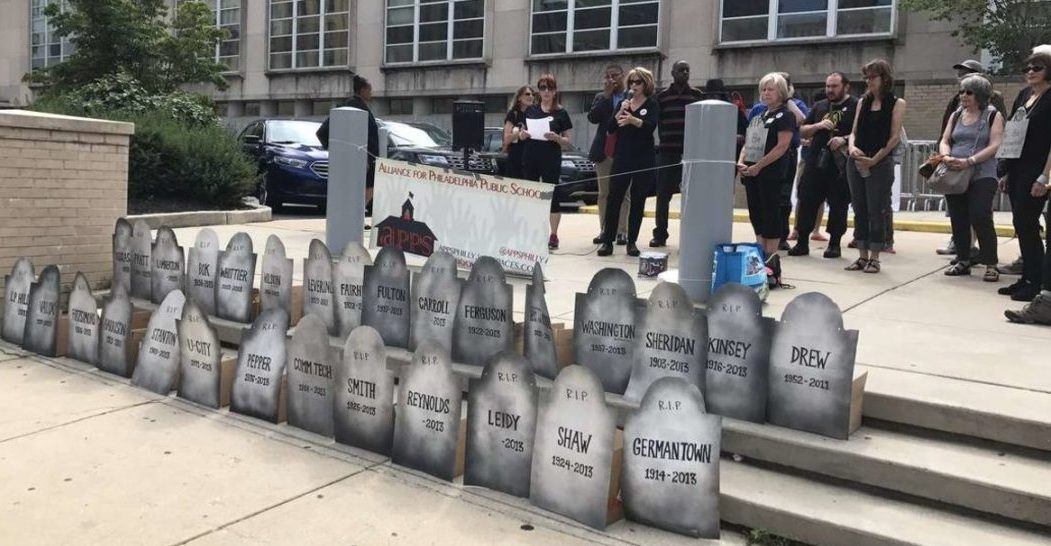
Board of Education Stonewalls Community on School Closings

by Lisa Haver

This image has an empty alt attribute; its file name is img_4184.jpg
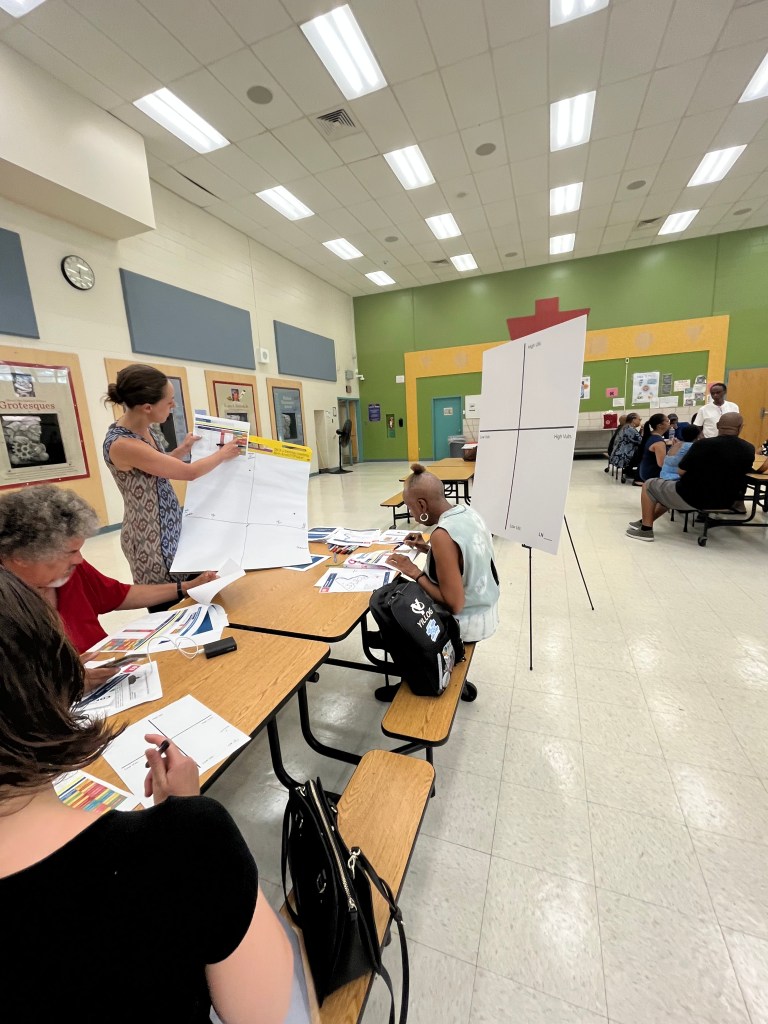
Distract staff preset data packets for community members at Bluford Elementary. (Photo: Lisa Haver)

At its September 2024 Action Meeting, the Board of Education, by unanimous vote, approved contracts with two consulting companies totaling $4,880,918. The board approved a one-year  $430,000 contract with Brownstone PR and Insight Education Group, LLC for “Community Engagement and Facilitation Support”. Purpose: “For support in community engagement and the facilitation of advisory groups and a working group related to the Facilities Planning Process”. They also hired DLR Group Inc. for “Facilities Planning Services” for $4,450,918; one-year contract for “development of a comprehensive Facilities  including Facility Condition Assessments, Educational Suitability Assessments, updated enrollment projections, and stakeholder engagement. 

One year later, at its August 2025 Action Meeting, the board unanimously ratified a $404,626 contract extension with Aramark, Inc. for “Facilities Assessment for Phase III”. According to meeting agenda attachments: “The facilities planning data warehouse has been completed and is currently hosted by Aramark.” 

Continue reading here
Board Outsources Extended Year Programs

Board of Education Action Meeting: June 27, 2024

by Lisa Haver

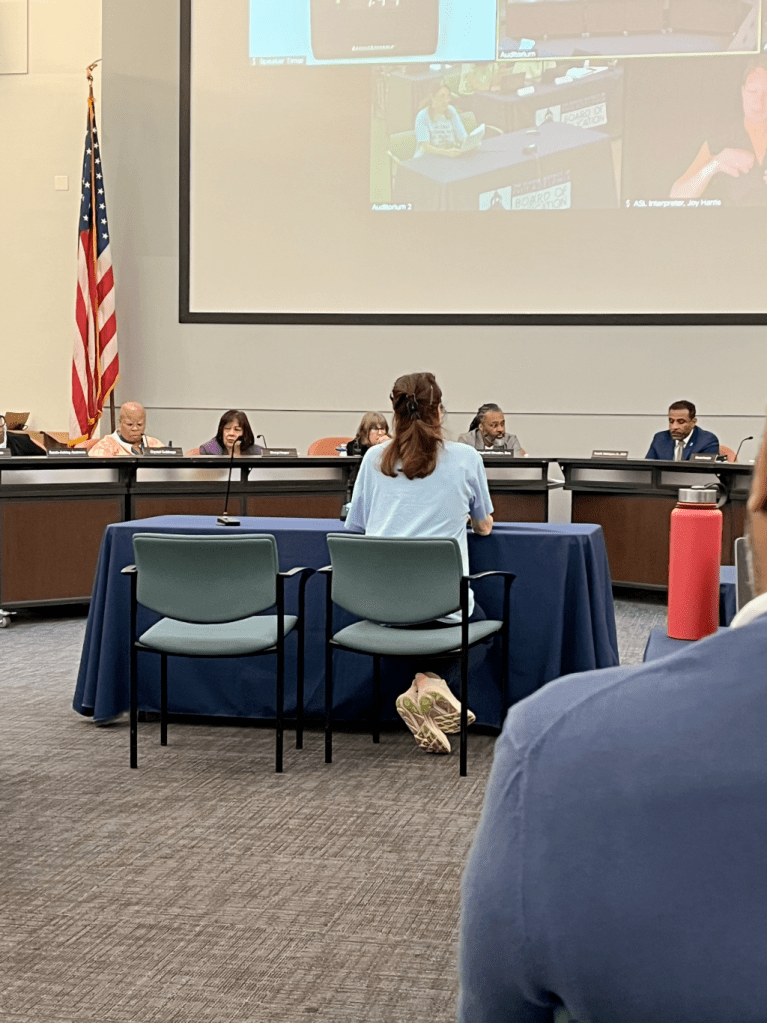
APPS member Lynda Rubin testifies at June 27 board meeting (Photo: Lisa Haver)

APPS members have asked the Board of Education many times, most recently at its June 13 “community hearing” at Rush middle school earlier this month, why they set up so few chairs for the public at their monthly meeting. In an auditorium that holds 240 people, there have been only 140 chairs. At this meeting, the board set up only 102 chairs. Why? The board raised the issue during the meeting of how they can improve public engagement, yet they have no explanation why room for the public shrinks with every meeting.

Board Outsources Extended Year Programs 
The board also raised the issue of public engagement when they discussed the pilot program for an extended school at 20 district schools. The district sent out emails to staff at the 20 designated schools on June 24–almost two weeks after schools closed for the summer. Many teachers found out when the email, sent by Deputy Superintendent Germaine Dawson, was reported in news stories and posted on social media. In addition, the Watlington administration has not sent emails to parents at the designated schools. On Thursday, hours before the board meeting, Mayor Cherelle Parker held a news conference to launch the pilot program for year-round school, a signature plank in her campaign platform. She was adamant, however, that reporters not refer to it as “year-round school”, saying that it was limited, at this time, to more extended day and extended year services. Parker expressed frustration that the story was “leaked”, but the fact is that her administration failed to communicate with those who would be involved, including the PFT, whose spokesperson told the Inquirer that they were “still awaiting direct communication” from the administration” about the program. The lack of coordination between the Watlington and Parker administration, and the failure of both to communicate with affected parties before the announcement, raised concerns about the success of the year-round initiative.

Read more about June 27 2024 action meeting.

Has the Board Made the District Better in Its First Five Years?

Preview: June 29, 2023 Board of Education Meeting

by Lisa Haver

uly 2023 marks five years since the reinstatement of the Board of Education after years of state control. Four of the nine original members still sit on the board.  What has the board accomplished in that time? Have they made education better for the city’s children? There are fewer school librarians than in 2018. Class size remains too high.  Standardized testing still determines where resources go and how students, teachers and schools are judged. Substandard charter schools continue to drain money, much of it for exorbitant CEO salaries. And when members of the public come to be heard on these and other issues, they find that the board’s speaker suppression policies bar them from speaking and give them a scant two minutes–if they are lucky enough to make the list. Recently, the board has actually barred members of the public from even entering the auditorium. What does the board tout as its biggest accomplishment? Goals and Guardrails, their new data system that labels schools “on-track” or “off-track”, and which they spend up to two hours analyzing every month.    

At this meeting, the board will vote on 104 official items and spend approximately $207, 084, 246. (Five items each cost $10 million or more, including Item 58 at $69 million.) Twenty-five of the items appear to be no-bid. Despite the number of items and the total costs, the board will still allow only 30 general speakers. 

Continue reading

Democracy Dies in Darkness

Board of Education Action Meeting:  May 25, 2023

 by Lisa Haver and Lynda Rubin

The board’s speaker suppression policies are now doing double duty: not just to keep members of the community from speaking but to keep them out of the room altogether. A guard at the door to the auditorium told Lynda Rubin she could go in because she was on the speaker list but barred Lisa Haver because she wasn’t.  Haver had tried to sign up but was told by the board that she would not be one of the 30 chosen speakers. She told the guard he could arrest her but that she was going in. Last month some APPS members were detained downstairs because they were not on the list.  

We wrote to the board after the April incident, pointing out that they had only set up 82 chairs in an auditorium that seats 240 people. Thus, the same people who were denied the right to speak now no longer have the right to be present. Did the board not want APPS to witness its voting to spend over $500 million in taxpayer money on 78 official items?  Or voting on a charter application that would cost the district hundreds of millions over the next five years?   A governmental body not accountable to the public can become tyrannical and dictatorial. We need an elected school board.

Continue reading