Board Covers for Watlington

Board of Education Action Meeting: August 20, 2026

by Lisa Haver

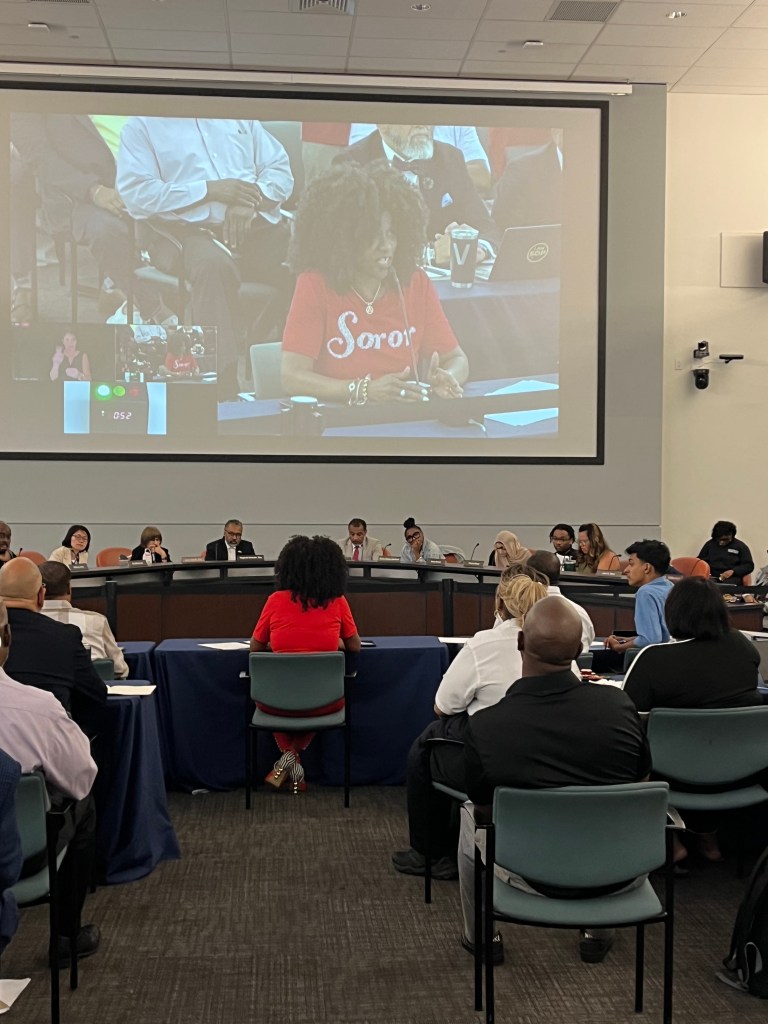
APPS member Kristin Luebbert testifies at August 20 Board of Education meeting. (Photo: Lisa Haver)

Board of Education President Reginald Streater often exhorts those in attendance to respect others’ time during public testimony and presentations. That doesn’t seem to apply to the board itself. Over the past year, the board has canceled and postponed several meetings with minimal public notice. They made people guess for months about when they would finally pass the Facilities Master Plan. They unexpectedly recessed the April 23 meeting and reconvened the following week. This month, they have rearranged their calendar, again at almost the last minute. The meeting changes were not placed into an official item, and the board never took a vote; that means the public had no opportunity to comment. The August 13 Goals and Guardrails Committee meeting–canceled. The public hearing scheduled for October 15–moved up to September 3. The September 3 Goals and Guardrails meeting–canceled. The September 24 action meeting–moved back to September 30. No explanation was given for any of these changes. The board apparently has no consideration for the time and schedules of parents, students, educators and community members. Maybe that’s why they refer to us as “customers”–so they can run things like regional managers and not as a governing body accountable to its constituents.

Continue reading here
Nobody Wants This, They Don’t Care

Board of Education Action Meeting: February 26, 2026

by Lisa Haver

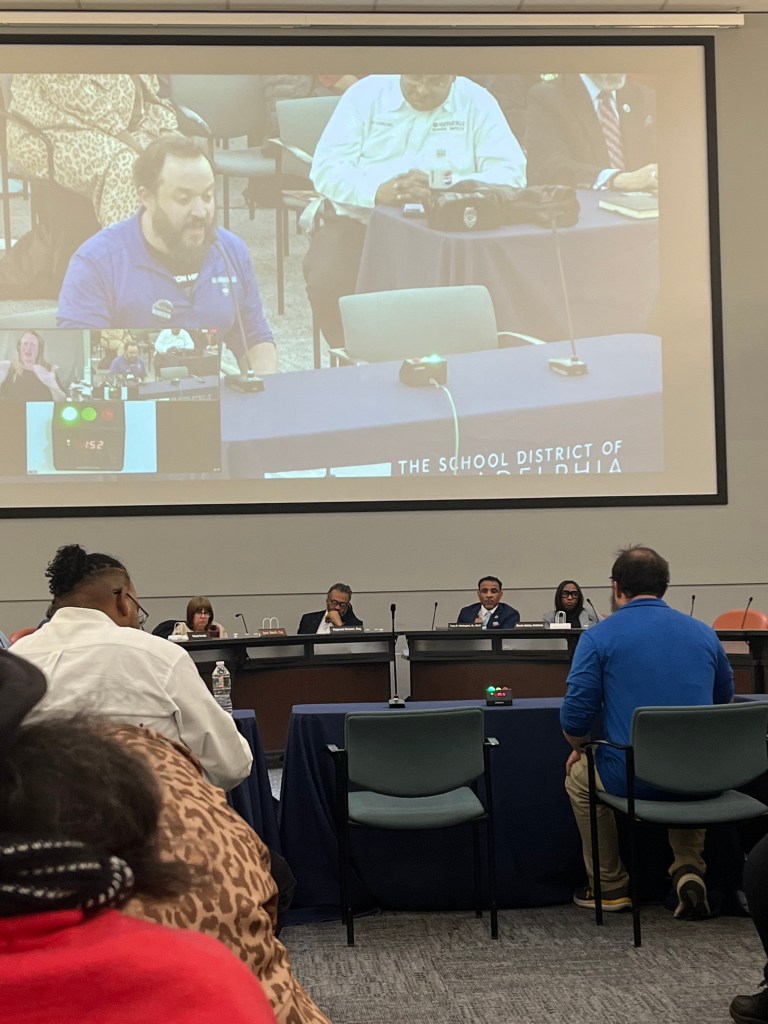
Robeson High School teacher Andrew Saltz testifies at February action meeting. (Photo: Lisa Haver)

“Passing this facilities plan would be an egregious breach of trust by the board.”
West Philadelphia Community Member Leah Clouden

Not for the first time, Philadelphia students put the adults in charge to shame. They came with facts and data that disproved the district’s misinformation. They came with well-reasoned arguments about why closing their school makes no sense. They came with charts and maps that clearly illustrate their position that their schools should remain open. They presented data that showed that Black students would be harmed most by losing their schools. This in contrast to Superintendent Tony Watlington, whose rambling, tangent-filled 31-minute speech was one of the reasons this meeting did not adjourn until early Friday morning. Parents, educators, and community members packed the meeting. They were joined by elected officials including City Councilmembers Jamie Gauthier, Jeffery Young, Quetcy Lozada and Cindy Bass, along with State Senators Anthony Williams and Sharif Street and State Representative Daresha Parker. All spoke against the plan and any school closings. The board, for the second month in a row, violated its own by-laws by marking present one board member, Chou-Wing Lam, despite the fact that she was seen by the public on screen for less than half an hour total during the 8-hour-plus meeting. She was not present for the public testimony, yet she was allowed to cast a vote for all action items. APPS did score one victory: after repeated emails to the board, they restored to the auditorium the almost 100 seats they had removed last year.

Read more about February Board of Education meeting here.

Board Must Protect Constitutional Rights of Public School Educators

Board of Education Action Meeting: December 4, 2025

by Lisa Haver

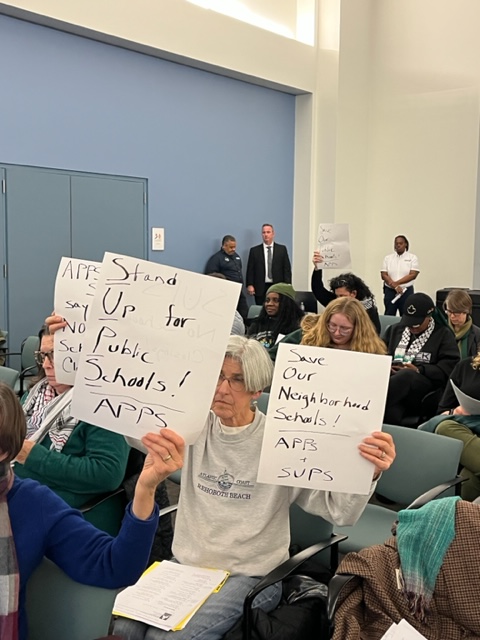
APPS members support Stand Up for Public Schools speakers.
(Photo: Lisa Haver)

The Board of Education says little of consequence. They create the illusion of deliberation, but most of what they say is directed not to members of the public but to the administration–not to question Superintendent Tony Watlington Sr. but to thank him and his staff for doing their jobs. At this action meeting, Board President Reginald Streater called on every board member for questions or comments after Watlington’s announcement of the new contract with members of the principals’ union (CASA). Except for Board Member Chou Wing-Lam, who asked one question, the rest simply echoed each others’ thanks to Watlington and his negotiating team. That took eleven minutes.  But real deliberation? Almost none. Prior to every action meeting, the board members agree to move most items into a “consent agenda” (likely a Sunshine Act violation), then take one vote–whether it’s for ten items or ninety–without any deliberation. At most action meetings, the entire process takes less than one minute. Streater calls this “efficiency. Parents, students, educators and community members who come to be heard and to get answers have never demanded “efficiency”. They ask the board and the administration to answer them and to take the time to address issues and solve problems that affect their children. The board is the governing body of the School District of Philadelphia. Their constituents include every person in the city–who deserve answers from board members. 

Continue reading here for December 4, 2025 action meeting.

Public School Board Bars Public School Parents, Educators from Speaking and Attending

Board of Education Action Meeting: June 26, 2025

by Lisa Haver

“The Party told you to reject the evidence of your eyes and ears. It was their final, most essential command.” George Orwell, 1984

This image has an empty alt attribute; its file name is img_4150.jpeg
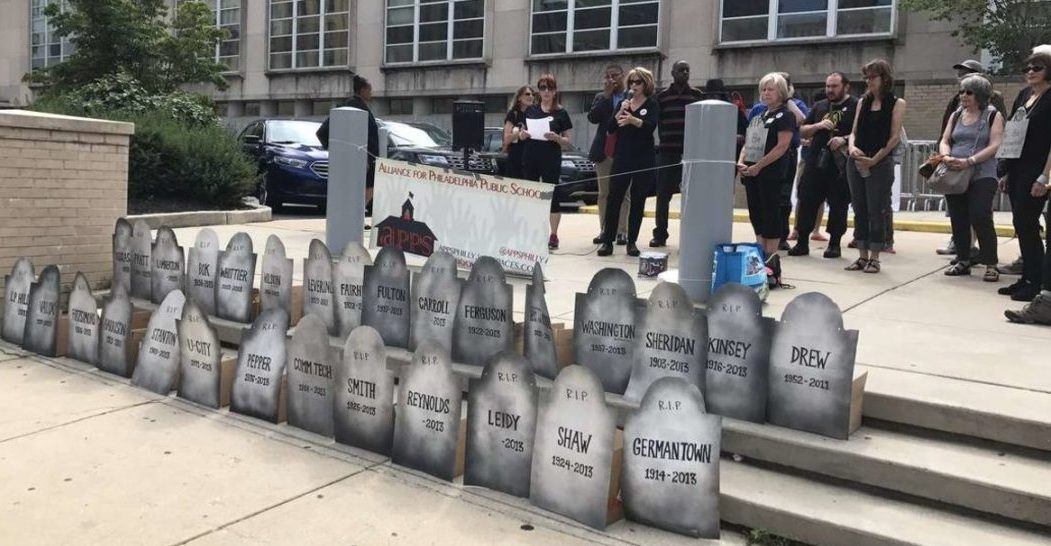
CASA President Robin Cooper testifies at June 26 action meeting. (Photo: Lisa Haver)

A governing body convenes an action meeting. They listen to a presentation from the director of a department they oversee. The president of the board raises each issue, and members of the board comment and question. The president then calls on each member to give their position. He tallies the responses, then directs the department chief to carry out the action that the majority of the board voted for. Except when the Philadelphian Board of Education does this, according to Board President Reginald Streater, it’s not voting. True, the terms “motion”,  “roll call” , and “vote” were not used. But the board came to decisions on the futures of six charter schools in the renewal cohort after listening to Charter Schools Chief Peng Chao and deliberating on the information presented.  Streater called on each member to state their position on whether the school would be granted a 5-year renewal, a 1-year renewal, or no renewal. He counted their responses, then directed Chao on what type of document to draw up. How is that not voting? Every time APPS members called out that the board was voting, even though none of those charter items had been placed on the agenda, Streater insisted they were not.  The dictionary definition of the word “vote”: a formal indication of a choice between two or more candidates or courses of action, expressed typically through a ballot or a show of hands or by voice. The public’s faith in this board continues to erode because of its lack of transparency and public engagement, along with its reluctance to hold the administration accountable. Now they want to tell people not to believe what they see and hear with their own eyes and ears. 

Continue reading here