
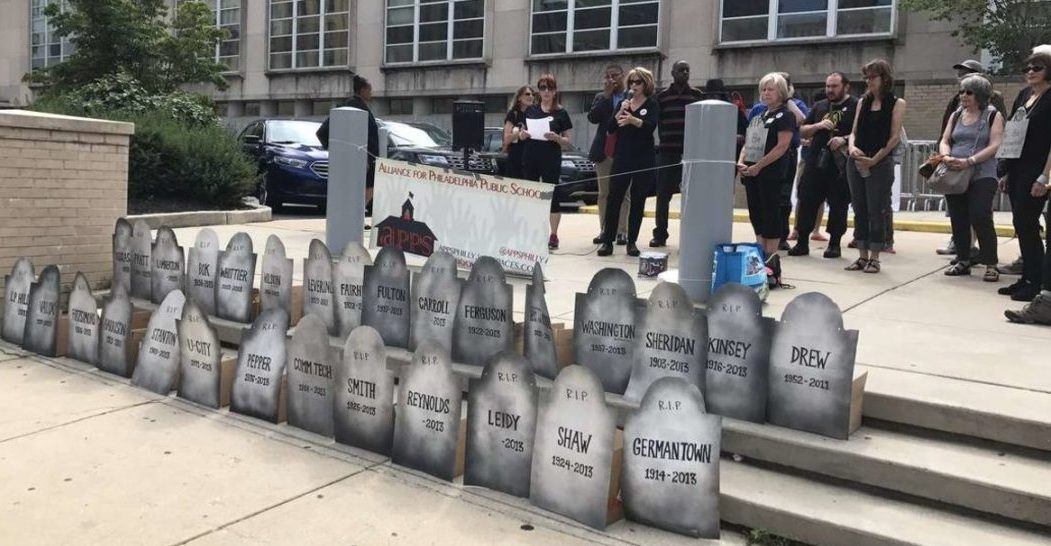
Board Again Renews Substandard Charters

by Lisa Haver and Deborah Grill

“As a board member, I am not willing to ignore low academic outcomes,” said Andrews. “We have to hold schools accountable for outcomes.” 
Board Member Sarah Ashley Andrews, May 14 Goals and Guardrails Meeting

The Board of Education does, in fact, ignore low academic outcomes every year when it renews charter schools that fail to meet basic academic standards.  Last year, the board renewed Mastery Douglass despite its “Does Not Meet” rating in Academics with only 36% points. They are now poised to renew 9 of the 11 schools in this year’s cohort despite only one rating “Meets” in Academics. 

The board conducts most charter business in secret.. There are no public renewal hearings. All negotiations with the board and the Charter School Office take place out of the public eye. The board deems all charter business “quasi-judicial”, then deliberates in executive session. The board votes on all charter renewals without posting the content of the renewal agreements, in effect taking those votes in secret. This year and last, Board President Reginald Streater took a de facto vote after the Charter School Office presentation at the Goals and Guardrails (G & G) Committee Meeting by polling board members, then instructing CSO Director Peng Chao to draw up the renewal documents. The G & G agenda did not list the renewals on the agenda as official action items. These are all clear violations of the state’s Sunshine Act. 

Charters sold themselves over 30 years ago as the key to improving public education; ceding control of public schools to private managers, maintaining only non-union staff, and testing children every year to prove their superiority. Charter companies, in their applications, promised to educate the city’s poor and minority children in underserved communities better than the district public schools. Many even predicted that establishing charter schools would lead to a decrease in poverty and violence. Districts across the country applied the free-market ideology that had public school systems run as businesses, including placing public assets of school buildings and property in the hands of private companies. That was accomplished in some cities by appointing an Emergency Financial Manager (EMF) to usurp the duties of the elected school board. In Philadelphia, the School Reform Commission (SRC) was installed by the state to replace the city’s appointed school board. 

Continue reading about 2025-26 charter renewals here.

Board Must Deny New Charter Applications

by Lisa Haver and Deborah Grill

The privatization of public schools over the past 25 years has had more to do with real estate and investments than educating children. By any standard, the privatization of public schools has been a failure. Data collected over the years, in Philadelphia and in districts nationwide, shows that neighborhood public schools consistently out-perform charter schools. Charter schools are not public schools; they do not accept all children in their neighborhood, and many have been cited for lack of service to students with special needs and English Language Learners. Charter expansion in Philadelphia has not improved education for the city’s children. It has, however, resulted in an entrenched financial and political patronage system. 

Both applications submitted to the district this year also promise educational superiority. Years of data show that the majority of charter schools in the district have failed to perform at even a satisfactory level, let alone out-perform the district’s public schools.  The district’s evaluation system, in effect, equates an “approaches standard”rating with a “meets”. Thus, a charter needs only to rate above 45% in Academics to be approved by the board for a 5-year renewal. One of the most common violations cited in charter renewal reports is lack of due process for students in expulsion or other disciplinary cases, along with barriers to enrollment.  In recent years, the board of education has routinely renewed charter schools without the legally mandated child abuse clearances and criminal background checks. 

When a charter school fails to fulfill the promises it made in its application, a common occurrence, the school should admit failure and voluntarily close its doors. But most charter administrators take their case to the state-appointed Charter Appeal Board which has the power to overrule the locally elected or appointed board. If CAB votes against them, they take their case to the state courts. All of this paid for by taxpayers. 

The district does not need, nor can it afford, any new charter schools. In addition to the substandard academic performance, over half the city’s charter schools are presently under-enrolled. 

The Board of Education must deny these applications.

Lynda Rubin contributed to this report.

Clink on the links below to read our reports on the new charter school applications:

Early College Charter School of Philadelphia

Pan American Academy Charter School-Pathways High School

Board Message to District Charter Operators: No Consequences for Substandard Performance

Board of Education Action Meeting:  January 25, 2023

by Deborah Grill, Lynda Rubin, Lisa Haver

Board Caves on Charter Renewal                   
At this action meeting, the Board of Education sent a clear message to all charter operators in the district: no matter how inadequate the education you provide to your students, no matter how many barriers to enrollment you use to exclude children, no matter how precarious your finances–we will let you carry on. The Board disregarded the law and its own procedures and policies when it caved to obvious political pressure and voted unanimously to reverse its previous decision and renew Southwest Leadership Academy Charter School. Dawn Chavous, charter lobbyist and now co-chair of Mayor Cherelle Parker’s Education Sub-Committee, testified in favor of renewing the charter.  Board members offered a variety of rationalizations but never explained how this one charter managed to be reconsidered for renewal after two votes not to renew. As Lisa Haver pointed out in her testimony, the Board voted last year for non-renewal after an extensive legal process in which data and evidence were reviewed, public testimony was heard, and the charter administrators had time to explain their failure to meet standards. The Board was now reversing itself without presenting any new evidence or explanation, she said.  The Board’s round-robin of questions before the vote amounted to a charade in which they acted as if this was just another renewal consideration, not an unprecedented reversal that ignored all data and evidence entered into the record.  Only one Board member asked what would happen if SWLA failed to carry out the conditions listed in the agreement.  Charter Schools Office Director Peng Chao responded that they could note that in the next renewal evaluation in 2027. In other words, there will be no enforcement of the conditions in the agreement, which has set academic conditions even lower than those that Southwest had failed to meet in its last evaluation. Chao also stated that his office remained open to collaborating with the school to ensure they meet the conditions. No board member pointed out that the CSO can only do that by manipulating the current standards and conditions and that only the school’s administration and staff could make sure that their students received an adequate education. One board member, apparently unaware of charter schools’ enrollment limits, suggested that the school needed to get more students to boost finances. More funding for Southwest Leadership Academy would of course mean less funding for District schools. This 5-year renewal will cost the district a minimum of $10 million. When Board leadership claims, repeatedly, to be “child-centered”, it seems that doesn’t apply to children at substandard charter schools.

Continue reading