Board Passes $4.9 Billion Budget, Community Questions Priorities

by Lisa Haver

Board of Education Action Meeting, May 28, 2026

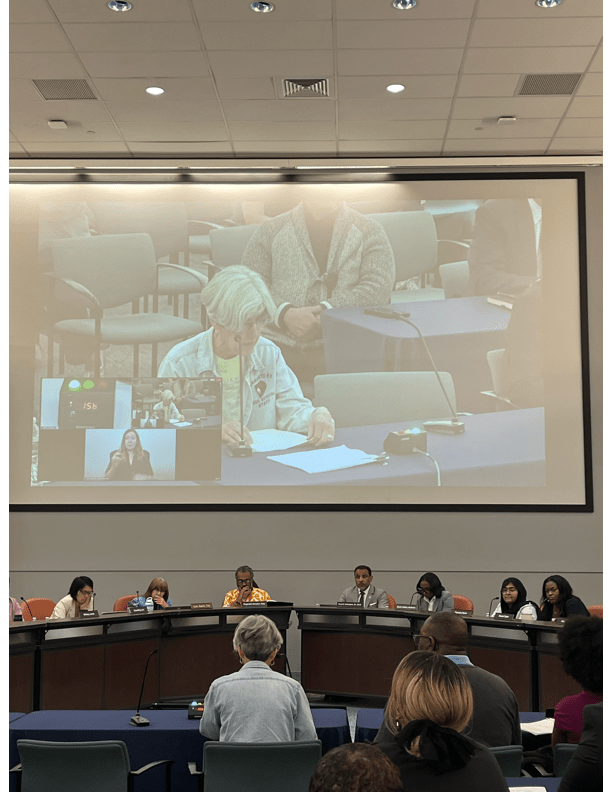
APPS member Deborah Grill testifies at May 28 Board of Education meeting. (Photo: Lisa Haver)

As a result of the Board of Education’s speaker suppression policies, over half of the 30 public speakers were representatives of charter schools, 6 from the same school. Several charter CEOs, who have daily access to the board’s Charter Schools Office, took speaker slots, including both Global Leadership Academy CEOs. Recent IRS information shows the GLA CEO making over $500,000 in annual salary/compensation/bonus; GLA Huey CEO made $378,000. Although APPS has raised these issues for years, the board says little about exorbitant administrative salaries, questionable financial practices, and failure to reach minimum academic ratings. In fact, the board exempted the entire charter sector from its $3 billion, ten-year Facilities Master Plan. 

Board Passes $4.6 Budget
The board voted 8-0 to pass the administration’s combined $4.6 billion budget for FY 2026-27 in Item 12 (BM Wanda Novales was absent). The board passed Item 15 by a vote of 7-1, approving the Amended Capital Budget for FY 2025-26, adoption of a Capital Budget for FY 2026-27, and a Capital Program for 2027-32. BM ChauWing Lam voted No on Item 15, citing some “lingering questions”. The 5-year Capital Improvement Plan includes some projects proposed in the Facilities Master Plan (FMP) passed by the board last month. Lam questioned Deputy Superintendent of Operations Oz HIll about why the budget details as presented to the board did not include construction of the new high school in the Northeast that was proposed in the FMP. Hill responded that as yet there was no funding for the school. Actually that is true of most of the projects in the FMP. APPS’ analysis of the FMP shows that at least ⅔ of the funding would come from additional revenues from the state (even though the budget presented at this meeting shows lower revenue from the state) and from unnamed philanthropic sources. BM Whitney Jones, who voted No on the FMP, remarked that the administration’s “intentions are exceeding revenues” and asked how they would fulfill the specific promises of the FMP. He asked Board President Reginald Streater to allow for regular updates on those metrics.

Continue reading

Board Again Renews Substandard Charters

by Lisa Haver and Deborah Grill

“As a board member, I am not willing to ignore low academic outcomes,” said Andrews. “We have to hold schools accountable for outcomes.” 
Board Member Sarah Ashley Andrews, May 14 Goals and Guardrails Meeting

The Board of Education does, in fact, ignore low academic outcomes every year when it renews charter schools that fail to meet basic academic standards.  Last year, the board renewed Mastery Douglass despite its “Does Not Meet” rating in Academics with only 36% points. They are now poised to renew 9 of the 11 schools in this year’s cohort despite only one rating “Meets” in Academics. 

The board conducts most charter business in secret.. There are no public renewal hearings. All negotiations with the board and the Charter School Office take place out of the public eye. The board deems all charter business “quasi-judicial”, then deliberates in executive session. The board votes on all charter renewals without posting the content of the renewal agreements, in effect taking those votes in secret. This year and last, Board President Reginald Streater took a de facto vote after the Charter School Office presentation at the Goals and Guardrails (G & G) Committee Meeting by polling board members, then instructing CSO Director Peng Chao to draw up the renewal documents. The G & G agenda did not list the renewals on the agenda as official action items. These are all clear violations of the state’s Sunshine Act. 

Charters sold themselves over 30 years ago as the key to improving public education; ceding control of public schools to private managers, maintaining only non-union staff, and testing children every year to prove their superiority. Charter companies, in their applications, promised to educate the city’s poor and minority children in underserved communities better than the district public schools. Many even predicted that establishing charter schools would lead to a decrease in poverty and violence. Districts across the country applied the free-market ideology that had public school systems run as businesses, including placing public assets of school buildings and property in the hands of private companies. That was accomplished in some cities by appointing an Emergency Financial Manager (EMF) to usurp the duties of the elected school board. In Philadelphia, the School Reform Commission (SRC) was installed by the state to replace the city’s appointed school board. 

Continue reading about 2025-26 charter renewals here.