Board Must Reject All New Charter School Applications

by Deborah Grill, Lisa Haver and Diane Payne

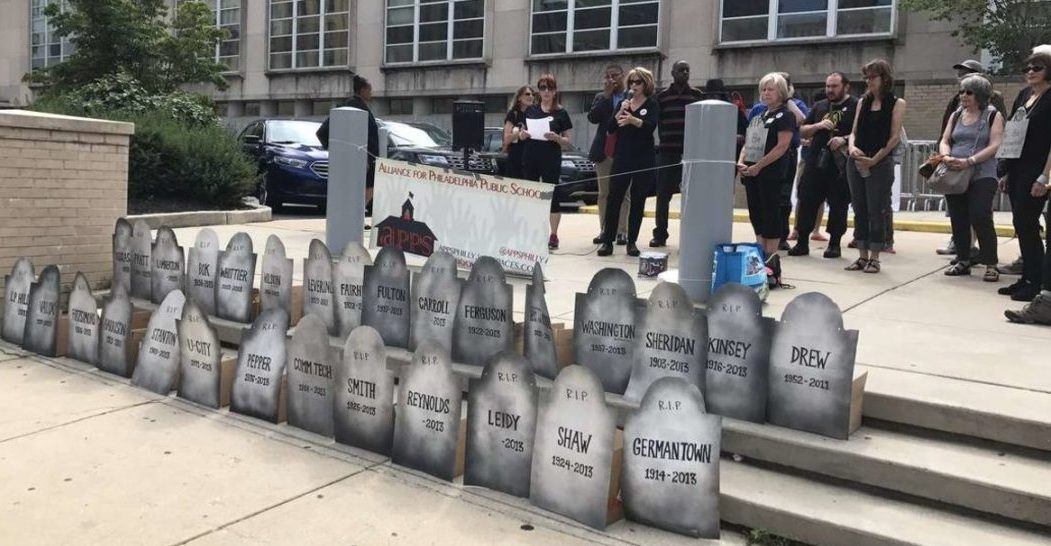
Every new charter school application is a budgetary and community assault on our current public school system as every charter school represents an unfunded state mandate. The charter school experiment concocted over twenty years ago–an experiment on mostly poor, urban, black and brown children–has failed. Clearly inadequate applications should be rejected at the outset. But the PA Charter law mandates that every application be reviewed and evaluated by the district’s staff, then reviewed for approval or denial by the elected or appointed board. Thus clearly inadequate and inexperienced applicants like Entrepreneurial Charter and perennial applicants like Aspira force the School District of Philadelphia to spend inordinate amounts of time and money for a months-long process. Despite the failure of these applicants to present a credible proposal to educate Philadelphia’s children, the Charter Schools Office (CSO)  must read and analyze lengthy applications with hundreds of pages of attachments, present a thorough and detailed evaluation, and participate in extensive and costly legal hearings–with the city’s taxpayers footing the bill for  hearing officers, attorneys, court reporters, and reams of documents. 
The District cannot afford any new charter schools. The District does not need any new charter schools.  The Board should reject all three new charter applications.

Please let the Board know at the action meeting on February 24 or March 3, in written testimony or in testimony by March 2, that they must vote to deny all of these applications.

Aspira Bilingual Business, Finance, and Technology Charter High School

Aspira Eugenio Maria de Hostos Preparatory Charter School

Philadelphia Entrepreneurial Development Academy Charter High School

Board Silences Community Voices

Ears on the Board of Education:  August 19, 2021

by Lisa Haver and Lynda Rubin

For the first time in APPS’ 9-year history, not one of our members was permitted to attend or to testify at a District Action Meeting. Lisa Haver signed up to speak on Action Item 44, YouthBuild Charter Renewal; Lynda Rubin  to speak on Action Item 2, an $800,000 grant over ten years from the University of Pennsylvania for a kindergarten teacher at Penn Alexander School. Both were notified that they would not be permitted to speak; thus, the Board deliberately blocked public testimony before voting on those action items, another blatant violation of the state’s Sunshine Act. Of course, there is no way to know how many other parents, students, educators and community members were not allowed to speak.  When Board President Joyce Wilkerson attempted to justify the Board’s dismantling of its speaker policy last year, she contended that those policies were preventing a variety of voices from being heard. At every meeting, General Counsel Lynn Rauch reads a statement that the Board wants to “prioritize new voices”. But the Board’s actions belie these claims. The Board no longer limits speakers on a given topic, pro or con; it is strictly first-come, first served. At this meeting, 10 adult speakers, ⅓ of those permitted to speak, addressed one topic–school reopenings. Are we to believe that no parent wanted to address the new bell schedule, which generated several news stories, or the amended 2021-22 calendar that moves professional development half-days from Fridays to Wednesdays? The Board allowed testimony on only six of the forty-eight Action Items. That means fewer perspectives heard on fewer issues. The Board crossed the line at this meeting, however, not just allowing corporate lobbyists and executives to take the limited speaker slots, but actually recruiting them. 

The Board could no longer sustain the optics of holding remote meetings while sending students and staff into school buildings at full capacity. They held a “hybrid” meeting at which only Board members, District staff and registered speakers would attend in person; there were about 25 people in a room that holds almost 300. The Board has used the COVID crisis to shield itself from District stakeholders who have criticized not just their speaker suppression but their disregard for the needs of students and families. Their solution: keep those voices silent by keeping them off the speaker list and out of the room.

Continue reading
Ears on the Board of Education: June 24, 2021

By Lynda Rubin

This last Board Action meeting of the 2020-21 school year should have been a time for the Board to reflect on the difficulties encountered during this past school year and the weaknesses of the Hite administration to provide a cohesive and well executed reaction to the pandemic. Yet  the meeting was mostly business as usual. One victory:  the board is now hearing all public speakers before the Goals and Guardrails data analysis that has gone on for up to two hours at each meeting. APPS pointed out to the Board that parents who must feed and put their children to bed and teachers preparing for the next day’s lessons cannot wait for hours to be heard.  When we fight, we win! 

All Board members were present: President Joyce Wilkerson, Vice President Leticia Etea-Hinton, Angela McIver, Mallory Fix Lopez, Julia Danzy, Reginald Streater, Cecelia Thompson, Lisa Salley and Maria McColgan, along with current Student Representatives Keylisha Diaz and Toluwanimi Olaleye. Both Student Reps have contributed insights and suggestions throughout the year. Among their recommendations: a hub on the District’s website for mental health concerns and services; separate counselors for academic and behavioral/mental health issues; at least two counselors in every school; more funding for after-school activities and programs; that Student Board members have the same voting rights as adult Board members. 

Click here to continue reading about the Board’s votes on outsourcing and a new charter application.

Board Should Not Renew Substandard Charters

Not one of the 2021 charter schools in the 2021 cohort has met academic standards. The District’s Charter Schools Office, however, has recommended all for 5-year renewals. This represents a cost to the district of  approximately  $  $484, 053, 891. 

Most of the schools in this cohort failed to meet most of the conditions they agreed to in their previous renewal agreements. That should come as no surprise.  As then-CSO Director DawnLynne Kacer told the School Reform Commission in 2017, there are no formal consequences for failing to meet conditions. With this year’s recommendations, we see that there are also no consequences for not meeting conditions included in a legal surrender agreement clause. 

None of the seven Renaissance charters in the 2021 cohort meets academic standards. APPS cited District reporting in our 2020 analysis of the Renaissance charters in concluding that none of the operators came close to keeping their promise to turn around the neighborhood public schools:  The companies awarded contracts to manage  those schools promised to “effect dramatic change”  at “chronically underperforming schools”.  The District, over the past ten years, has spent hundreds of millions on Renaissance schools while getting very little in return. Although the Initiative stipulated  that “Renaissance Schools will be granted greater autonomy in exchange for increased accountability”, there has actually been less accountability, as seen by the repeated renewals of Renaissance charters that fail to meet basic standards, let alone surpass District performance.  

Note: All academic data taken from most recent CSO renewal evaluations, District school profiles and District SPRs.  All CEO salary/compensation data from 2018 and 2019 IRS Form 990s. Projected costs of operating of charter schools based on 2021 District budget information. 

This report was written by Lisa Haver, Karel Kilimnik, Deborah Grill, Diane Payne and Ilene Poses.

Click on the name of the school to read the report:

Universal Charter School at Audenreid

Universal Charter School at Vare Stem and Arts Academy

Mastery Charter Schools at Wister, Clymer, Gratz and Shoemaker

Richard Allen Preparatory Charter School

Global Leadership Academy at Huey

TECH Freire Charter School

Harambee Institute of Science and Technology Charter School

Lindley Academy Charter School at Birney

YouthBuild Philadelphia Charter School