Board Carries on Legacy of the SRC

Board of Education Meeting: September 19, 2024

by Lisa Haver

CASA President Dr. Robin Cooper testifies in defense of Philadelphia’s public schools. (Photo: Lisa Haver)

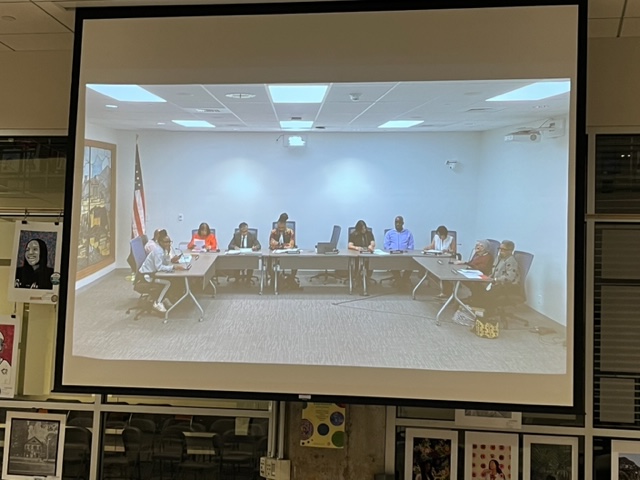
It was freezing in the auditorium during the September action meeting, so cold that they actually brought blankets out for board members. Was it an air conditioning malfunction–or the icy breath of the SRC past?

Board Begins Process of Closing Neighborhood  Schools
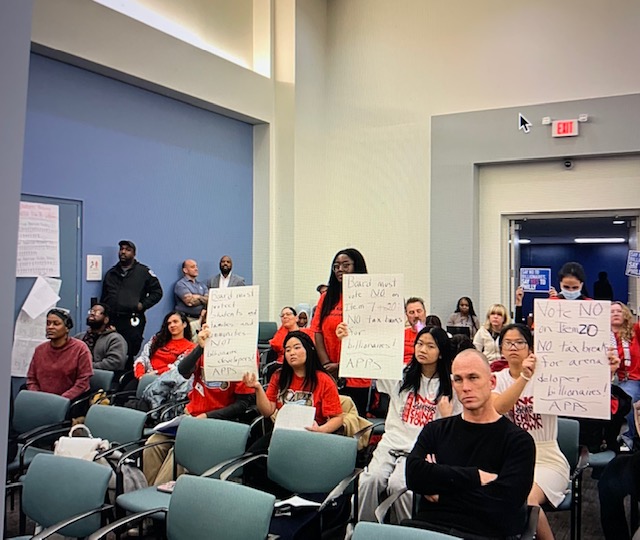
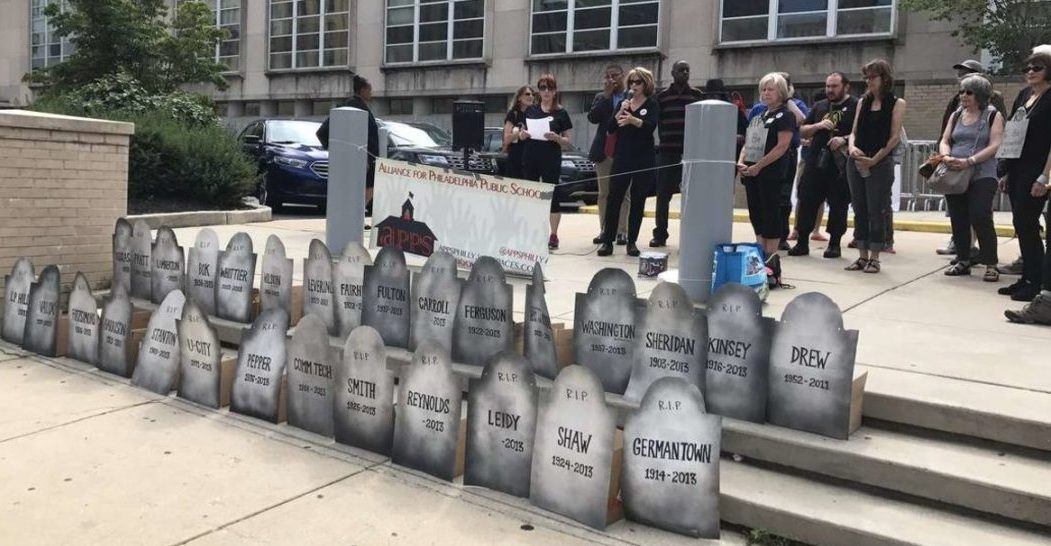
Following the legacy of the School Reform Commission, the Board of Education appointed by Mayor Cherelle Parker will be closing more neighborhood schools. No clear reasons were given by Superintendent Tony Watlington, Board President Reginald Streater, or any of the other board members, most of whom remained mute as they do in most meetings. Streater announced the board’s intention to close schools in an Inquirer story published the day before the meeting, but he avoided saying that directly in his remarks.  He used the euphemism “co-location” at one point, but people know that if you “combine” two schools that means you closed one of them.  We heard–from the president of the board that has enacted speaker suppression policies that keep people off of the speaker list and out of the auditorium–promises of meaningful community engagement. Streater said more than once that the board did not want to rely on outside consultants–just before passing a $4.5 million item to hire a consulting firm to begin the process.  We heard assurances that the board will be carrying on robust discussions about the Facilities Plan. Yet eight members had no questions for Watlington after his facilities plan presentation. Only one board member, ChouWing Lam, questioned the price tag of the $4.5 billion consulting contract (Lam later voted for the contract).  Any plan to close schools is a betrayal of the people of Philadelphia. The parents, students, educators, and community members who fought to end the rule of the state-controlled SRC believed that bringing back local control would change the spending priorities of the district and make education better for the city’s children. What we got is a board that protects the financial interests of charter investors and administrators, and now says we can’t afford to keep neighborhood schools open.

Continue reading about September 19, 2024 board action meeting here.

Board of Education Silent on Every Issue Raised by Constituents

Board of Education Action Meeting: August 22, 2024

by Lisa Haver

This image has an empty alt attribute; its file name is image-1.png

Board renews three substandard charters. (Photo: Lisa Haver)

At its August action meeting, the Board of Education passed thirty-six agenda items totaling over $79 million. They also approved three 5-year charter renewals, whose projected costs–at least $85 million total, based on the current district budget –were not posted.  Board member Cheryl Harper was absent, as was Chou-Wing Lam, who has not attended a board meeting since April. At this point, Board Member Lam should have communicated to the public the reason for her third consecutive absence and whether she is able to continue to serve. If she is not able to carry out her duties, she should resign. Most notable about this meeting is what didn’t happen: none of the board members spoke about any of the agenda items or responded to any of the issues that parents, educators, and community members came to testify about. Not one question, not one comment. 

Continue reading about Board of Education August 22, 2024 action meeting here.

Board Outsources Extended Year Programs

Board of Education Action Meeting: June 27, 2024

by Lisa Haver

APPS member Lynda Rubin testifies at June 27 board meeting (Photo: Lisa Haver)

APPS members have asked the Board of Education many times, most recently at its June 13 “community hearing” at Rush middle school earlier this month, why they set up so few chairs for the public at their monthly meeting. In an auditorium that holds 240 people, there have been only 140 chairs. At this meeting, the board set up only 102 chairs. Why? The board raised the issue during the meeting of how they can improve public engagement, yet they have no explanation why room for the public shrinks with every meeting.

Board Outsources Extended Year Programs 
The board also raised the issue of public engagement when they discussed the pilot program for an extended school at 20 district schools. The district sent out emails to staff at the 20 designated schools on June 24–almost two weeks after schools closed for the summer. Many teachers found out when the email, sent by Deputy Superintendent Germaine Dawson, was reported in news stories and posted on social media. In addition, the Watlington administration has not sent emails to parents at the designated schools. On Thursday, hours before the board meeting, Mayor Cherelle Parker held a news conference to launch the pilot program for year-round school, a signature plank in her campaign platform. She was adamant, however, that reporters not refer to it as “year-round school”, saying that it was limited, at this time, to more extended day and extended year services. Parker expressed frustration that the story was “leaked”, but the fact is that her administration failed to communicate with those who would be involved, including the PFT, whose spokesperson told the Inquirer that they were “still awaiting direct communication” from the administration” about the program. The lack of coordination between the Watlington and Parker administration, and the failure of both to communicate with affected parties before the announcement, raised concerns about the success of the year-round initiative.

Read more about June 27 2024 action meeting.

Board Must Not Bar Parents, Students, Educators from Public Meetings

Board of Education Action Meeting: May 30, 2024

by Lisa Haver

Philadelphia’s unelected Board of Education demonstrated how little it is accountable to the public at this May action meeting. Before and during the meeting, both district security and Philadelphia police blocked parents, students, educators and community members from entering the building and the auditorium. As social media was documenting in real time the violation of the rights of the people outside the doors to exercise their First and Fourth Amendment rights, as people were calling out to the board to do something, not one member of the board spoke up for their constituents. At least two reporters who showed press credentials were blocked from entering the building by 440 security and Philadelphia police; another reporter had to intercede twice before they were allowed inside. 

Continue reading here.