Addressing the needs of English learners during the pandemic

The following commentary was written by APPS member Cheri Micheau and published by The Notebook on April 15, 2020.

During the coronavirus crisis, staff and administration in the Philadelphia School District have been understandably concerned about equitable access to online/virtual instruction for all students, including those with special needs. I am sure that the public applauds its plan, in this rapidly changing and unpredictable situation, to buy and distribute Chromebooks, work with service providers to ensure that all students have internet connections, and produce educational packets and online resources.

Instructional approaches will inevitably evolve, and the outbreak provides an opportunity to consider how, and how well, the District has been addressing the learning needs of English learners (ELs) and how it will meet their instructional requirements online. This attention could pay off in more appropriate instructional approaches and policies, both now and in the long term.

I have long advocated, from both inside and outside the District, for high-quality, thoughtful English learner education. It has been clear to me that the needs of English learners have been poorly understood and only superficially addressed by the District for decades.

Click here to read the rest of the commentary


Ears on the Board of Education: March 26, 2020

by Diane Payne

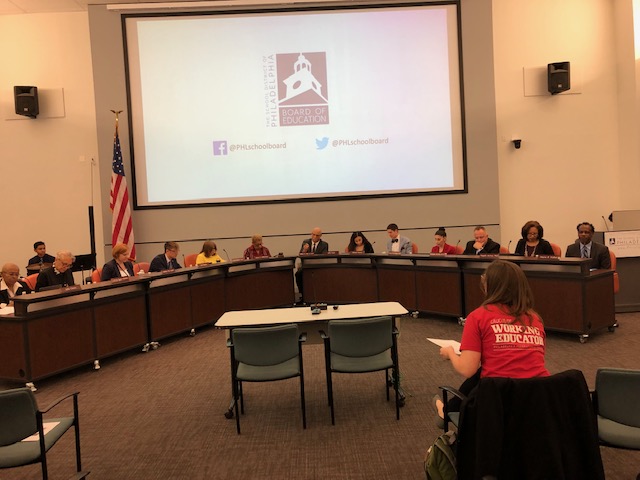
The Board of Education conducted this Action Meeting following  a number of adaptations to pandemic restrictions. In times of crisis, we may lose sight of the importance of following long-established government rules and policies, but these are the very times that make that even more important. The PA Sunshine Act ensures that the public has the ability to observe and  participate in decisions made by their government. While adjusting to the needs of Governor Wolf’s public safety direction to not gather in groups, it is incumbent on the Board to facilitate Action Meetings with as much public participation as technology affords. The Board had initially allowed for no public participation, saying that people could send in testimony 24 hours before the meeting, summaries of which would be read by Board members.  No public voices would be heard during the meeting. APPS continued to point out–in public statements and in letters to the Board–that available technology allowed for them to take and respond to questions and comments in a number of ways. For example, if most of the Board members were participating by phone, then one phone line could be used to hear from the community. Comments and questions taken via twitter and email could be answered during the meeting–and when the meeting came, that is exactly what the Board did.  It was heartening to see APPS’ suggestions put into practice. Board members read public testimony in full, and they read and responded to messages sent via twitter and email. Superintendent Hite did try to answer some of those questions with promises to provide additional answers in the follow-up venues of FAQs on the District website and his weekly Facebook live meetings on Wednesdays at 3:00 p.m. The Board has promised to improve on its efforts for April’s meeting by tapping into the technology options that offer live, interactive possibilities. Unfortunately, the Board’s introduction of two crucial items the day of the meeting has served to cast doubt on the Board’s promises of transparency.

Click here to read the rest of the report

Defenders of Public Education Speak before the BOE, March 26, 2020

BOE

Click on the name to read the transcript of the individual’s testimony.

Beth Beitler

Barbara McDowell Dowdall

Shakeda Gaines

Deborah Grill

Karel Kilimnik

Dr. Cheri Micheau

Andrea Moselle

Diane Payne

Ilene Poses

Lynda Rubin

Cecelia Thompson

APPS Letter to the Board: Action Meetings Must Remain Public

March 24, 2020

Dear President Wilkerson and Members of the Board of Education,

We write to you concerning the protocols for the March 26, 2020 Action Meeting.

Holding a meeting that the public cannot attend in person violates the PA Sunshine Act, but of course the Board must heed the health warnings from city and state officials. The alternative is to hold a virtual meeting that the public can both observe and participate in. Current technology allows for both of these.

The Board has announced that it will live-stream the meeting at the scheduled time. Members of the public can send in testimony in writing or by phone no later than 24 hours before the meeting. Members of the Board will read summaries of those testimonies.

That is not a public meeting.  That is a live TV show.

We have been told that most Board members will be present via phone. That same technology could be used to have members of the public testify via phone. People could submit their numbers by calling in advance or emailing their phone numbers and topics before the meeting. Staff could call them at the appropriate time—before or after voting—and each person could give their own testimony, in full, in their own words.  Everyone watching would be able to hear the testimony.  In addition, some of the questions and comments sent via email and twitter could be answered during the meeting.

The Chief Financial Officer will be making a presentation on the lump sum budget.  Without real-time participation, no one would be able to ask a question about that presentation. Testimony sent in ahead of time could not be amended to include comments or questions about that or any other business taking place during the meeting.

We have also asked that all non-essential Items be withdrawn for now, and that each Item Description include a sentence explaining why it is essential and must be voted on this month. Thanks to the Board for already withdrawing Item 31.

In this difficult time, it is important that the public be able to participate in the democratic process.  The Board must make a good faith effort, using the technology available, to include the public in this week’s public meeting. We appreciate being part of the conversation. We look forward to your response.

Sincerely,

Lisa Haver

Karel Kilimnik