
Board of Education Action Meeting: October 29, 2026
by Lisa Haver
If we are the leaders of tomorrow, we deserve to be heard today.
Student, Parkway Northwest High School for Peace and Justice
If you are not going to represent our interests, put your resignations in tonight.
CASA President Robin Cooper
Why do we need a local school board if you are going to do the same thing the School Reform Commission did?
City Councilmember Jamie Gauthier
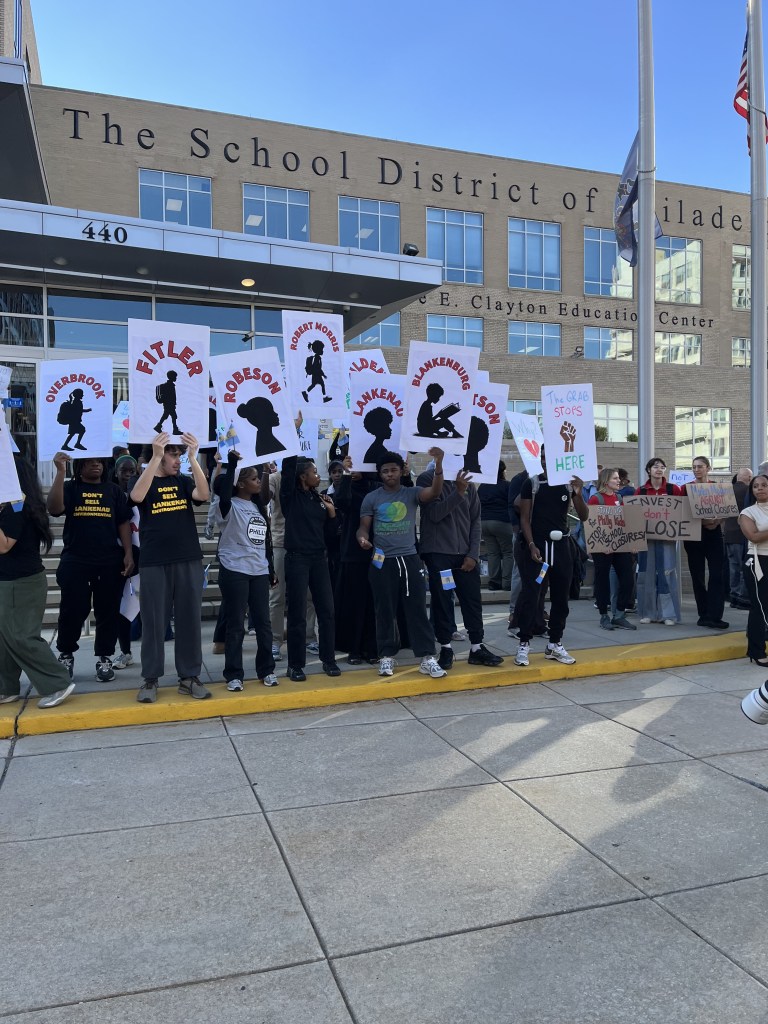
Students, teachers, principals and parents from the 17 school communities under threat of closure rallied on the steps of 440 before the board action meeting. Student drum lines played, accompanied by Philly Elmo. Several elected officials spoke, vowing to fight the facilities plan. Ninety people had signed up to speak: 21 students, 63 adults, 2 union leaders and 4 elected officials. Yet the board set up only 165 seats in the auditorium, 75 fewer than capacity. APPS members demanded that more chairs be set up, promising to interrupt the meeting if people were detained in the atrium despite plenty of room in the auditorium. After initially saying it wasn’t possible, district staff brought in 40 more seats. When we fight we win.
Students Demand to Be Heard
Students rallied before the meeting, then came in to speak to the board directly about how devastating the loss of their school would be to them and their families. Several students asked Superintendent Tony Watlington Sr. and the board why they have still not given a reason for closing their schools. Lankenau, for example, has a beautiful facility and a 100% graduation rate. President Reginald Streater often speaks about how much the board cares about “the babies” and how important it is to hear from “the village”. The district paints slogans and murals on the walls of 440 about how much they are “for the children”. Yet when the children come to speak to them, some of them visibly distraught, there is no acknowledgement of their pain, no engaging with them on the issues they raise. The students hear only Streater’s auto-response: “Thank you for your public testimony.”
Watlington Admits His Facilities Plan Still Largely Unfunded
In our March 2026 analysis of the proposed facilities plan, APPS asked: How can the district base a comprehensive 10-year plan on non-existent funding? That question stands. Six months after the board’s vote to approve the $3 billion plan, no additional government or philanthropic funding, which most of the facilities improvement projects depend on, has materialized. At this meeting, the board voted unanimously to approve Item 8, which transfers $200 million, apparently from the district’s capital fund, to the City of Philadelphia via PAID (Pennsylvania Authority for Industrial Development) for the facilitation of construction projects at four district schools. APPS emailed the board about the $200 million item three days before the meeting, asking for the source of the $200 million, the details of PAID’s role, how PAID would be accountable to the public, and where the district ranked the facilities projects from low- to high-priority as stated in the item description. Whitney Jones, the only board member to raise any concerns about the $200 million expenditure, asked Watlington some of the same questions. He asked Watlington to explain how his administration intends to carry out a plan that is still ⅔ unfunded (⅓ depends on the district’s ability to borrow money through the bond process). Jones, who voted against the facilities plan in April, also asked when and where these projects were designated “high priority”. Watlington’s response ignored most of Jones’s questions. Watlington cited a “well-defined timeline”, actually, no timeline appears in the plan or in the agenda item for any of the projects, nor is there any ranking of projects from high- to low-priority. He finally acknowledged that ⅔ of the plan remains unfunded. “Let’s go lobby together”, Watlington said, for the remaining $2 billion. It was unclear who he was addressing. Six board members voted in April for a ten-year, $3 billion plan with little more than hopes and dreams that it would ever be fully funded.
Board Members Disregard Student Testimony
Members of the public witnessed some new lows at this board meeting: Board Member Joyce Wilkerson’s tone-deaf comments on what a great idea it is to close Lankenau High School and President Reginald Streater’s lecturing students and educators facing the elimination of their schools. More than ten students testified about what losing Lankenau will cost them: their “second home”, their friends, their teachers, the curriculum, the dual enrollment opportunities, and the beauty of the natural surroundings. Not one board member responded to any of the students. Wilkerson, who has not visited the school nor met with any members of the school community, ignored everything that the Lankenau students just told the board as she expressed her enthusiasm for having Lankenau merge with Saul because they “have so much in common”. The truth is that the schools are not merging, and they have very little in common. Wilkerson added that she has been “shocked” at seeing the disparity in the quality of resources in different schools. Wilkerson was appointed chair of the SRC in 2016.
No Response from Board Members to Public Testimony
City Council member Jamie Gauthier returned to express her frustration with Dr. Watlington and the board, who failed to consider the plan she submitted months ago to save the schools in her district, including Robeson High. She pointed to the board’s “meanness” in their intention to close Robeson High and replace it with another district educational program–which Robeson students would be banned from attending. City Council member Isaiah Thomas suggested having Mayor Cherelle Parker come to the “table” to mediate so that a “compromise” could be reached. None of that makes sense. The mayor appoints all nine members of the board; they approved the plan she wants. And no constituent of Thomas, an at-large councilmember, has said they want to compromise. Everyone at every meeting this year, at both 440 and in City Council, has demanded no school closings. APPS member Kristin Luebbert asked again, as she has in previous testimony, why the Watlington administration seems unable to carry out its basic duties. PSSA scores still have not been released. At the September 24 action meeting, several Girls High students rallied and testified about the severe understaffing at the school. Watlington claimed he had no knowledge of the problem. Luebbert asked how it was possible that Watlington heard nothing from any assistant superintendent or district leader about the conditions at Girls. Had he not read the Chalkbeat story published six days before the September meeting? APPS member Deborah Grill, in her written testimony, pointed out that Watlington is ignoring the wishes of parents and community members he refers to as “customers” to stop the mass school closings. Several members of one Philadelphia family returned to advocate for the reopening of several district pools, as they have been doing for over 5 years. “Do your job”, one young family member told Dr. Watlington, because he was ready to replace him. The audience loudly endorsed that idea. Teachers from Harding, Parkway NW, Penn Treaty, and other schools returned to tell the board how school closings would hurt their students and disrupt their already struggling communities. The principal of Lawton Elementary in Wisssinoming raised an important point about the facilities plan that Watlington and the board have refused to address: the disruption that grade band changes will cause. Lawton is currently a pre-K to 5 elementary. The facilities plan would add a middle school with grades 6, 7 and 8. The principal asked: How would the Lawton building be repurposed for the incoming older students? She received no answer. As APPS pointed out in our report, the board has held no meetings to discuss anything other than closings; there has been no discussion about co-locations, catchment area shifts, grade band changes or modernization projects. Adding middle school grades to a K-5 elementary changes a school profoundly. School communities who requested meetings on these matters have been denied by the district. Only when elected officials interceded, as Councilmember Jeffery Young did for the Bache-Martin, Waring and Morris communities, did the district hold meetings at some schools.
Board Renews Substandard Charter School
The board voted unanimously to approve the 5-year renewal of Harambee Charter School. Harambee failed to meet standards in both Academic and Organizational domains. The board also approved a location change for Young Scholars Charter School. In violation of the Pennsylvania Sunshine Act, neither item contained any content, including the cost of the items; thus the board voted in secret on both charter items. The board passed 21 official items and approved spending a total of $204,431,334 (not including cost of the charter renewal). The board deliberated on only three of the items.
November Board Meetings
Goals and Guardrails: Thursday, November 5, 4:30 PM at 440 N. Broad Street.
Policy Committee: Thursday, November 12, 4:30 PM at 440 N. Broad Street.
Action Meeting: Thursday, November 19, 4:30 PM at 440 N. Broad Street.
The meeting adjourned at 8:21 PM.
[Published November 2, 2026]

