
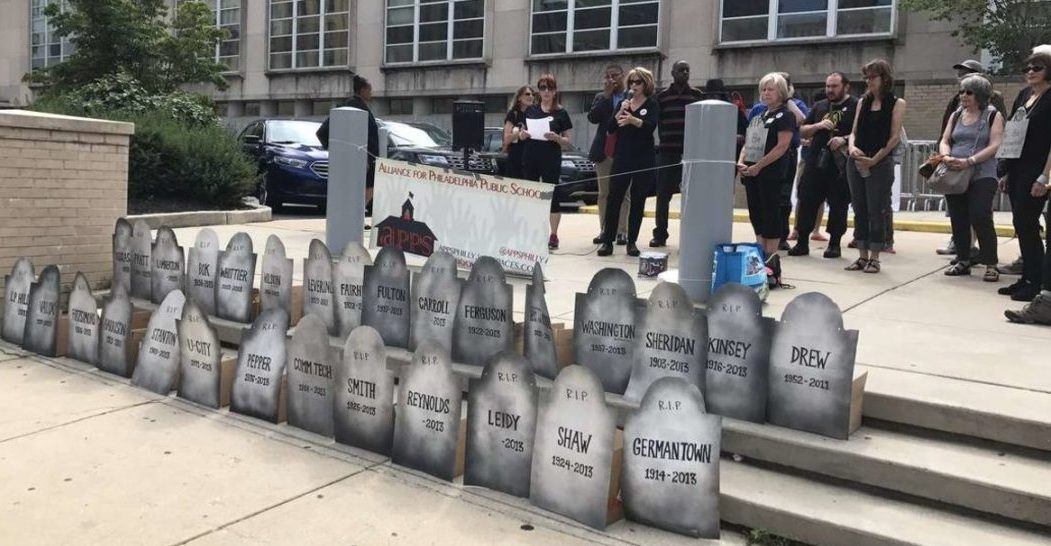
Board Must End Practice of Renewing Substandard Charters

by Lisa Haver, Deborah Grill, Lynda Rubin, Ilene Poses

At its August 17 action meeting, the Board of Education will vote on the renewals of nineteen charter schools. After just one brief presentation by the Board’s Charter Schools Office at the June meeting, Board President Reginald Streater announced Board recommendations for fourteen of the19-school cohort, directing CSO Director Peng Chao to negotiate renewal contracts with the operators of those schools. Thus, without any Board vote or any public hearing, the Board decided in effect to renew most of the charter schools, despite the fact that only one had met standards in all three major categories. Streater made no recommendation for the remaining five, all of which had received a “Does Not Meet” rating in at least one category. 

Should the Board vote to renew all nineteen, the district would be spending approximately $470 million over the next five years.  Of that, approximately $20 million will be spent on CEO salary and compensation. Review of the CSO renewal evaluations shows that:

  • 13 did not rate “Meets” in Academics
  • Board recommending renewal for 8 of the schools rate below “Meets” in Academics
  • 5 of the 19 schools have been operating under expired agreements
  • 3 of the 4 schools in their first term rate “Does Not Meet” in academics
  • 9 of the 19 are well below authorized enrollment

Continue here to read information on each school up for renewal


Democracy Dies in Darkness

Board of Education Action Meeting:  May 25, 2023

 by Lisa Haver and Lynda Rubin

The board’s speaker suppression policies are now doing double duty: not just to keep members of the community from speaking but to keep them out of the room altogether. A guard at the door to the auditorium told Lynda Rubin she could go in because she was on the speaker list but barred Lisa Haver because she wasn’t.  Haver had tried to sign up but was told by the board that she would not be one of the 30 chosen speakers. She told the guard he could arrest her but that she was going in. Last month some APPS members were detained downstairs because they were not on the list.  

We wrote to the board after the April incident, pointing out that they had only set up 82 chairs in an auditorium that seats 240 people. Thus, the same people who were denied the right to speak now no longer have the right to be present. Did the board not want APPS to witness its voting to spend over $500 million in taxpayer money on 78 official items?  Or voting on a charter application that would cost the district hundreds of millions over the next five years?   A governmental body not accountable to the public can become tyrannical and dictatorial. We need an elected school board.

Continue reading

Southwest Leadership Academy Charter Non-Renewal Hearing Report

by Lynda Rubin

Southwest Leadership Academy Charter School (SLACS) has had less than stellar academic and financial accomplishments for years. The K-8 school in Southwest Philadelphia was originally authorized by the SRC in 2007 as a K-6 at one location, but currently operates out of two rented facilities, (Gr. 3-8) 7107 Paschall Ave, 19142 (its original location) and (Gr K-2) 6901 Woodland Ave, 19142. It has a City-wide admissions designation, but students reside mainly in the local geographical areas and Delaware County (to which some prior students moved while attending SLACS and continued at SLACS). The school’s student composition is 89% African American, 7% Hispanic and 4% White. Asian Pacific and Multiracial. 13% have special needs, 4% are English Language Learners (ELL) and 69% of the population lives in poverty status.

Continue reading here

Board Must Deny All New Charter Applications from Global Leadership, Aspira and Perseverance

by Deborah Grill, Lisa Haver and Diane Payne

This district opened its first charter school in 1998.  Every year, those lobbying for and profiting from the privatization of public schools have promised to improve education for the city’s children.  They said that the district had an obligation to create charters for the good of the children and the community.  Twenty-five years later, we can see that the charter experiment foisted upon the city and its families has failed.  Because of the backing of well-funded PACs and special interest groups, with their increasing political influence, charters have avoided accountability to the same communities they made 6their promises to.  

The district has had many years to learn that the aspirational language of charter apps is rarely achieved.  Charter renewal evaluations don’t measure whether the schools have fulfilled their promises of innovation; they cite standardized test scores and other data. 

To read the reports on the applications click here