Board Outsources Extended Year Programs

Board of Education Action Meeting: June 27, 2024

by Lisa Haver
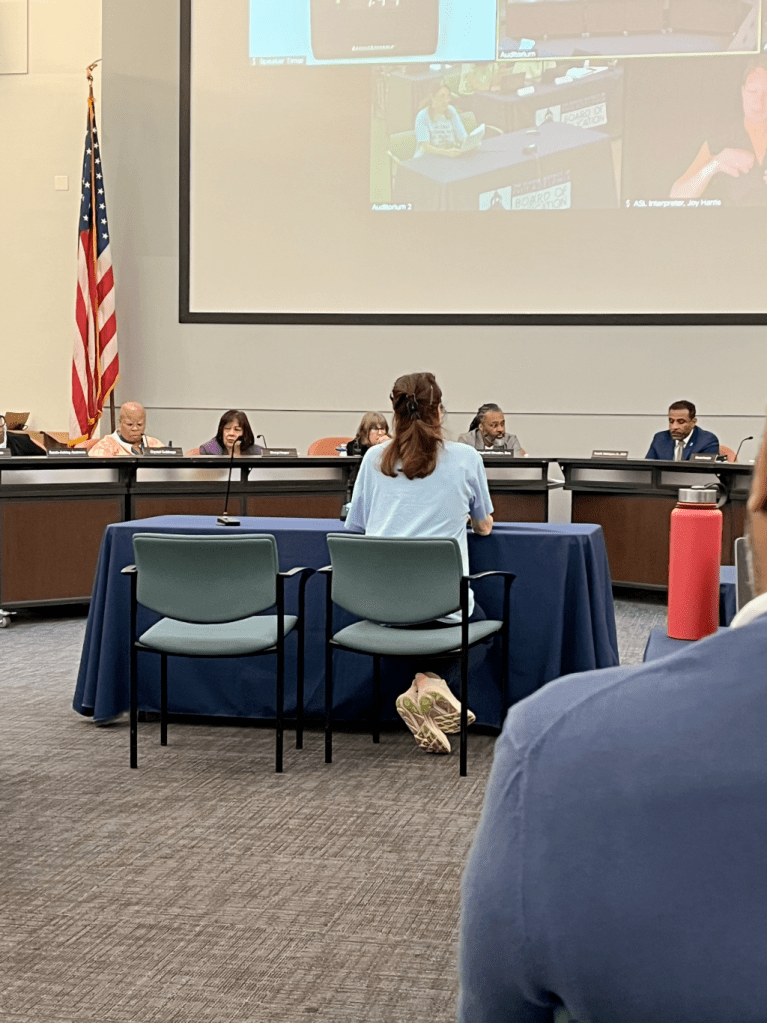
APPS member Lynda Rubin testifies at June 27 board meeting (Photo: Lisa Haver)

APPS members have asked the Board of Education many times, most recently at its June 13 “community hearing” at Rush middle school earlier this month, why they set up so few chairs for the public at their monthly meeting. In an auditorium that holds 240 people, there have been only 140 chairs. At this meeting, the board set up only 102 chairs. Why? The board raised the issue during the meeting of how they can improve public engagement, yet they have no explanation why room for the public shrinks with every meeting.

Board Outsources Extended Year Programs 
The board also raised the issue of public engagement when they discussed the pilot program for an extended school at 20 district schools. The district sent out emails to staff at the 20 designated schools on June 24–almost two weeks after schools closed for the summer. Many teachers found out when the email, sent by Deputy Superintendent Germaine Dawson, was reported in news stories and posted on social media. In addition, the Watlington administration has not sent emails to parents at the designated schools. On Thursday, hours before the board meeting, Mayor Cherelle Parker held a news conference to launch the pilot program for year-round school, a signature plank in her campaign platform. She was adamant, however, that reporters not refer to it as “year-round school”, saying that it was limited, at this time, to more extended day and extended year services. Parker expressed frustration that the story was “leaked”, but the fact is that her administration failed to communicate with those who would be involved, including the PFT, whose spokesperson told the Inquirer that they were “still awaiting direct communication” from the administration” about the program. The lack of coordination between the Watlington and Parker administration, and the failure of both to communicate with affected parties before the announcement, raised concerns about the success of the year-round initiative.

Read more about June 27 2024 action meeting.

Board Must Not Bar Parents, Students, Educators from Public Meetings

Board of Education Action Meeting: May 30, 2024

by Lisa Haver

Philadelphia’s unelected Board of Education demonstrated how little it is accountable to the public at this May action meeting. Before and during the meeting, both district security and Philadelphia police blocked parents, students, educators and community members from entering the building and the auditorium. As social media was documenting in real time the violation of the rights of the people outside the doors to exercise their First and Fourth Amendment rights, as people were calling out to the board to do something, not one member of the board spoke up for their constituents. At least two reporters who showed press credentials were blocked from entering the building by 440 security and Philadelphia police; another reporter had to intercede twice before they were allowed inside. 

Continue reading here.

Board Consistently Renews Charters that Fail to Meet Standards

by Lisa Haver

In its recent report on alleged bias against some charter school operators, the law firm of Ballard Spahr recommended that the Philadelphia Board of Education make the renewal process more transparent, with more opportunities for public input.  APPS has been calling for public renewal hearings for over ten years. It seemed strange that the charter operators themselves were not making the same demand, as it would give them a chance to present evidence that they were outperforming district schools. Charter operators could list the charter schools that were fully enrolled or over overenrolled, thus verifying their assertion that there is a waiting list of 40,000 students waiting for admission to the city’s charter schools. When you consider, though, the fact that district schools outperform charters in every category, that charter schools in every area of the city are actually significantly under-enrolled, and that charter administrators are collecting exorbitant salary and compensation packages, the failure of charter operators to call for public hearings starts to make sense.  

During the expansion of charter schools, enabled by the state takeover of the district and the installation of the School Reform Commission in 2001, charters sold themselves by promising to outperform public schools and provide children with better education. Every year, however, the data shows that has not happened.

Continue reading here.

Board Must Respect Constituents’ First Amendment Rights

Board of Education Action Meeting:  March 28, 2024

by Lisa Haver

Over the years, we have seen people come before this board, and before that to the School Reform Commission, in order to advocate for better public schools. West Philadelphia community members showed up for months, asking that the board provide funds for pools so that children could learn to swim. Parents have come demanding that the board do everything in its power to remove the lead and asbestos and to make schools less toxic. Students have come to ask for mental health services, as many are still recovering from the effects of the pandemic lockdown. Just last month, PFT members led a rally before the action meeting, then in their testimony asked for an end to the oppressive and unfair practice that punishes them for taking their contractually allotted sick days.  Parents, students, educators and community members all come in the hope that the members of the board will hear them, respond to them, and do something to improve education for the city’s children. 

Outgoing Board Member Mallory Fix Lopez, however, sees them not as advocates but as impediments. Fix Lopez, during a presentation on the district’s lump sum budget, launched into a diatribe against “protestors” whom she blamed for the state’s underfunding of the city’s schools.  She claimed that when she attends “high-level” government meetings in Harrisburg, legislators cite news stories about the district as proof that the board and the district are “incompetent” and don’t deserve more funding. According to Fix Lopez,  people who may be “well-intentioned”  neither understand the issues nor know who they should be talking to about them. She said that when people “ask for things”–like pools,  libraries, schools, better technology, the end of leveling, more art and music, better ventilation in classrooms–they are actually doing it “with the intentional intent” to make the board look incompetent.

Continue reading