A grass-roots organization of parents, community members, and school staff, fighting to defend public education. We work together to provide analysis and demand accountability from the School District of Philadelphia to provide students with a high-quality education.
Author: appsphilly.net
The Alliance for Philadelphia Public Schools is a grass-roots organization of parents, community members, and school staff—including teachers, school nurses, librarians, counselors and safety staff—dedicated to the preservation of public schools. APPS is an independent organization with no political or union affiliation. We are entirely self-funded and do not take financial donations from outside sources. All members donate their time and receive no salary.
by Lisa Haver, Deborah Grill, Lynda Rubin, Barbara Dowdall, Ilene Poses
At some time in the future, the Board of Education will cast their final votes on the eighteen charter schools in the 2024-25 renewal cohort. Actually, the board has already made its decision on all of the schools. The future of the schools now lies in the hands of the charter operators.
The board convened a “Special Action Meeting” June 12, 2025 for the sole purpose of reviewing the charter schools in the current cohort. The agenda included a presentation from
Charter Schools Office Chief Peng Chao summarizing their 18 renewal evaluation reports, along with public testimony. It was actually a public hearing as there were no official action items on the agenda to be voted on. By the end of the meeting, they had separated the cohort into two categories: 12 that needed no further review and 6 that did because of failure to meet academic standards. That meant that 12 would proceed to renewal, with CSO Chief Chao drawing up renewal agreements with the schools’ administrators. For all intents and purposes, the board had voted to renew 12 charter schools.
“The Party told you to reject the evidence of your eyes and ears. It was their final, most essential command.” George Orwell, 1984
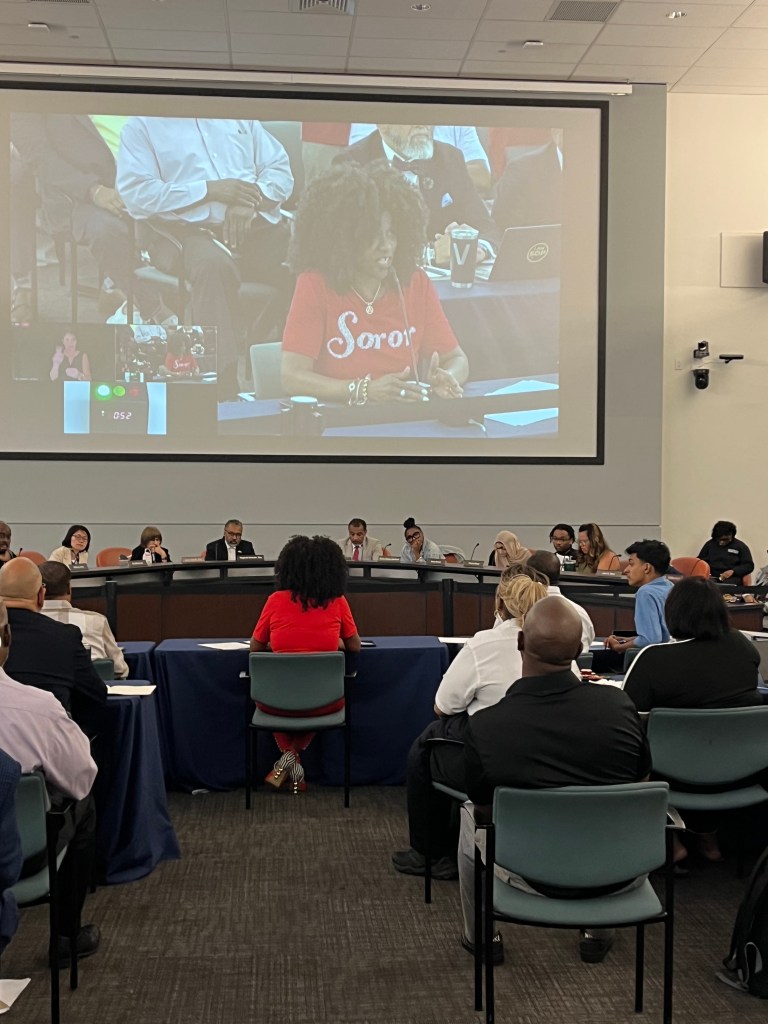
CASA President Robin Cooper testifies at June 26 action meeting. (Photo: Lisa Haver)
A governing body convenes an action meeting. They listen to a presentation from the director of a department they oversee. The president of the board raises each issue, and members of the board comment and question. The president then calls on each member to give their position. He tallies the responses, then directs the department chief to carry out the action that the majority of the board voted for. Except when the Philadelphian Board of Education does this, according to Board President Reginald Streater, it’s not voting. True, the terms “motion”, “roll call” , and “vote” were not used. But the board came to decisions on the futures of six charter schools in the renewal cohort after listening to Charter Schools Chief Peng Chao and deliberating on the information presented. Streater called on each member to state their position on whether the school would be granted a 5-year renewal, a 1-year renewal, or no renewal. He counted their responses, then directed Chao on what type of document to draw up. How is that not voting? Every time APPS members called out that the board was voting, even though none of those charter items had been placed on the agenda, Streater insisted they were not. The dictionary definition of the word “vote”: a formal indication of a choice between two or more candidates or courses of action, expressed typically through a ballot or a show of hands or by voice. The public’s faith in this board continues to erode because of its lack of transparency and public engagement, along with its reluctance to hold the administration accountable. Now they want to tell people not to believe what they see and hear with their own eyes and ears.
Legal Notice on page B2 in May 28,2025 Philadelphia Inquirer
In this era of authoritarianism, the will of the people is too often subverted to the will of the wealthy and powerful. Despite polls that show a majority of Americans do not support the privatization of public schools, and the overwhelming defeat of voucher proposal referenda in several states, politicians have found a way to overrule the voters and impose anti-public school measures. And despite the growing evidence that an increasing number of the city’s parents are rejecting charter schools, including under–enrollment at over half of the city’s charters, Philadelphia’s Board of Education voted to approve a new application, one they had previously voted to deny. Their convoluted and dishonest justifications served only to underscore how much they had betrayed their constituents for the benefit of the politically connected special interests. That reason, among others, is why APPS members called on Mayor Cherelle Parker to ask for the resignations of the members of the board.
Board of Education Budget Hearing, Board of Education Action Meeting: April 24, 2025
by Lisa Haver
Shawmont student advocates for keeping librarian at his school. (Photo: Lisa Haver )
“I am not just a statistic, and neither are my peers.” Academy at Palumbo student to Board of Education
Parents, students, educators and community members came before the board to testify on the many issues facing our children and our schools: mental health supports for struggling students, filthy bathrooms, outdated textbooks, restoring school librarians, the need for air filters in classrooms. President Reginald Streater assured speakers, as he does at every meeting, that the board is listening. As one APPS member said in her testimony, “Students will know you are listening when they see that their bathrooms are finally clean.”
Ilene Poses contributed to this report.
Board Meetings Must Be Fully Public Because APPS members have attended Board of Education meetings for years, we knew that the board would be holding two meetings on April 24: the monthly action meeting and the hearing on the next annual budget. But anyone who may have been attending or testifying for the first time would have seen only one meeting for 4 pm posted on the board’s website calendar. Two agendas were posted, but both gave 4 pm as the starting time. At the beginning of the meeting, President Streater said that the board would hold a 15-minute recess after the conclusion of the hearing…”perhaps”. But just after the final speaker on the budget was heard, Streater said “we are going into the action meeting” and began to narrate a slide presentation. It was unclear what was happening as the board did not vote to adjourn, nor did Streater declare the hearing adjourned. General Counsel Lynn Rauch, who serves as the board’s parliamentarian under the board’s by-laws, did not call the roll for the action meeting. When Streater took office, he promised that the board would be following Robert’s Rules of Order. After her testimony, Lisa Haver filed a formal objection to the board’s violation of the Pennsylvania Sunshine Act. The board did not give proper notification of the proceedings on the website or at the meeting itself. Haver pointed out that these are not legal technicalities, that the public has a right to know what the board is doing. People who are just leaving work or school often text APPS members to ask where the board is on the agenda and whether they can make it in time to testify. The board must honor the rule of law.