
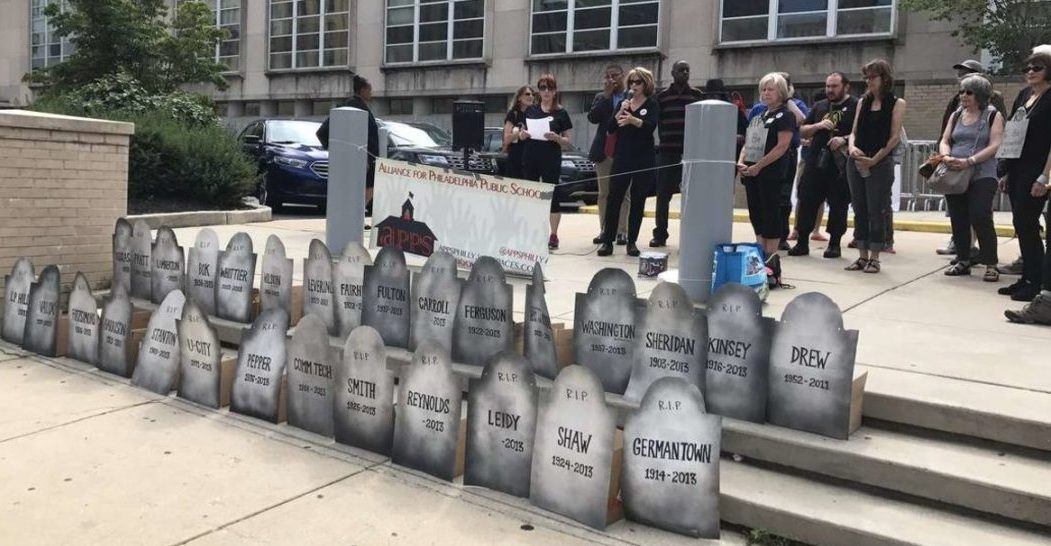
Board Passes $4.9 Billion Budget, Community Questions Priorities

by Lisa Haver

Board of Education Action Meeting, May 28, 2026
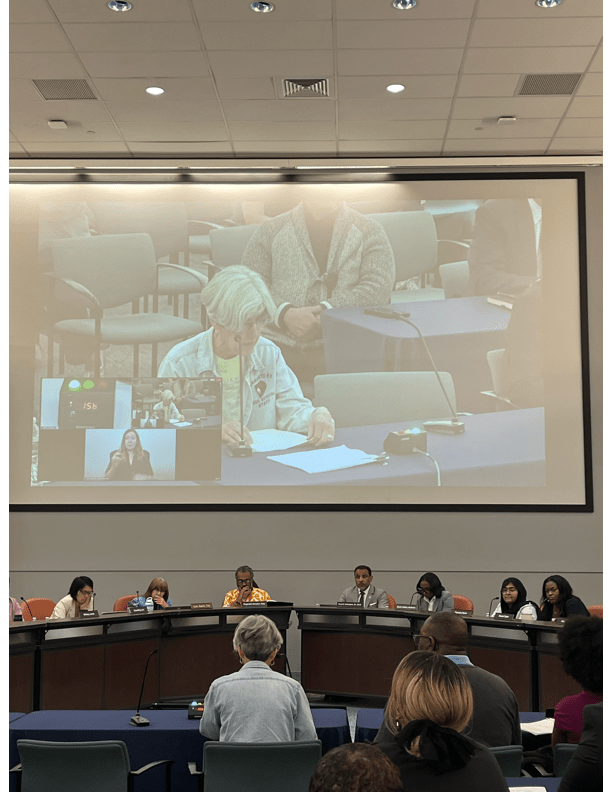
APPS member Deborah Grill testifies at May 28 Board of Education meeting. (Photo: Lisa Haver)

As a result of the Board of Education’s speaker suppression policies, over half of the 30 public speakers were representatives of charter schools, 6 from the same school. Several charter CEOs, who have daily access to the board’s Charter Schools Office, took speaker slots, including both Global Leadership Academy CEOs. Recent IRS information shows the GLA CEO making over $500,000 in annual salary/compensation/bonus; GLA Huey CEO made $378,000. Although APPS has raised these issues for years, the board says little about exorbitant administrative salaries, questionable financial practices, and failure to reach minimum academic ratings. In fact, the board exempted the entire charter sector from its $3 billion, ten-year Facilities Master Plan. 

Board Passes $4.6 Budget
The board voted 8-0 to pass the administration’s combined $4.6 billion budget for FY 2026-27 in Item 12 (BM Wanda Novales was absent). The board passed Item 15 by a vote of 7-1, approving the Amended Capital Budget for FY 2025-26, adoption of a Capital Budget for FY 2026-27, and a Capital Program for 2027-32. BM ChauWing Lam voted No on Item 15, citing some “lingering questions”. The 5-year Capital Improvement Plan includes some projects proposed in the Facilities Master Plan (FMP) passed by the board last month. Lam questioned Deputy Superintendent of Operations Oz HIll about why the budget details as presented to the board did not include construction of the new high school in the Northeast that was proposed in the FMP. Hill responded that as yet there was no funding for the school. Actually that is true of most of the projects in the FMP. APPS’ analysis of the FMP shows that at least ⅔ of the funding would come from additional revenues from the state (even though the budget presented at this meeting shows lower revenue from the state) and from unnamed philanthropic sources. BM Whitney Jones, who voted No on the FMP, remarked that the administration’s “intentions are exceeding revenues” and asked how they would fulfill the specific promises of the FMP. He asked Board President Reginald Streater to allow for regular updates on those metrics.

Continue reading

Board Moves to Renew More Substandard Charter Schools

by Lisa Haver, Deborah Grill, Lynda Rubin, Barbara Dowdall, Ilene Poses

At some time in the future, the Board of Education will cast their final votes on the eighteen charter schools in the 2024-25 renewal cohort. Actually, the board has already made its decision on all of the schools. The future of the schools now lies in the hands of the charter operators.

The board convened a “Special Action Meeting” June 12, 2025 for the sole purpose of reviewing the charter schools in the current cohort. The agenda included a presentation from 

Charter Schools Office Chief Peng Chao summarizing their 18 renewal evaluation reports, along with public testimony.  It was actually a public hearing as there were no official action items on the agenda to be voted on. By the end of the meeting, they had separated the cohort into two categories: 12 that needed no further review and 6 that did because of failure to meet academic standards. That meant that 12 would proceed to renewal, with CSO Chief Chao drawing up renewal agreements with the schools’ administrators. For all intents and purposes, the board had voted to renew 12 charter schools. 

Continue reading here.

Charter CEOs Collecting High Salaries, Benefits and Bonuses

by Lisa Haver, Deborah Grill, and Lynda Rubin

Three of the six most highly paid administrators identified in String Theory’s most recent tax information are members of the Corosanite family:  Chief Executive Officer Angela Corosanite, Chief Information Officer Jason Corosanite, and Director of Facilities Thomas Corosanite. Their total salary and compensation, as listed in the charter management organization’s  2021 IRS 990, comes to almost $900,000. String Theory manages only two schools in the city, but the company has six administrators making over $100,000 in salary and compensation. In addition, each school has its own CEO. Why does a network of only two schools need so many highly-paid administrators? 

There are no guidelines for charter compensation, that is, no schedule of salary steps as there is for district principals and administrators.   Ad Prima charter, a small charter school with 600 students, has a CEO, a principal and a “site director” on staff, all paid over $100,000.00 in salary and compensation. Community Academy charter has a CEO, deputy CEO, a Chief Academic Officer and deputy CAO. Pan American, an elementary school with 750 students, lists eight administrators. Folk Arts Cultural Treasures (FACTS), on the other hand, has one administrator making over $100,000. Global Leadership Academy is a two-school network. Each school has its own CEO–one making more than the district’s superintendent, the other making slightly less. GLA’s principal  made over $11,000 more than a district principal with seven years or more of principal experience.  

Click here to continue reading and to find out what the CEO and administrators of each charter make in salary and compensation.