Board Consistently Renews Charters that Fail to Meet Standards

by Lisa Haver

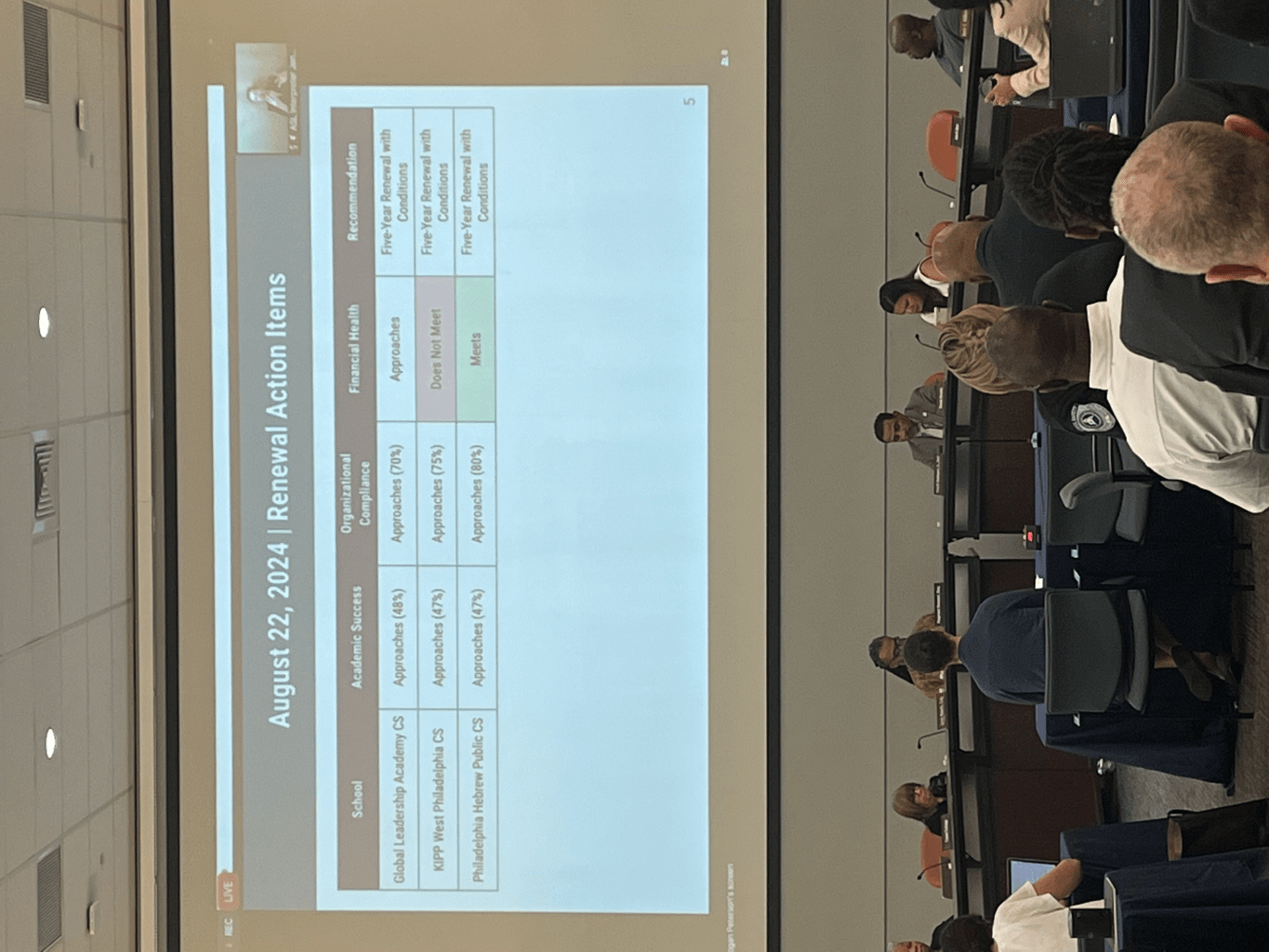
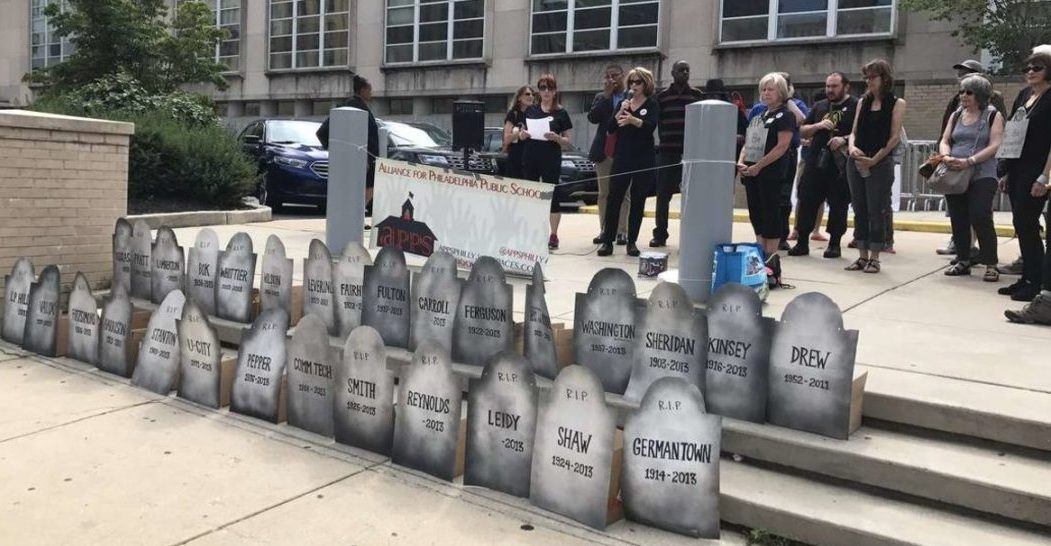
In its recent report on alleged bias against some charter school operators, the law firm of Ballard Spahr recommended that the Philadelphia Board of Education make the renewal process more transparent, with more opportunities for public input.  APPS has been calling for public renewal hearings for over ten years. It seemed strange that the charter operators themselves were not making the same demand, as it would give them a chance to present evidence that they were outperforming district schools. Charter operators could list the charter schools that were fully enrolled or over overenrolled, thus verifying their assertion that there is a waiting list of 40,000 students waiting for admission to the city’s charter schools. When you consider, though, the fact that district schools outperform charters in every category, that charter schools in every area of the city are actually significantly under-enrolled, and that charter administrators are collecting exorbitant salary and compensation packages, the failure of charter operators to call for public hearings starts to make sense.  

During the expansion of charter schools, enabled by the state takeover of the district and the installation of the School Reform Commission in 2001, charters sold themselves by promising to outperform public schools and provide children with better education. Every year, however, the data shows that has not happened.

Continue reading here.

Parents and Educators Return in Hopes of Getting Answers

Board of Education Action Meeting:  April 25, 2024

by Lisa Haver

Attorney Dan Urevick-Ackelsberg of the Public Interest Law Center testifies at City Council hearing on the Board of Education nominees. (Photo: Lisa Haver)

Without explanation or notice, the board suspended its speaker policy so that over fifteen unregistered and unidentified people could testify, untimed, in favor of passing one item on the agenda. Item One proposed naming school district headquarters at 440 North Broad Street after the late Constance Clayton, district superintendent in the 80s and 90s. The board then violated the Pennsylvania Sunshine Act by voting on Item One before public testimony was taken from the registered speakers. The ceremony, which was not listed on the agenda, took over an hour. People who came to testify on other matters had no idea when it would end. 

Continue reading about April 25, 2024 Board of Education action meeting.

Board Must Respect Constituents’ First Amendment Rights

Board of Education Action Meeting:  March 28, 2024

by Lisa Haver

Over the years, we have seen people come before this board, and before that to the School Reform Commission, in order to advocate for better public schools. West Philadelphia community members showed up for months, asking that the board provide funds for pools so that children could learn to swim. Parents have come demanding that the board do everything in its power to remove the lead and asbestos and to make schools less toxic. Students have come to ask for mental health services, as many are still recovering from the effects of the pandemic lockdown. Just last month, PFT members led a rally before the action meeting, then in their testimony asked for an end to the oppressive and unfair practice that punishes them for taking their contractually allotted sick days.  Parents, students, educators and community members all come in the hope that the members of the board will hear them, respond to them, and do something to improve education for the city’s children. 

Outgoing Board Member Mallory Fix Lopez, however, sees them not as advocates but as impediments. Fix Lopez, during a presentation on the district’s lump sum budget, launched into a diatribe against “protestors” whom she blamed for the state’s underfunding of the city’s schools.  She claimed that when she attends “high-level” government meetings in Harrisburg, legislators cite news stories about the district as proof that the board and the district are “incompetent” and don’t deserve more funding. According to Fix Lopez,  people who may be “well-intentioned”  neither understand the issues nor know who they should be talking to about them. She said that when people “ask for things”–like pools,  libraries, schools, better technology, the end of leveling, more art and music, better ventilation in classrooms–they are actually doing it “with the intentional intent” to make the board look incompetent.

Continue reading

Board Rejects New Charter Application

Board of Education Action Meeting: February 29, 2024
Members of the Caucus of Working Educators of the PFT present their petition for the end of the punitive 3-5-7-9 absence policy to the Board of Education (Photo by Lisa Haver)

by Lisa Haver

In a 6-3 vote, the Board of Education voted to deny Global Leadership Academy’s application for a charter high school. Board members cited numerous reasons for their votes, including the substandard proposed curriculum and the questionable affiliations with charter management organizations and legal firms. Two board members cited plummeting academic scores at GLA’s Renaissance charter, Huey Elementary. President Reginald Streater cited GLA’s failure to remedy an issue that the board cited in its previous denial–the organization’s claims that it was GLA but not really part of GLA.  As APPS’ Deb Grill said in her report about GLA CEO Naomi Johnson-Booker’s claim of non-affiliation: “That might be true if one doesn’t count the name, the academic model, the relationship with business consultants Charter Choices, and her position as CEO of GLACS.”  Grill, in her testimony, reminded the board that over half of the city’s charter schools are under-enrolled, thus there is no need for any new charter school.

The consideration of even one application for a new charter costs the district dearly in time and money. Two hearings preceded this decision. The Charter School Office must conduct an in-depth evaluation of the application and review hundreds of pages of attachments. CSO Director Peng Chao gives presentations to the board at several points in the 6-month process. At this meeting, Chao gave another extensive presentation on the GLA application, followed by a lengthy question-and -answer session from the board. In addition, the board’s deliberations just before the vote took over half an hour, and fourteen of the thirty approved speakers addressed this one topic. Three elected officials spoke in support of the GLA application.

Continue reading