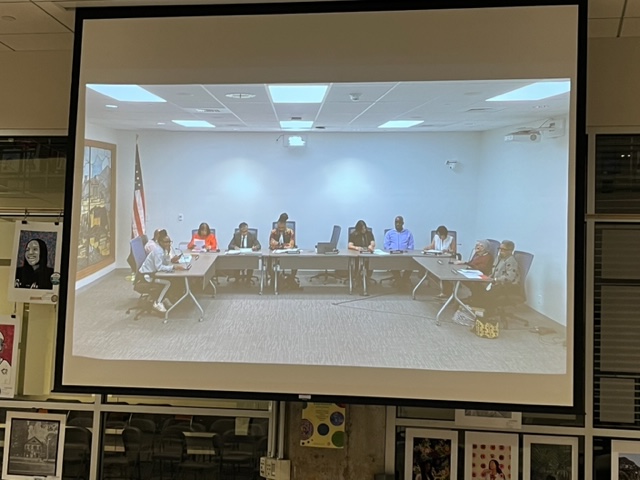
Board Calls Police on Silent Protesters

Board of Education Action Meeting: December 5, 2024

by Lisa Haver

Do Not Obey in Advance.
Timothy Snyder, On Tyranny

Which side are you on?
Pete Seeger

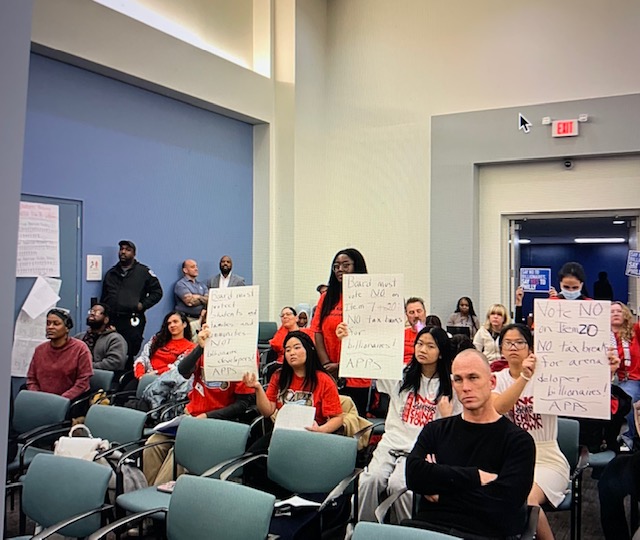
Several APPS members, in their testimony, asked the members of the Board of Education, in essence: Which side are you on? They pointed out that the board sided with billionaire developers in October when they voted to extend their Keystone Opportunity Zone (KOZ) tax abatements and again in November when they approved tax breaks for developers that paved the way for building an arena on Chinatown’s doorstep. Almost every month the board sides with charter investors and their highly paid CEOs when, in secret voting, and with no public hearing, they vote for 5-year extensions for substandard charter schools.  Many Philadelpians are expressing real fears that under the next president, they and their loved ones may be deported, unfairly prosecuted, or targeted and profiled–some possibly  removed from public schools by law enforcement and ICE. They have already asked Mayor Cherelle Parker to strengthen Philadelphia’s  sanctuary city status. The next action will be held in the first month of the next Trump administration. What will the Board of Education do to protect students, families and educators?

The board gave its answer: they called in police to threaten silent protesters with arrest.
Continue reading here

President Streater, Tear Down This Wall!

Board of Education Action Meeting: November 21, 2024

by Lisa Haver

Community members protest Board’s vote on Sixers arena TIF (Photo: Lisa Haver)

Parents, students, educators and community members came to November’s board meeting to be heard on many issues: student censorship, funding to save extra-curricular activities, school closings, renewal of substandard charter schools, restoring school librarians, and the board’s vote on tax breaks for developers of the proposed arena at Chinatown’s door. They hoped to find a board that would be open to their concerns and respond to them. They found, instead, a board that had built a wall around itself, ramped up security measures, and attempted to intimidate public speakers. Outside the auditorium they encountered a table for people to sign in and be issued an identification sticker to be worn during the meeting. Inside had been erected a barrier between the audience and the board, with security staff positioned on both sides of public speakers. Board members now enter and exit through a door on their side of the barrier. There was no opportunity for any contact between board members and their constituents. All of this was an apparent reaction by the board to the protest at the October meeting, during which the board left the meeting and re-convened in a locked room. The board’s bunker-like mentality violates its own Guardrail 2: “Every parent and guardian will be welcomed and encouraged to be partners in their child’s school community.”

Continue reading about the November board meeting here.

Board Violates Sunshine Act, Civil Rights of Constituents

Board of Education Action Meeting: October 24, 2024

by Lisa Haver

Board votes on official items after locking public out of meeting (Photo: Lisa Haver)

After all of the public speakers had testified, and before the voting on action items, about twenty-five members of the audience went to the front of the room, held up signs and demanded the reinstatement of Keziah Ridgeway to her teaching position at Northeast High School.  Less than a minute after the protestors stood, board members and Superintendent Tony Watlington left the room without comment or explanation. During this time, Lisa Haver went down to the board’s office on the first floor, knowing that they would do what they did five years ago when students protested their vote on metal detectors: scurry down to their committee room, accompanied by security, and lock the door.APPS members demanded entry to the meeting then, and we demanded it this time. Haver knocked on the door as the board members entered the committee room; she continued to knock for the entirety of the secret meeting. Several district security and Philadelphia police officers ordered her to move, even threatening arrest, but she refused to move. Eventually they backed off. Board members could be heard on hot mics over the livestream commenting about Haver: “Why is she knocking?” and “Is she taking pictures?” In their barricaded room, with no public allowed, the board voted to approve over $94 million in contracts to various vendors. They also voted unanimously to grant the KOZ (Keystone Opportunity Zone) tax abatement extensions to developers of properties at the Navy Yard and the massive Hilco/Bellwether site. APPS had intended to state a formal objection to the KOZ votes under the state’s Sunshine Act as the board did not disclose in its item how much the KOZs would be costing the district. None of the votes taken in that private meeting is legitimate.  Ilene Poses contributed to this report.

Continue reading about the board’s secret meeting here.

Charter Schools Have Built a Profitable Patronage Network in Philadelphia

by Alliance for Philadelphia Public Schools and Philly Power Research

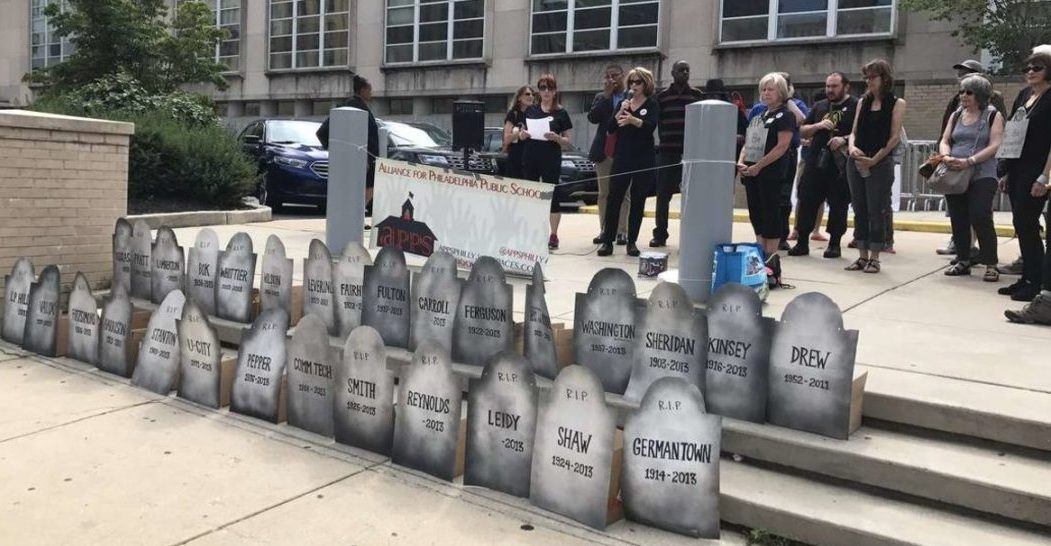
The privatization of public schools has never been about improving education. The goal was to create opportunities for businesses while diminishing the political power of parents, educators and the community.  In that respect, the expansion of charter schools in Philadelphia has been an undeniable success. 

The privatization of public schools, though a reform agenda funded by wealthy corporations, individuals, and foundations, has been devastating to school districts across the country. The school privatization movement has been funded by right-wing billionaires including Jeffrey Yass, the richest person in Pennsylvania; it is a major plank in the Republican party platform. The strategies and methods of the corporate reform agenda have been incorporated into both the curricula and pedagogy of both public and charter schools, including standardized testing of children in every grade after third and the requisite test prep classes that edges out creative teaching and learning.  Students are judged on how well they can take a standardized multiple-choice test, not on creative thinking and problem-solving. Schools whose students score lower, for a number of reasons including poverty, inadequate resources and understaffing, are labeled “failing”. Schools in underserved neighborhoods have found themselves on the chopping block, either handed over to a charter company in a hostile takeover or closed for good. 

Charter schools were sold as the answer to struggling schools. They promised to improve student achievement. Some investors even contended that more charter schools would lead to the elimination of poverty and violence.

None of that has come to pass. By every measure, including those instituted to justify the creation of charter schools—data-driven education—charter schools have failed to keep the promises they made. The median Philadelphia  charter school in 2022-2023 had a lower percentage of students who scored at least proficient in PSSA math than the median Philadelphia public school. (1) Charter schools excuse their failure to meet standards by saying they are educating children in underserved neighborhoods, despite the fact that they sold themselves as a means to educate those very children. 

To read more about how charter companies have profited, continue here.