Reckless Facilities Plan Will Devastate Philadelphia Communities

by Lisa Haver and Deborah Grill
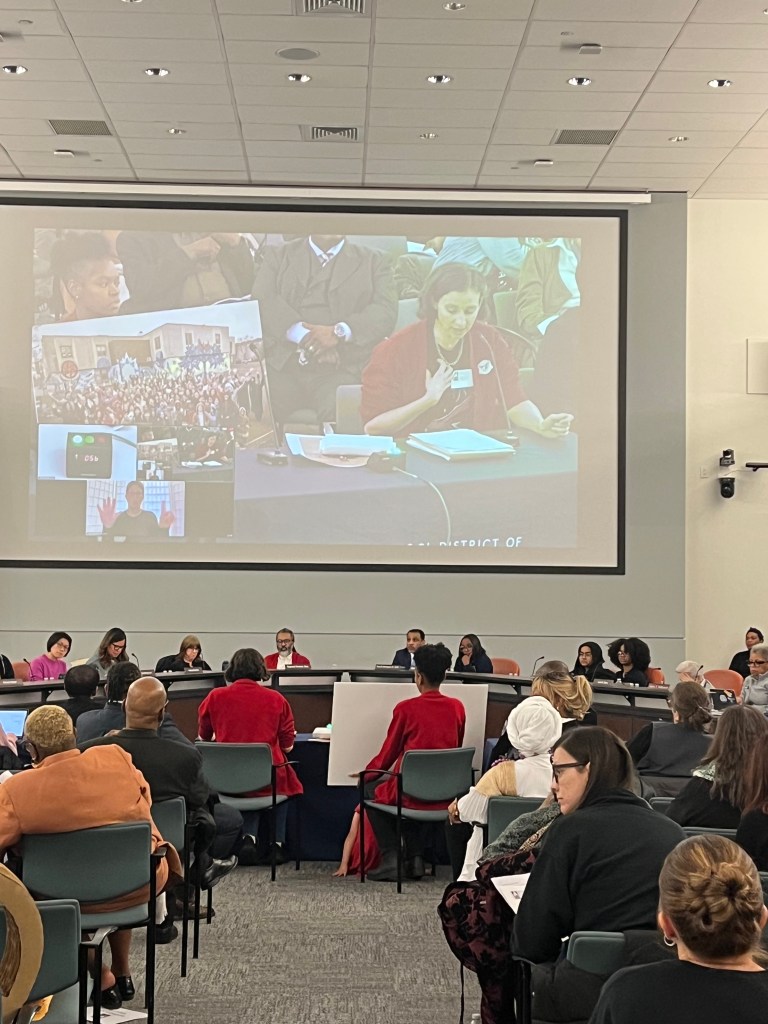
Moffet Elementary parent Katy Donoghue testifies at March 12 district town hall.
(Photo: Lisa Haver)

You didn’t answer my question.”
Parents, teachers, students, community members at district facilities meetings

‘This is not a budget issue.”
From the District’s  2024-25 facilities plan presentation

School District of Philadelphia Tony Watlington Sr. has released a $2.8 billion Facilities Master Plan that, if passed by the Board of Education, will have a devastating effect on communities in every part of the city. The latest draft of the plan, issued on February 27, recommends 18 permanent school closures, 12 co-locations, 8 buildings to be given to the city at no cost, grade band changes in 34 schools, 16 catchment areas redrawn affecting approximately 33 schools in over 20 zip codes, and modernization projects at 159 schools to begin in 2032. Schools targeted for closure are fighting to stay open. With a couple of exceptions, no meetings were held at schools facing grade conversions or catchment area changes. Most of those recommendations, in fact, were issued weeks after the original plan. 

There are no projected costs for any of the recommendations or modernization projects in the plan. 
The Watlington administration and its consultants have assembled a house of cards. If a middle school is built in South Philadelphia, then students would feed into certain high schools. If a school is built in Kensington, then the catchment maps would be redrawn for the three high schools in that neighborhood. If the district creates an honors program in one high school, the students who transfer to the school after theirs was closed might get into that program. And the one that the entire plan balances on: If the district receives more funding from the state and if the district raises funds from unnamed philanthropic sources, they might be able to make improvements to over 150 school buildings. At almost every meeting, board members implore the public to call their representatives in Harrisburg and ask them to fully fund public schools. Yet this plan assumes that Harrisburg will fund a large part of it.  How can the district base a comprehensive 10-year plan on imaginary funding?

Continue reading here
President Streater, Tear Down This Wall!

Board of Education Action Meeting: November 21, 2024

by Lisa Haver

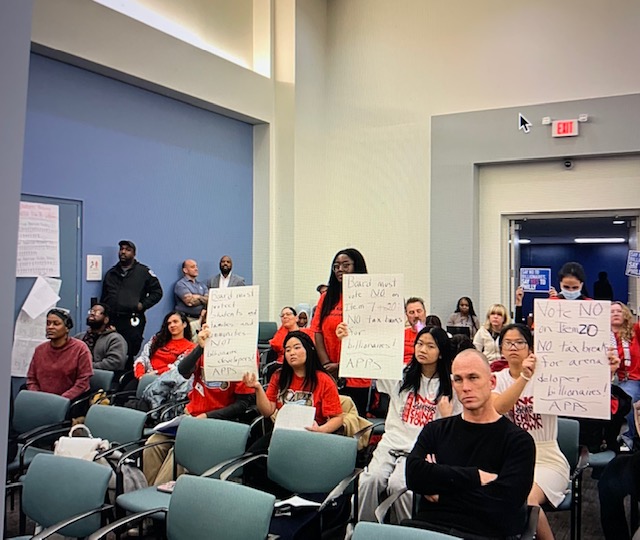
Community members protest Board’s vote on Sixers arena TIF (Photo: Lisa Haver)

Parents, students, educators and community members came to November’s board meeting to be heard on many issues: student censorship, funding to save extra-curricular activities, school closings, renewal of substandard charter schools, restoring school librarians, and the board’s vote on tax breaks for developers of the proposed arena at Chinatown’s door. They hoped to find a board that would be open to their concerns and respond to them. They found, instead, a board that had built a wall around itself, ramped up security measures, and attempted to intimidate public speakers. Outside the auditorium they encountered a table for people to sign in and be issued an identification sticker to be worn during the meeting. Inside had been erected a barrier between the audience and the board, with security staff positioned on both sides of public speakers. Board members now enter and exit through a door on their side of the barrier. There was no opportunity for any contact between board members and their constituents. All of this was an apparent reaction by the board to the protest at the October meeting, during which the board left the meeting and re-convened in a locked room. The board’s bunker-like mentality violates its own Guardrail 2: “Every parent and guardian will be welcomed and encouraged to be partners in their child’s school community.”

Continue reading about the November board meeting here.

Board Carries on Legacy of the SRC

Board of Education Meeting: September 19, 2024

by Lisa Haver

CASA President Dr. Robin Cooper testifies in defense of Philadelphia’s public schools. (Photo: Lisa Haver)

It was freezing in the auditorium during the September action meeting, so cold that they actually brought blankets out for board members. Was it an air conditioning malfunction–or the icy breath of the SRC past?

Board Begins Process of Closing Neighborhood  Schools
Following the legacy of the School Reform Commission, the Board of Education appointed by Mayor Cherelle Parker will be closing more neighborhood schools. No clear reasons were given by Superintendent Tony Watlington, Board President Reginald Streater, or any of the other board members, most of whom remained mute as they do in most meetings. Streater announced the board’s intention to close schools in an Inquirer story published the day before the meeting, but he avoided saying that directly in his remarks.  He used the euphemism “co-location” at one point, but people know that if you “combine” two schools that means you closed one of them.  We heard–from the president of the board that has enacted speaker suppression policies that keep people off of the speaker list and out of the auditorium–promises of meaningful community engagement. Streater said more than once that the board did not want to rely on outside consultants–just before passing a $4.5 million item to hire a consulting firm to begin the process.  We heard assurances that the board will be carrying on robust discussions about the Facilities Plan. Yet eight members had no questions for Watlington after his facilities plan presentation. Only one board member, ChouWing Lam, questioned the price tag of the $4.5 billion consulting contract (Lam later voted for the contract).  Any plan to close schools is a betrayal of the people of Philadelphia. The parents, students, educators, and community members who fought to end the rule of the state-controlled SRC believed that bringing back local control would change the spending priorities of the district and make education better for the city’s children. What we got is a board that protects the financial interests of charter investors and administrators, and now says we can’t afford to keep neighborhood schools open.

Continue reading about September 19, 2024 board action meeting here.