APPS News: July 2017

APPS-Facebook-Banner-8-18

by Karel Kilimnik
July 5, 2017

SRC’s Tsunami of Resolutions

The SRC loaded over 140 resolutions onto its June 15 Action Meeting agenda. Commissioner Green voted No on the new PFT contract at the June 20 SRC meeting because he deemed it “fiscally irresponsible”, but he did not raise that concern about any of the programs or contracts, many to private businesses, which totaled over $200 million in one sitting. Familiar corporate education vendors Mindset Works, back selling more “leadership kits” (A-82); Catapault Inc., possible recipient of a 5-year, $54 million contract for a controversial facility for special-needs students (B-8 ); along with Teach for America, Relay Graduate training, and Foundations, Inc and Jounce Partners (B23) continue feeding at the trough of education dollars. The District’s overdrive to outsource jobs and services races along with far too many resolutions to list here. As usual, the SRC provides scant information, leaving out descriptions altogether for many items, then vote the resolutions in blocks of twenty or thirty at the meeting’s end with no discussion or questions raised. APPS continues to point out that the SRC prioritizes charter operators at closed door meetings.

The district continues to funnel money to private law firms—this time another $8.5 million (Resolution A-71, which passed 4-1, Estelle Richman voting against). The SRC spent millions with these private law firms to fight the PFT after illegally cancelling that contract, appealing at every opportunity. The district has its own Office of General Counsel with twenty-one attorneys plus support staff. How many librarians, art teachers, and music teachers could that $8.5 million buy?

Solution for Special Needs Students—or Bonanza for Private Company?

 Resolution IU-7 was posted just three days before the June 15 meeting, then was “withdrawn by staff” at the last minute. This original resolution proposed entering into a 3-year, $36 million with the for-profit Catapault Learning Company to create a segregated K to 12 school for special needs students due to open in September 2017 (with a possible extension to a 5-year, $54 million contract). Barely two months to find a location, hire staff, and have an operational school for 100 students in kindergarten through twelfth grades. This resolution came as a surprise to parents of special-needs children and the community; as a result, there has been tremendous pushback, including letters from the Public Interest Law Center and the Education Law Center on behalf of a coalition of advocacy organizations including APPS. IU-7 has a twisted tale of resurrection as Diane Payne documents in the June 15 Ears on the SRC. At the City Council meeting held earlier that same day Councilman Derek Green introduced a resolution for the SRC to reject I-U7. It passed unaminously.

Although he did not address the issues of the secrecy and hurriedness of his actions around IU-7, Dr. Hite’s explanation was that the district needed to find 100 placements for former Wordsworth Academy students. After the homicide of a student at Wordsworth last October, the District was pressured to terminate its contract. There have been persistent complaints of physical and sexual abuse of children placed at Wordsworth’s residential treatment center since it opened. However, the resolution also included space for special needs students who were not residents of Wordsworth. Rather than use the better part of a year planning how best to serve this vulnerable student population, the Hite administration is attempting to present a fait accompli to parents who should not be rushed into making this kind of decisions about their children’s futures.

Requiem for Closed Philly Schools Vigil

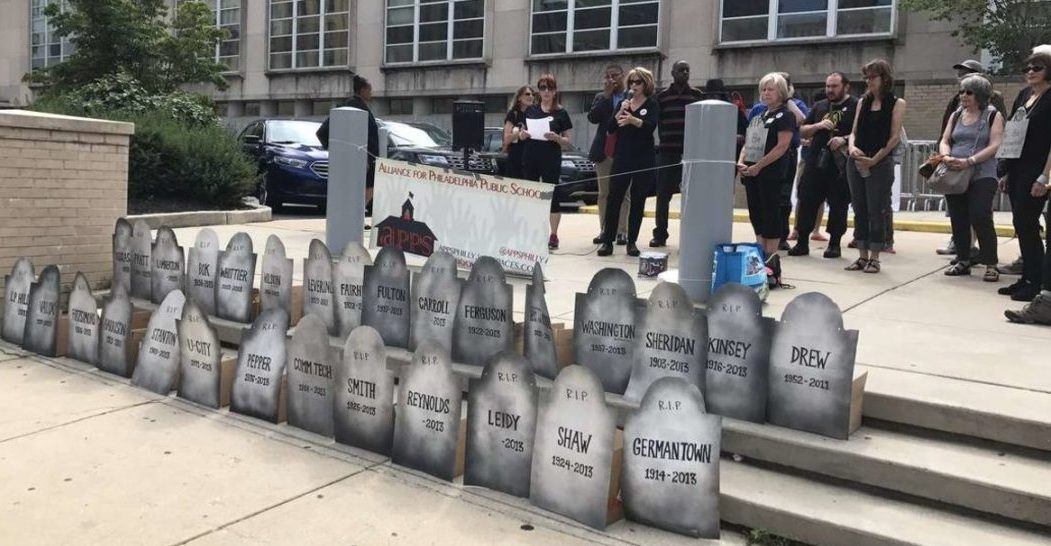
We have listened to Dr Hite repeatedly state that he wants to close three schools a year over the next five years. We attended the neighborhood meetings in 2012 to allow public comment. We heard the anguish of students, parents, teachers, and community members as they desperately tried to save their schools from closure. We sat through numerous SRC meetings and listened to similar groups plead for their schools to remain open. Having heard the heartbreak of school closures and witnessed the devastation wrought upon those neighborhoods, we decided it was time to honor the closed schools as well as draw attention to Dr. Hite’s intentionsAPPS’ Requiem for Philly’s Closed Schools presented a beautiful yet mournful presence in the 29 tombstones created for each of the schools closed since 2011. We created three additional tombstones with a question mark as to who is next on the chopping block. Along with this video of the event there is an Action Sheet with ideas to help school communities organize.

Defenders of Public Education

 There were over 50 speakers on the June 15 list; several people whose names did not appear were allowed, without explanation, to speak during the meeting. One man, who did sign up to speak in advance, was omitted from the list. He sat through hours of testimony, then approached district and SRC staff requesting that they correct their admitted mistake and allow him to speak. Two APPS members approached both District and SRC staff requesting that he be allowed to speak. He even rose after the last speaker to request his turn only to be refused by Chair Wilkerson. The SRC’s capricious speakers policy was on full display at this meeting as some people were added to the list and others excluded.

The Our Cities Our Schools organization has developed a timeline that shows why the present commissioners must vote soon in order to return local control of the district to the people of Philadelphia. Several OCOS members spoke on this issue.

Also see:
SRC to vote Thursday on downsized proposal for new special education program | The Notebook – July 5. 2017

New, $10M special-ed school for Philly kids draws fire | Philadelphia Inquirer = July 5, 2017

Over objections, SRC authorizes$10M new special ed program for Philly kids | Inquirer – Juyly 6, 2017

School Reform Commission approves new in-house special education program | The Notebook – July 6, 2017

 

Actions show District prioritizes charter operators

144606937393246969-src-april-20.full

Closed-door meetings, postponed renewal votes and approvals of underperforming charters create questions about transparency.

The following commentary was published by the Philadelphia Public School Notebook on June 12, 2017

by Lisa Haver and Lynda Rubin

In September 2016, the School Reform Commission posted renewal resolutions that had been postponed for over a year for Mastery Gratz, Mastery Shoemaker, and Mastery Clymer; all three resolutions were withdrawn just before the meeting. They were re-posted in October and November and withdrawn before both meetings. Although test scores indicated that serious improvement was needed at two of the schools, Mastery objected to the conditions recommended by the Charter Schools Office.

In March 2017, the board of Russell Byers Charter School filed a request with the School Reform Commission for permission to relocate some students to an auxiliary location. The SRC approved the request at its May 1 action meeting.

During that time, the District was holding secret meetings with several charter operators and investors, including Laurada Byers, founder and board chair of Russell Byers Charter, and Scott Gordon, CEO of Mastery Charter Schools. According to Avi Wolfman-Arent’s story in NewsWorks, high-ranking District officials including Superintendent William Hite, Chief Financial Officer Uri Monson, and Charter Schools Office Executive Director DawnLynne Kacer met over a six-month period with representatives from several charter companies, along with charter supporter and investor Mark Gleason, executive director of the Philadelphia School Partnership.

The purpose of those meetings, according to District officials, was to formulate a replacement for the state’s existing charter law. Hite told NewsWorks, ironically: “We wanted whatever we came up with to be transparent and predictable.”

In fact, those closed-door meetings ran concurrent with both the charter renewal and new charter application processes. In February, the SRC voted on three new charter applications after reviewing reports presented by Kacer and her staff. That office also presents recommendations on whether existing charters should be renewed.

On May 1, with less than one week’s notice, the SRC voted to renew eight of the 23 charters due for renewal. Before the meeting, the SRC made a decision to postpone, apparently indefinitely, voting on the 11 schools whose managers refused to agree to what they characterized as unfair conditions by the District. Were some of those same charter operators present at the closed-door meetings?

Far from the District and charters having a relationship of “bickering,” as the article refers to, the SRC continues to prove that the interests of charter operators take precedence over those of District stakeholders.  At its last meeting, the SRC approved yet another new charter, denied just three months ago, despite Kacer’s statement that the CSO found “no substantive differences” between the original and revised applications. The SRC has allowed clearly substandard charters such as Aspira and Universal to continue to operate by simply kicking the can down the road for more than a year (in Aspira’s case, more than two years) and offering no explanation to the public.

Serious questions have arisen about how these private meetings between District officials and charter executives have influenced the District’s decisions over the last six months. Kacer sat across the table from managers and board chairs of the very schools for which she decides whether to recommend renewal.  At the May 1 SRC meeting, she referred several times to the “Mastery family of schools.”

District officials told NewsWorks that the purpose of the meetings was to form an alliance to stop Pennsylvania House Bill 97, a new charter bill that would have serious financial repercussions, from being passed. That bill, of course, would have to be palatable to the charter owners and investors including Mark Gleason, who in 2015 offered the SRC $35 million to approve 39 new charters. Offering government officials large sums of money to pass a resolution is the definition of a bribe, but the SRC actually considered it. This year alone, the SRC has approved five resolutions in as many months for PSP initiatives in public schools. Why were no independent education activists — no parents or educators —invited to the table?

When public officials meet with organizations that they have been entrusted to regulate, the people have a right to know exactly what they are doing and saying. Hite had many opportunities during those six months to inform the taxpayers who pay his salary what he and his staff were negotiating with charter operators.

No one other than those in the room knows what was discussed or negotiated. After months of secrecy, the District cannot expect anyone to trust its word on this. We don’t know all of the players or the totality of what was discussed. The Alliance for Philadelphia Public Schools has filed a right-to-know request asking for the names of all who attended, minutes of meetings, and all communications.

Parents, educators, and community members who advocate for public schools at SRC meetings know that their microphone will be turned off at exactly three minutes. But charter managers get all the time in the world.

Lisa Haver is a retired teacher and co-founder of the Alliance for Philadelphia Public Schools (APPS).  Lynda Rubin is a retired school counselor and legislative liaison for APPS.


School Reform Commission still a destructive agency

lisa-haver-2

by Lisa Haver
published in the Philadelphia Daily News – June 8, 2017.

In April, the Inquirer/Daily News conducted a reader survey on whether City Council should hold hearings on Council’s $17 million budget.  No surprise that most who responded voted “Yes.” Taxpayers want to know how elected officials are spending their money, and they want to have their say about it.

 Most Philadelphians probably feel the same about appointed officials, especially those who hold the purse strings on a budget that totals almost $3 billion. The School Reform Commission, after 16 years of everything but reform, continues to earn its reputation as the city’s least transparent, most destructive governmental body, second only, perhaps, to the Philadelphia Parking Authority.

My reader survey would ask these questions:

 Should the SRC release the district’s $2.9 budget before the public hearing?

The district’s first official budget hearing on April 20 opened with the unveiling of its lump-sum budget. Alliance members who requested that it be released before the meeting, so that the public could review it and ask informed questions, were told by the SRC that it was “ever-changing” and would not be available until the meeting.

Should the SRC hold hearings on contracts over $10 million? How about $50 million?

At its Feb. 16 meeting, the SRC approved two contracts for food services totaling $90 million.  No hearings were held; there wasn’t even a staff presentation at the meeting itself. In March, the SRC renewed its contract with Durham bus service, again without deliberation, for $69 million. A subsequent news story revealed that the district had just sent this company, which it hired after outsourcing all of its bus services, a legal notification that it was in breach of contract. Several parents had complained in writing and at SRC meetings that their children were not being picked up on time or at all several days a week.

Should the SRC hold hearings on reviewing and amending its official policies at 9 a.m.?

 The newly created Policy Committee has scheduled its meetings for a time when the teachers who must implement the policies, and the students and parents who will be affected by them, are unable to attend or provide any insight on how the policies could best be formulated and carried out.

Should the SRC be allowed to vote without telling the people exactly what they are voting on? 

The SRC has decided that in some cases it will reveal only the topic to be voted on.  Full resolutions are composed and posted after the meeting.  The official SRC minutes then report that those are the resolutions they actually voted on.  Like to see City Council or the state Legislature try that one.

Should the SRC be allowed to ignore its own rules?

At an April meeting with only three commissioners present, one left early, without notice; the SRC, in violation of its own bylaws, continued without a quorum.  At a meeting the following week, the same commissioner left again, missing not only most of the public speakers but an hourlong staff presentation on the sole topic under consideration.

Should the SRC schedule a meeting in which it plans to decide on renewals of 23 charter schools with less than a week’s notice?

The district’s budget shows that it will spend $894 million — about one-third of the budget — on charters next year. Shouldn’t the SRC allow enough time for those paying the tab to read the reports? They may want to ask why schools that have met none of the standards are being recommended for renewal.

Should the SRC publicly deliberate before voting on significant financial, academic and policy resolutions?

The SRC approved contracts totaling $149.2 million at its February meeting; it spent $173.1 million in March. Resolutions are voted on in batches of 10 or 15, with little explanation of why.

How do we reform the School Reform Commission? By abolishing it. Philadelphians have the right, as all other Pennsylvanians do, to decide who will represent them on an elected school board.

Lisa Haver is a retired teacher and co-founder of the Alliance for Philadelphia Public Schools.

Also see:
Lisa Haver: It Is Time to Establish Democratic Control of Philadelphia’s Public Schools | Diane Ravitch’s blog – June 9, 2017