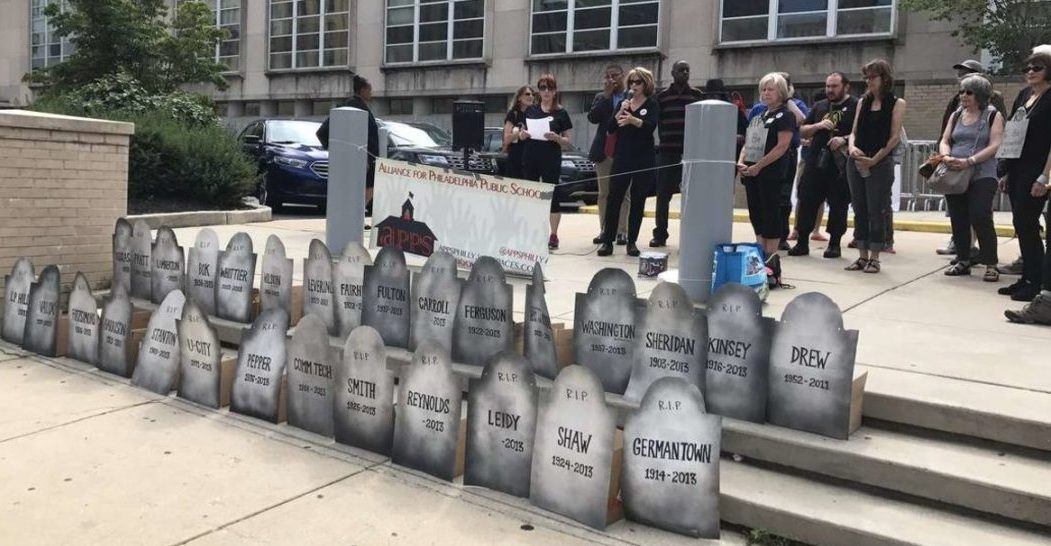
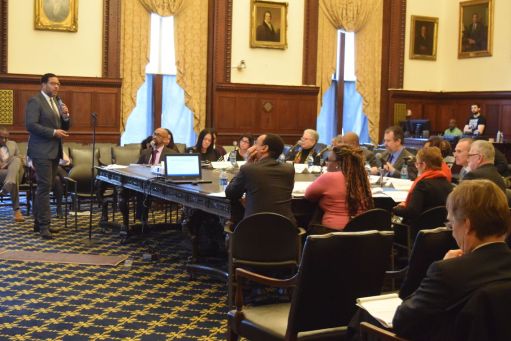
The School Board nominating panel holds its first meeting. APPS protests blatant violations of the Sunshine Act.

390887482217432814-nominating-panel.full

The following is an excerpt from the Philadelphia Public School Notebook article The School Board nominating panel holds its first meeting. APPS protests blatant violations of the Sunshine Act.

A point of for the Alliance for Philadelphia Public Schools (APPS) is transparency. APPS members sued the SRC in 2014 for violating the state’s Sunshine Act, which sets rules for the the conduct of government business,  and won a settlement that reshaped the way the SRC dealt with issue of transparency—although APPS is  quick to point out it’s a settlement they feel has not been consistently honored. For instance, the SRC often posts full descriptions of SRC resolutions after they have been voted on instead of in advance.

“The [nominating] panel is convened under the rules of the City Charter,” Haver said. “They are not an advisory panel. They are charged with selecting candidates for public office. They are city officials, and were addressed as such by members of the Mayor’s office.”

“As such, all of their meetings, including any committee meetings, must follow the provisions of the PA Sunshine Act,” she said. “Selection of candidates, and any deliberation about candidates, for this panel, is official action.”

The Mayor’s office disagrees with this interpretation of the Act.

“We appreciate the Alliance’s understandable desire to conduct as much public business as practicable in public,” Peterson said in a statement. “But the Alliance’s reading of the Sunshine Act is far from complete.”

She cited a section of the act that allows for deliberations involving political appointments to be conducted in closed-door executive sessions.

“A candid discussion about the strength and weaknesses of potentially hundreds of possible candidates cannot effectively be conducted in public,” she said. “It is also very likely that candidates will be more forthcoming about potential issues or conflicts of interest in private discussions.”

Haver suggested her organization is considering further action.

“APPS members have not fought against the lack of transparency by the SRC only to sit by and watch another board conduct its business in the same manner. We will be addressing our concerns to the panel and to the Mayor in the coming days.”

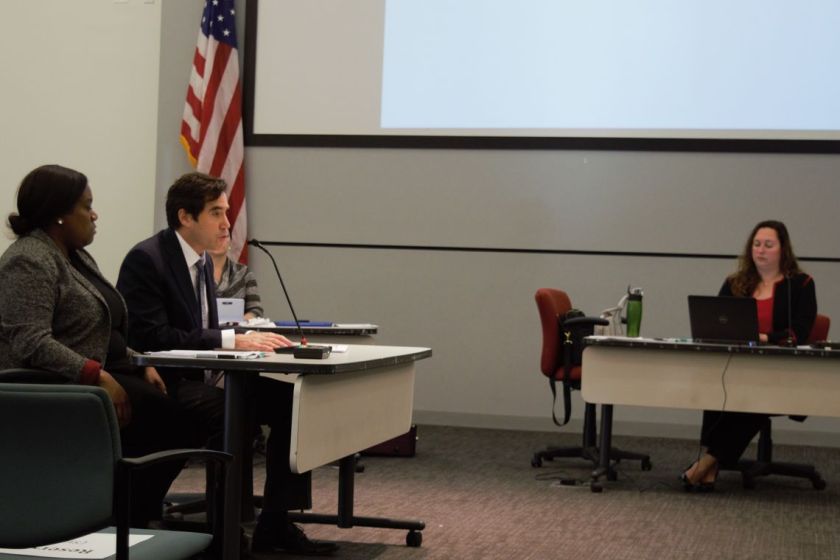
First hearings held for nine proposed new charters

priority schools

First hearings held for nine proposed new charters | Philadelphia Public School Notebook -December 19, 2017

See the above article for a description of each of the proposed nine new charters. The article concludes with testimony of APPS members:

Aspira had to settle several suits brought against the company because of the sexual harassment perpetrated by Aspira Philadelphia CEO Alfredo Calderone. Unbelievably, he is still CEO… [Dawn Lynn Kacer, head of the CSO] testified that the financial improprieties had not only not been resolved, as promised by Kenneth Trujillo in May 2016, they had actually gotten worse,” Haver said in her public comment. “For the SRC to agree to put the education of more young people into the hands of Aspira would be a clear dereliction of duty.

She ceded the floor to several other activists from the Alliance for Philadelphia Public Schools (APPS), familiar faces to anyone who regularly attends the SRC.

“Corporate charter schools continue to fight the SRC even today challenging the District’s right to oversee our public school students’ academic progress in their schools,” Lynda Rubin said during her public comment. “The SRC was put in place to purportedly shore up the financial supports for real public education in Phialdelphia. Not to hold a fire sale, selling or giving away its parts to private companies masquerading as public education stakeholders.”

Karel Kilimnik took issue with the argument made by SRC commissioners like Bill Green, that the SRC is not legally allowed to consider the financial impact that authoizing new charter schools would have on the District, since students take state dollars with them when they leave to attend a charter.

Kilimnik read from the 2015 SRC testimony of David Lapp, who was then an attorney with the Education Law Center:

I testified to the District that, when reviewing new charter school applications, the factors the District should consider cut against approval of new charters in the current fiscal and educational climate. This is especially true given the dearth of evidence that the charter sector has achieved superior results.

There have been recent public comments that suggest a mistaken belief that the charter law requires the SRC to approve new applications without considering the impact on District students. To the contrary, since the District has been declared to be in fiscal distress and the state constitution still requries that there be a ‘thorough and efficient system of public education,’ the impact of charter expansion on all students should be the most important consideration of all. But since questions have been raised, I wish to briefly clarify why such considerations are also legally valid.

The bottom line is that there has never been a [Charter Appeals Board] or court holding that a fiscally distressed school district is prevented from considering the educational impact on all students, including students in District schools and existing charter schools, when deciding whether to approve a new charter school application. In addition, no cases have addressed these issus since the charter reimbursement was eliminated. As you identify problems with the merits of a partricular charter application, you should be sure to also include, in the alternative, evidence and findings that approving the charter would negatively impact the educational experience of all students, including District students.

Lisa Haver has a column in the Daily News saying billionaires are gaining too much influence on public education.

billionaire know it all trying to destroy publiuc schools 2

Billionaires gaining too much influence on public education | Philadelphia Daily News

When President Trump nominated Betsy DeVos, a woman with no degree or experience in education, as U.S. Secretary of Education, defenders of public education organized an unprecedented effort to fight her confirmation. Unfortunately, her stunning display of ignorance about education and the rights of public school students was not enough to stop the Senate from confirming her.  But we now know who DeVos is and what her agenda is: advancing the privatization of public education under the guise of  “choice.”  She is a government official, accountable to the American people. We can call our elected officials when she fails to uphold the rights of all schoolchildren.

But whom can we call to stop Priscilla Chan from imposing her will on public education?  Or Laurene Jobs?

Priscilla Chan is a physcian and wife of Facebook founder and CEO Mark Zuckerberg, now the world’s fifth wealthiest person. Laurene Jobs is the widow of Apple co-founder Steve Jobs and the world’s fourth wealthiest woman. Neither has a degree in education or any experience teaching in public schools, but both have embarked on massive projects to impose their ideological visions of education on schoolchildren across the country.

The recently established Chan Zuckerberg Initiative is funding the development and distribution of software that would create an online profile of each student’s “strengths, needs, motivations, and progress” and may, according to a June Education Week article, “help teachers better recognize and respond to each student’s academic needs while also supporting a holistic approach to nurturing children’s social, emotional and physical development.” That’s a tall order for two young people with no background in child development or education—unless you count Zuckerberg’s foray into education reform in Newark in 2014, when his $100 million grant enabled Gov. Christie’s disastrous privatization scheme. Zuckerberg, who has never lived in Newark, later told a reporter he “learned a lot of lessons from that.”

Meanwhile, CZI is investing in lobbying for legislation that would enable the imposition of this unproven program in schools and districts across the country in the same way the Bill and Melinda Gates Foundation successfully lobbied for the use of Common Core standards in all 50 states before they had been tested in a pilot program.

Laurene Jobs graduated with a degree in economics from Penn, ran a natural foods company and worked for three years at Goldman Sachs as a trading strategist before marrying Steve Jobs. None of that qualifies her to even teach in a public school, but her massive wealth apparently makes her an expert in the history and curriculum of public education, as well as child development and pedagogy. Recently, Jobs and her XQ Institute bought an hour on the four major TV networks to simulcast a star-studded (but not educator-studded) extravanganza  to hawk her plan to “reimagine” the country’s high schools — mostly by using more technology.  Has Jobs found some research that shows teenagers need to spend more time looking at electronic devices?  When you run a technology company, not surprisingly, the answer to everything, including the things you know nothing about, is more technology.

Over the past 20 years, education policy has increasingly been enacted not to satisfy the needs of the students and their families, but the wants of the wealthy and powerful who are converting public education from a civic enterprise to a marketplace for edu-vendors: the Bill and Melinda Gates foundation has paid to expand charters and lobby for the use of Common Core standards in all 50 states; real estate and insurance mogul Eli Broad now leads a group of corporate funders pushing a plan to move half of all K-12 students in Los Angeles into charter schools; the Walton family has initiated a new $1 billion campaign to promote charters nationwide; Trump financier Carl Icahn has established a chain of charters in New York City.

No one elected these billionaires, and they are accountable to no one.  We can’t call our members of Congress to object to their policies. While Americans continue to condemn the power of the very rich to influence elections, we must also fight to stop them from having more influence over the future of our young people than the constituents of democratically elected school boards.

Also see:
Be Like Lisa | Save Maine Schools 
September 18, 2017
APPS Files Right to Know Appeal on District’s Secret Meetings with Charter Operators

by Lynda Rubin
August 9, 2017

APPS has filed an appeal to the Pennsylvania Office of Open Records after receiving sparse information from the district in response to a formal Right to Know request filed in May. That request was filed after a NewsWorks article, also published in the Public School Notebook, revealed that SRC and district officials had met for months behind closed doors with several charter operators and industry supporters.

imgresHigh-level school district officials—including Superintendent William Hite, Charter School Office Director Dawn Lynne Kacer and SRC Chief of Staff Claire Landau—met behind closed doors for over six months with several charter operators and charter industry lobbyists, including Philadelphia School Partnership Director Mark Gleason, Mastery Schools CEO Scott Gordon, Russell Byers CEO Laurada Byers, Global Leadership Academy CEO Naomi Booker and PCCY Executive Director Donna Cooper.

The reason given by district spokespersons for those meetings was to discuss changes in the state’s charter law being proposed in the state legislature. No explanation was given for the secrecy of the meetings or the exclusion of advocacy groups and individuals who had come out publicly against the pending bill. If the SRC and district had intended to create language which balanced the ability of public schools to thrive side-by-side with charters, advocates to safeguard public school interests would have been involved and the meetings would, and should, have been held publicly.

APPS filed a legal Right-to-Know request with the SRC and School District on May 23, 2017 in order to discover the exact nature of these meetings: who attended and what was discussed, as well as any communications about proposed resolutions drafted by the group or individuals on behalf of the group.

The district’s Office of General Counsel responded on July 14, 2017, providing few details beyond those already included in the NewsWorks article. In fact, the district claimed that no minutes were taken. One of the heavily redacted emails between Landau and Amanda Fenton, Director of State and Federal Policy for the National Association of Charter School Authorizers, referred to “the attached proposal for a comprehensive overview of the legislative proposal with the items discussed added.” However, the district claimed in its official response that the proposal in question was “an internal document”. A follow-up email from Landau to Fenton (Subject: “Legislative Language Check-In”) states, “Attached is the document that sums up where we are at the moment.” That document was also redacted by the district’s lawyers in the RTK response to APPS.

When SRC and district officials meet in secret, for months, with the managers of the schools they are supposed to be regulating, that is an obvious conflict of interest. That should be investigated by the PA Attorney General. When SRC and district officials meet to discuss legislation it will be proposing or supporting, that is a public matter. APPS will be investigating possible violations of the PA Sunshine Act, which says that the public has a right to know, and comment on, what its government officials are doing when conducting public business.

APPS Attorney Rich Migliore has filed an appeal to obtain all requested information and documents. Stay posted for the outcome of this appeal.

Actions show District prioritizes charter operators | Commentary by Lisa Haver and Lynda Rubin in the Public School Notebook – June 12, 2017