Community Fights Closing of Strawberry Mansion High

strawberry mansion

by Lynda Rubin
April 9, 2018

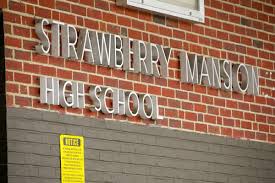
 Several APPS members, in response to requests from community members, attended a meeting at Strawberry Mansion High School  (SMHS) on Wednesday, March 28. About fifty people—including parents, educators and alumni—attended the meeting, facilitated by Eric Becoats, Assistant Superintendent in charge of the district’s Turnaround Network. Like many of those in attendance, APPS members found out about the meeting from a notice posted on social media two days before. The district posted no banner about the meeting on its website, nor was there was any mention of possible change at SMHS at recent SRC meetings. Rumors had spread, in the absence of definitive information from the school district, that Strawberry Mansion, as a comprehensive high school, would be closing at the end of this school year. Some had heard that other programs, possibly twilight school or alternative education programs for students with academic and/or behavioral issues, would be housed in the building.

Using barely readable power-points, Becoats read through some possible changes and the reasons the district is “phasing out” the existing educational program at SMHS. There will be no 9thgraders admitted in September 2018. The remaining students will complete their years and graduate from Mansion.  Starting in September 2018, Becoats said, neighborhood students could attend a newly added accelerated school in the building, but he gave no details about the program or who would oversee it. An evening program for overage students and adults may be added later. In September 2019, 9thgraders could then be admitted to a new “skills-based” high school in the building.  Becoats said that was only “under consideration”, to which a community member responded, “So new students will evict existing students.” Becoats claimed that there would be full staffing until the last class graduates, and that the remaining students would complete their years and graduate from Mansion, but did not specify how the school could maintain sufficient staff for a variety of programs with declining enrollment. Nor did he seem to have any idea how the students in the remaining grades would deal with decreases in student body and staff.  Becoats continued to deny that Strawberry Mansion High School is being closed, as if the existence of the building constitutes the essence of the actual high school.

Parents, community and neighborhood leaders expressed their frustration at both Becoats’ dismissive attitude and the district’s lack of community outreach prior to making their decision.  One community member asked: Are we in the planning stage or the implementation stage? Becoats admitted that the district is now in the implementation stage.

Click here to read the entire post.

Who–and What–Does the New School Board Represent?

Kenney and Hite
Mayor Kenney enters the press conference with Superintendent Hite to announce the new Philadelphia School Board.

By Deb Grill, Karel Kilimnik and Lisa Haver
April 4, 2018

APPS biographies of the nine members of the new Philadelphia School Board.

Unlike the other 500, Philadelphia is the only school district in Pennsylvania whose voters cannot elect a school board. We’ve had town halls, online surveys, and pronouncements from city politicians, but it all comes down to this:  The government officials who will decide the future of the city’s public schools, and who will control a $3 billion budget, have been chosen by one person, Mayor Kenney.  His decision has been based, in part, on the opinions of the thirteen people selected by him to be on the Nominating Panel. It has also been based on the wishes of the influential individuals, organizations and corporations who have lobbied him to represent their interests on the board. Two built-in lobbyists on the Nominating Panel, Stephanie Naidoff and Bonnie Camarda, are members of the board of the Philadelphia School Partnership, which funnels millions every year from private investors into schools of their choice for the programs of their choice, mostly charters.

All of the deliberations of the Panel were held in secret. None of the district’s stakeholders, or the city’s taxpayers, were able to express their opinions about any of the candidates, whether pro or con, or to raise concerns about possible conflicts of interest. APPS did everything we could, short of legal action, to open up this process. We sent letters to the Mayor and to the Panel, refuting the Mayor’s false assertion that the Panel could deliberate in Executive Session because it was discussing “personnel matters”, pointing out that the Panel was neither hiring nor appointing any personnel. We had several community groups sign a letter asking the mayor to obey the Sunshine Act. 

APPS members  Karel Kilimnik and Rich Migliore wrote an op-ed published in the  Philadelphia Inquirer decrying the lack of democracy and the mayor’s attempt to have the charter change include language that would allow him to remove school board members without any due process, which would have killed the possibility of having a truly independent board.

Lisa Haver also wrote an op-ed questioning whether trading in one unelected, unaccountable school board for another, under the banner of local control, could be considered progress.

APPS also researched all forty-five Panel nominees. Now that the final selection has been made, we are re-posting the profiles of those selected with updated information.  One thing that stands out in the Mayor’s selection: there are no known advocates for public education. Since no one could question the nominees, we have no idea whether, or how much, they are committed to defending public education. We don’t know whether they believe that privatization and charterization are solutions to the problem of under-resourced neighborhood schools. We don’t know what their stance is on using anonymous private donations to fund public and charter schools.


Also see:
Is the new school board diverse enough? | Philadelphia Public School Notebook – April 19, 2018


Following are some of the patterns and connections that we have observed, so far, among the board members:

District and Charter School Connections

Click here to see a preliminary analysis of the
District and Charter School Connections of the new School Board.

Ears on the SRC – March 22, 2018


Click the picture to view the video.

Supporters of public education speak before the March 22nd SRC

APPS member Ilene Poses at 0:00
(Click here to read the transcript of Ilene’s testimony)
APPS member Diane Payne at 3:16
(Click here to read the transcript of Diane’s testimony)
APPS member Lisa Haver at 6:15
SRC vote on Resolutions at 8:02


Ears on the SRC: March 22, 2018

by Diane Payne
April 2, 2018

 Present

Three of the remaining four commissioners were present for this special budget meeting of the SRC: Chair Wilkerson and Commissioners Richman and McGinley.  Farah Jimenez departed the position abruptly and without explanation in January leaving four commissioners; Governor Wolf said he will not appoint a replacement.  Commissioner Bill Green has assumed a laissez-faire attendance record since April 2017.  It is not uncommon for Green to be absent, come in late in time to vote on resolutions (often totaling millions of dollars), miss staff presentations and public speakers, or leave early and call in to vote.  This is now the seventh time he has been absent since April 2017.  In the waning months of this lame duck SRC, Green continues to exhibit a pattern of behavior that would not be acceptable in the students whose welfare he has been charged to oversee.

 Six members of APPS were present for this meeting; three spoke in defense of public education.  To see their testimony see the video at top of this page.

 Budget: Resolution SRC-1

Click here to read the rest of the post.

APPS Statement on Surprise Resignations and Replacements on SRC

SRC 3 3-15-18
The Philadelphia School Reform Commission: Chris McKinley, Bill Green, Estelle Richman, Joyce Wilkerson; Superintendent William Hite
The day after the schools closed for spring break, district stakeholders woke up to find out that major changes have taken place in the governance of the city’s public schools.

In a surprise move, two members of the SRC have resigned, and they have already been replaced by two people chosen by the mayor. The governor has already named the new chair. No mention of these changes was made at last week’s SRC meeting.These changes, planned and implemented without consultation of district stakeholders, serves to highlight the disenfranchisement of the people of the city when it comes to choosing those who make decisions on the future of the city’s public schools. The mayor expects the public to pay the bills, including another increase in property taxes, but to have no say in how the money is spent. The stakeholders and taxpayers, apparently, are expected to play the role of passive observers watching as the pieces are moved around the chessboard.

The SRC will be approving a $3 billion budget in the coming months just before its dissolution. This lame-duck Commission will be voting on that budget.

The mayor will be appointing a new school board next week. In violation of the PA Sunshine Act, there have been no public meetings at which the people of the city could weigh in, pro or con, on the candidates, or to raise concerns about possible conflicts.


Also see APPS in the news:
Two SRC members resign, opening path to a new board | Philadelpia Tribune – 3/29/18