Reckless Facilities Plan Will Devastate Philadelphia Communities

by Lisa Haver and Deborah Grill
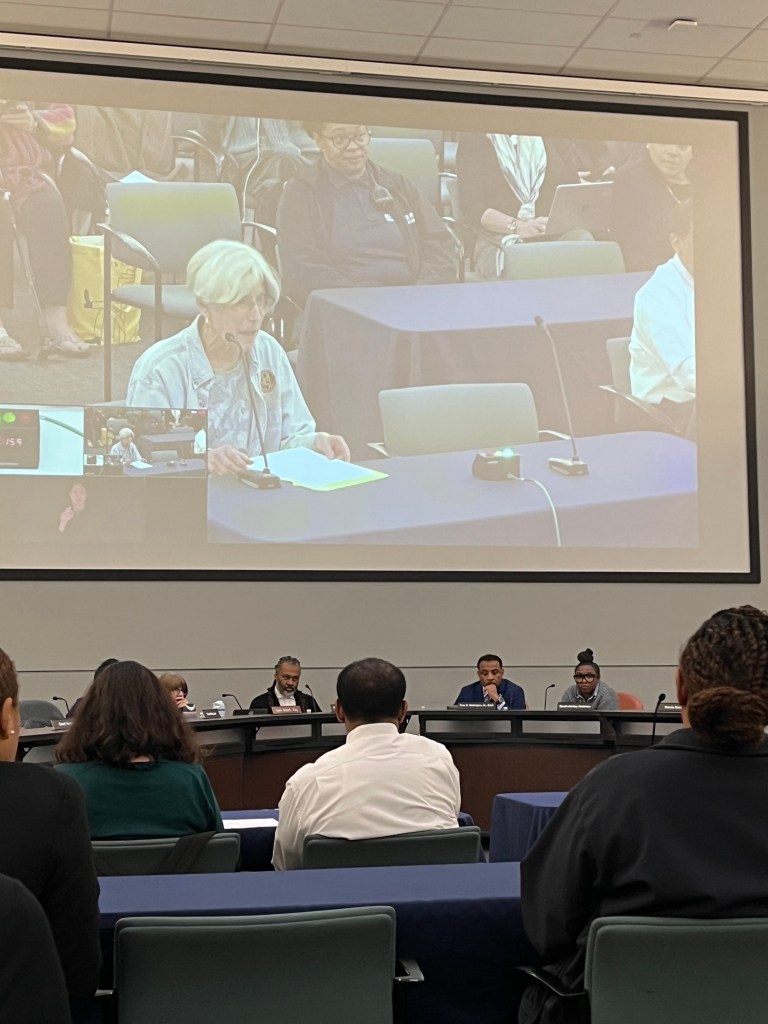
Moffet Elementary parent Katy Donoghue testifies at March 12 district town hall.
(Photo: Lisa Haver)

You didn’t answer my question.”
Parents, teachers, students, community members at district facilities meetings

‘This is not a budget issue.”
From the District’s  2024-25 facilities plan presentation

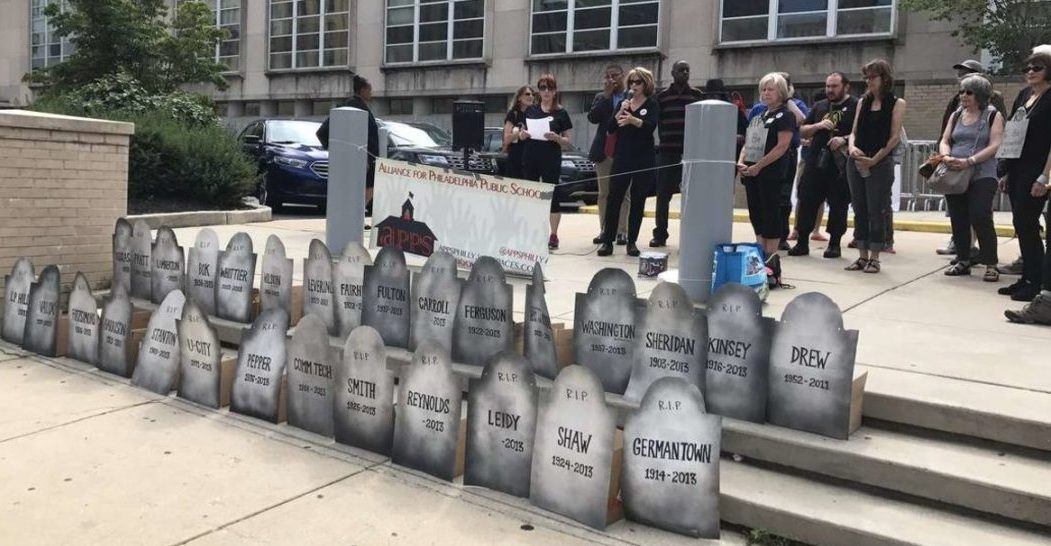
School District of Philadelphia Tony Watlington Sr. has released a $2.8 billion Facilities Master Plan that, if passed by the Board of Education, will have a devastating effect on communities in every part of the city. The latest draft of the plan, issued on February 27, recommends 18 permanent school closures, 12 co-locations, 8 buildings to be given to the city at no cost, grade band changes in 34 schools, 16 catchment areas redrawn affecting approximately 33 schools in over 20 zip codes, and modernization projects at 159 schools to begin in 2032. Schools targeted for closure are fighting to stay open. With a couple of exceptions, no meetings were held at schools facing grade conversions or catchment area changes. Most of those recommendations, in fact, were issued weeks after the original plan. 

There are no projected costs for any of the recommendations or modernization projects in the plan. 
The Watlington administration and its consultants have assembled a house of cards. If a middle school is built in South Philadelphia, then students would feed into certain high schools. If a school is built in Kensington, then the catchment maps would be redrawn for the three high schools in that neighborhood. If the district creates an honors program in one high school, the students who transfer to the school after theirs was closed might get into that program. And the one that the entire plan balances on: If the district receives more funding from the state and if the district raises funds from unnamed philanthropic sources, they might be able to make improvements to over 150 school buildings. At almost every meeting, board members implore the public to call their representatives in Harrisburg and ask them to fully fund public schools. Yet this plan assumes that Harrisburg will fund a large part of it.  How can the district base a comprehensive 10-year plan on imaginary funding?

Continue reading here
Board Must Protect Constitutional Rights of Public School Educators

Board of Education Action Meeting: December 4, 2025

by Lisa Haver

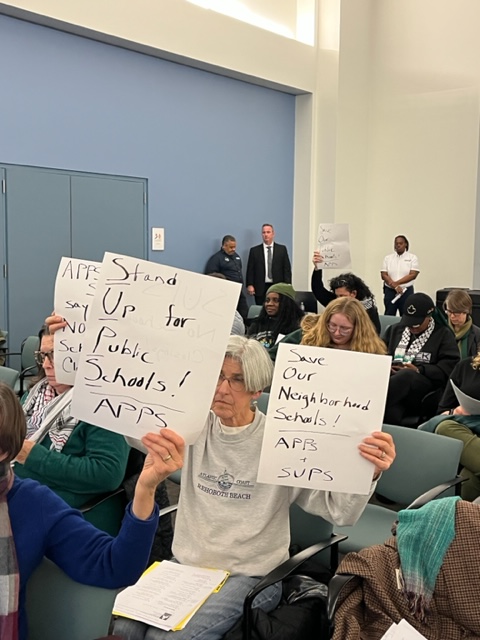
APPS members support Stand Up for Public Schools speakers.
(Photo: Lisa Haver)

The Board of Education says little of consequence. They create the illusion of deliberation, but most of what they say is directed not to members of the public but to the administration–not to question Superintendent Tony Watlington Sr. but to thank him and his staff for doing their jobs. At this action meeting, Board President Reginald Streater called on every board member for questions or comments after Watlington’s announcement of the new contract with members of the principals’ union (CASA). Except for Board Member Chou Wing-Lam, who asked one question, the rest simply echoed each others’ thanks to Watlington and his negotiating team. That took eleven minutes.  But real deliberation? Almost none. Prior to every action meeting, the board members agree to move most items into a “consent agenda” (likely a Sunshine Act violation), then take one vote–whether it’s for ten items or ninety–without any deliberation. At most action meetings, the entire process takes less than one minute. Streater calls this “efficiency. Parents, students, educators and community members who come to be heard and to get answers have never demanded “efficiency”. They ask the board and the administration to answer them and to take the time to address issues and solve problems that affect their children. The board is the governing body of the School District of Philadelphia. Their constituents include every person in the city–who deserve answers from board members. 

Continue reading here for December 4, 2025 action meeting.

Board Must Be Honest with Constituents

November 20, 2025: Board Action Meeting

by Lisa Haver

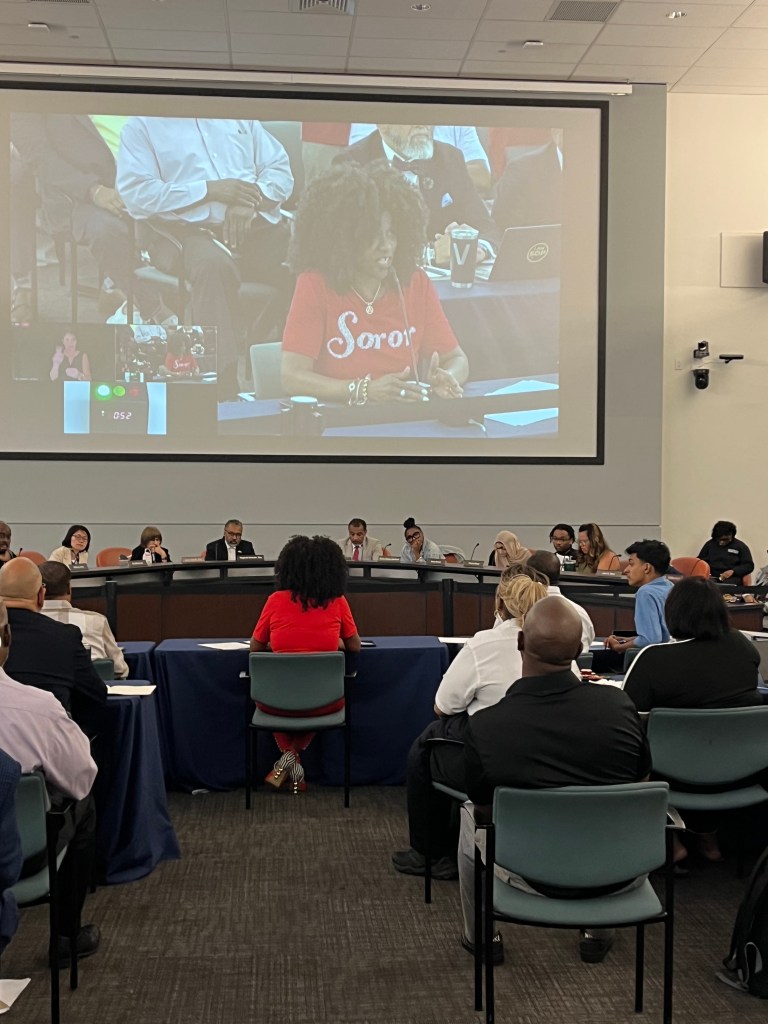
APPS member Deborah Grill testifies at November board meeting. (Photo: Lisa Haver)

The members of the Board of Education, as the governing body of the School District of Philadelphia, must be honest with their constituents. They must direct security staff at 440 not to let some people into the auditorium before others, then lie about whether they are going to bar people who are not on the speaker list. Board President Reginald Streater must stop announcing that people “blocking” the center aisle are in violation of the fire code. APPS challenged him months ago to cite the relevant provision in the city fire code; he could not,  because there is none. The board should replace the almost 100 seats they removed from the auditorium, then they could no longer have their security claim that the room is “at capacity”. The board should stop holding long recesses during the meeting and   “tech” issues. Most important: don’t promise the public for over a year that the facilities plan will be released in November, then go back on it when that time comes. Superintendent Tony Watlington Sr. should not write in district presentations in 2024 that closing schools is not because of budget issues, then the next year imply that long-term underfunding of the district is the reason. The stakeholders of the district deserve the truth.

Continue reading here about November 20, 2025 Board of Education Meeting.

Public School Board Bars Public School Parents, Educators from Speaking and Attending

Board of Education Action Meeting: June 26, 2025

by Lisa Haver

“The Party told you to reject the evidence of your eyes and ears. It was their final, most essential command.” George Orwell, 1984

This image has an empty alt attribute; its file name is img_4150.jpeg
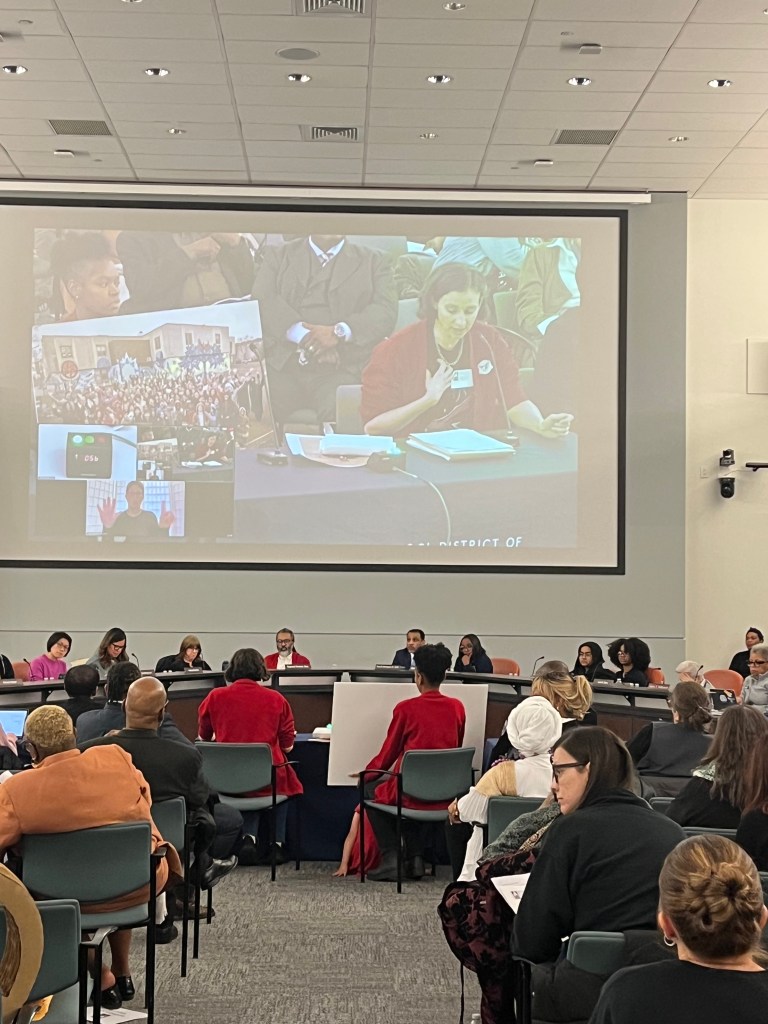
CASA President Robin Cooper testifies at June 26 action meeting. (Photo: Lisa Haver)

A governing body convenes an action meeting. They listen to a presentation from the director of a department they oversee. The president of the board raises each issue, and members of the board comment and question. The president then calls on each member to give their position. He tallies the responses, then directs the department chief to carry out the action that the majority of the board voted for. Except when the Philadelphian Board of Education does this, according to Board President Reginald Streater, it’s not voting. True, the terms “motion”,  “roll call” , and “vote” were not used. But the board came to decisions on the futures of six charter schools in the renewal cohort after listening to Charter Schools Chief Peng Chao and deliberating on the information presented.  Streater called on each member to state their position on whether the school would be granted a 5-year renewal, a 1-year renewal, or no renewal. He counted their responses, then directed Chao on what type of document to draw up. How is that not voting? Every time APPS members called out that the board was voting, even though none of those charter items had been placed on the agenda, Streater insisted they were not.  The dictionary definition of the word “vote”: a formal indication of a choice between two or more candidates or courses of action, expressed typically through a ballot or a show of hands or by voice. The public’s faith in this board continues to erode because of its lack of transparency and public engagement, along with its reluctance to hold the administration accountable. Now they want to tell people not to believe what they see and hear with their own eyes and ears. 

Continue reading here