Board Violates Sunshine Act, Civil Rights of Constituents

Board of Education Action Meeting: October 24, 2024

by Lisa Haver
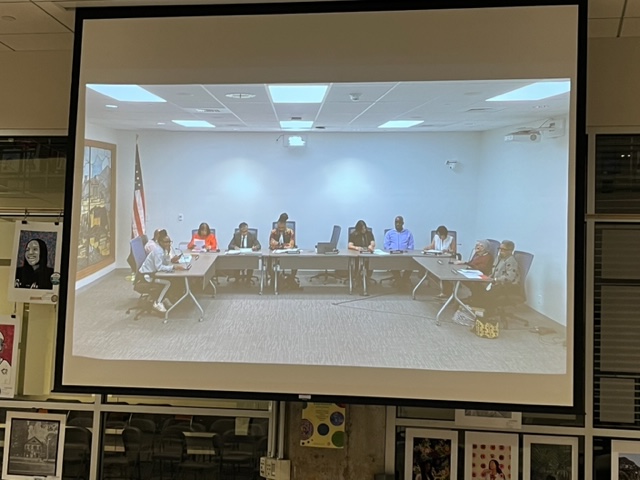
Board votes on official items after locking public out of meeting (Photo: Lisa Haver)

After all of the public speakers had testified, and before the voting on action items, about twenty-five members of the audience went to the front of the room, held up signs and demanded the reinstatement of Keziah Ridgeway to her teaching position at Northeast High School.  Less than a minute after the protestors stood, board members and Superintendent Tony Watlington left the room without comment or explanation. During this time, Lisa Haver went down to the board’s office on the first floor, knowing that they would do what they did five years ago when students protested their vote on metal detectors: scurry down to their committee room, accompanied by security, and lock the door.APPS members demanded entry to the meeting then, and we demanded it this time. Haver knocked on the door as the board members entered the committee room; she continued to knock for the entirety of the secret meeting. Several district security and Philadelphia police officers ordered her to move, even threatening arrest, but she refused to move. Eventually they backed off. Board members could be heard on hot mics over the livestream commenting about Haver: “Why is she knocking?” and “Is she taking pictures?” In their barricaded room, with no public allowed, the board voted to approve over $94 million in contracts to various vendors. They also voted unanimously to grant the KOZ (Keystone Opportunity Zone) tax abatement extensions to developers of properties at the Navy Yard and the massive Hilco/Bellwether site. APPS had intended to state a formal objection to the KOZ votes under the state’s Sunshine Act as the board did not disclose in its item how much the KOZs would be costing the district. None of the votes taken in that private meeting is legitimate.  Ilene Poses contributed to this report.

Continue reading about the board’s secret meeting here.
Board Carries on Legacy of the SRC

Board of Education Meeting: September 19, 2024

by Lisa Haver

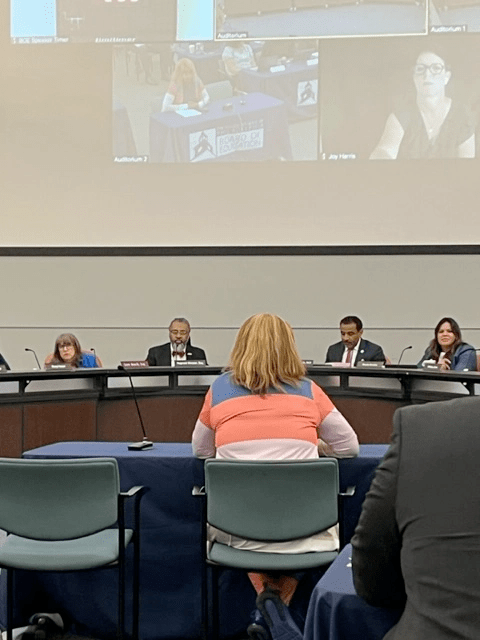
CASA President Dr. Robin Cooper testifies in defense of Philadelphia’s public schools. (Photo: Lisa Haver)

It was freezing in the auditorium during the September action meeting, so cold that they actually brought blankets out for board members. Was it an air conditioning malfunction–or the icy breath of the SRC past?

Board Begins Process of Closing Neighborhood  Schools
Following the legacy of the School Reform Commission, the Board of Education appointed by Mayor Cherelle Parker will be closing more neighborhood schools. No clear reasons were given by Superintendent Tony Watlington, Board President Reginald Streater, or any of the other board members, most of whom remained mute as they do in most meetings. Streater announced the board’s intention to close schools in an Inquirer story published the day before the meeting, but he avoided saying that directly in his remarks.  He used the euphemism “co-location” at one point, but people know that if you “combine” two schools that means you closed one of them.  We heard–from the president of the board that has enacted speaker suppression policies that keep people off of the speaker list and out of the auditorium–promises of meaningful community engagement. Streater said more than once that the board did not want to rely on outside consultants–just before passing a $4.5 million item to hire a consulting firm to begin the process.  We heard assurances that the board will be carrying on robust discussions about the Facilities Plan. Yet eight members had no questions for Watlington after his facilities plan presentation. Only one board member, ChouWing Lam, questioned the price tag of the $4.5 billion consulting contract (Lam later voted for the contract).  Any plan to close schools is a betrayal of the people of Philadelphia. The parents, students, educators, and community members who fought to end the rule of the state-controlled SRC believed that bringing back local control would change the spending priorities of the district and make education better for the city’s children. What we got is a board that protects the financial interests of charter investors and administrators, and now says we can’t afford to keep neighborhood schools open.

Continue reading about September 19, 2024 board action meeting here.

Board Rejects New Charter Application

Board of Education Action Meeting: February 29, 2024
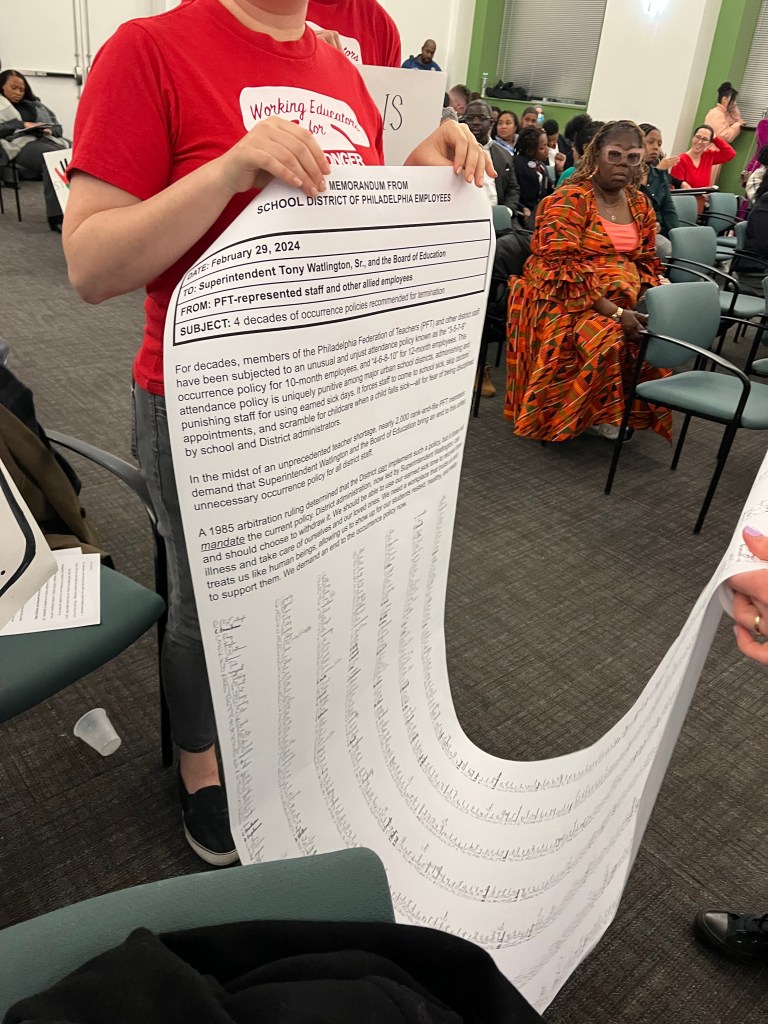
Members of the Caucus of Working Educators of the PFT present their petition for the end of the punitive 3-5-7-9 absence policy to the Board of Education (Photo by Lisa Haver)

by Lisa Haver

In a 6-3 vote, the Board of Education voted to deny Global Leadership Academy’s application for a charter high school. Board members cited numerous reasons for their votes, including the substandard proposed curriculum and the questionable affiliations with charter management organizations and legal firms. Two board members cited plummeting academic scores at GLA’s Renaissance charter, Huey Elementary. President Reginald Streater cited GLA’s failure to remedy an issue that the board cited in its previous denial–the organization’s claims that it was GLA but not really part of GLA.  As APPS’ Deb Grill said in her report about GLA CEO Naomi Johnson-Booker’s claim of non-affiliation: “That might be true if one doesn’t count the name, the academic model, the relationship with business consultants Charter Choices, and her position as CEO of GLACS.”  Grill, in her testimony, reminded the board that over half of the city’s charter schools are under-enrolled, thus there is no need for any new charter school.

The consideration of even one application for a new charter costs the district dearly in time and money. Two hearings preceded this decision. The Charter School Office must conduct an in-depth evaluation of the application and review hundreds of pages of attachments. CSO Director Peng Chao gives presentations to the board at several points in the 6-month process. At this meeting, Chao gave another extensive presentation on the GLA application, followed by a lengthy question-and -answer session from the board. In addition, the board’s deliberations just before the vote took over half an hour, and fourteen of the thirty approved speakers addressed this one topic. Three elected officials spoke in support of the GLA application.

Continue reading