The problem with the District’s philanthropic fund for literacy

564686367677841877-the-fund-kickoff.0.386.3264.1632.full

by Lisa Haver

April 12, 2015

Reprinted from the Philadelphia Public School Notebook.

The state takeover of the School District of Philadelphia more than 15 years ago brought a new set of problems, not the least being the failure of the School Reform Commission — and a succession of highly paid superintendents and CEOs — to fulfill its stated purpose of restoring the District’s financial stability.

At the same time, the public’s ability to be heard on these and other issues has been squelched by growing corporate influence, as grants from outside organizations, including the Gates Foundation, the Philadelphia School Partnership, the William Penn Foundation, and others, have come with mandates for school closures, charter expansion, and weakening of some collective bargaining rights such as longstanding seniority protections. The Great Schools Compact Committee, which oversaw distribution of the Gates money, acted as a shadow school board.

The revival of the Fund for the School District of Philadelphia appears to be an extension of that model, in which private money has a growing influence on a public institution. Established in 2003 as a fundraising arm of the District, it later collected private donations to buy out former Superintendent Arlene Ackerman’s contract, although the District ultimately picked up the bill. Its 17-member board is made up of representatives from banking, energy, cable, financial investment, and consulting businesses — and two educators. “Investors” include GlaxoSmithKline, Wells Fargo, and the Barra, Carnegie and Lenfest Foundations.

Executive Director Donna Frisby-Greenwood said in a NewsWorks interview in January that “the Fund is committed to transparency.” But when I called to ask when the next board meeting would be held, Frisby-Greenwood told me “those meetings are private.”

The fund’s website says that the board will be working with Superintendent William Hite to “help set funding priorities … toward the needs of Philadelphia’s public schools to improve educational services and academic achievement.” But it is not the role of a handful of people from one stratum of society to make those decisions. Giving corporations and foundations a larger voice in decisions on education cedes control of the democratic process to those with the highest net worth. The rest of us get three minutes a month at the SRC meeting.

One of the fund’s initiatives is to build “classroom libraries” in the lower grades to promote early literacy. Countless studies show that having a school library with research facilities, staffed by a certified librarian – not just a small collection of books in each classroom – makes significant improvements in student learning.  The fund’s spending priorities, in this case, send the message that our children should settle for a lesser version of a school library instead of the real thing. No one should be setting those kinds of low expectations for our students.

Schools have long been recipients of donations from local businesses, some of whom develop a relationship with the students and faculty.  But having this kind of funding become institutionalized places our children in the role of charity cases, who can only receive a decent education if they have demonstrated their worthiness. The fund’s website may tell us that “the private donations that we contribute to the District do not supplant government monies,” but it does send the message that someone is here to pick up the slack when Harrisburg comes up short year after year.

Wealthy individuals and corporations, and their lobbyists, have significant influence in  Harrisburg. They should use that power to speak in one voice for a permanent fair funding formula so that principals and teachers don’t have to beg for what their schools deserve.

Mayor Kenney, who hosted a $5,000-a-person inaugural party to benefit the fund, should not place his stamp of approval on an organization that shuts out the people he has vowed to represent.  “I trust these folks and know where they stand on the issues and trust them for raising money for them,” he said of the fund’s board. But the public does not know those who staff the fund. The people, as citizens and taxpayers, are the fund for the School District of Philadelphia. That ensures us an equal place at the table when decisions about our children’s futures are made.

APPS members testimony to the Philadelphia School Reform Commission – March 17, 2016.

SRC 3-17-16 #1

On March 17th, 2016 the Philadelphia School Reform Commission held its monthly meeting.

This is the testimony of members of the Alliance for Philadelphia Public Schools at this meeting.

All eight videos can be viewed here. (Click on the second blue dot for the second page.) Testimony is in the order of appearance.

Click on the pictures below to view the individual video.


Diane Payne SRC 3-17-16

Video of APPS member Diane Payne testifying at the Philadelphia School Reform Commission meeting – March 17, 2016.

The transcript of Diane’s testimony and related links.
Note: Due to technical difficulties, the beginning of Diane’s testimony is missing in the video. See her transcript for her full statement.


Deborah Grill SRC testimony 3-17-16

Video of APPS member Deborah Grill testifying at the Philadelphia School Reform Commission meeting – March 17, 2016.

The transcript of Debbie’s testimony.


Karel Kilimnick SRC testimony 3-17-16

Video of APPS member Karel Kilimnik testifying at the Philadelphia School Reform Commission meeting – March 17, 2016.

The transcript of Karel’s testimony.


Carol Heinsdorf SRC testimony 3-17-16

Video of APPS member Carol Heinsdorf testifying at the Philadelphia School Reform Commission meeting – March 17, 2016.

The transcript of Carol’s testimony.


Lisa Haver SRC 3-17-16

Video of APPS member Lisa Haver testifying at the Philadelphia School Reform Commission meeting – March 17, 2016.


Barbara Dowdall SRC 3-17-16

Video of APPS member Barbara Dowdall testifying at the Philadelphia School Reform Commission meeting – March 17, 2016.

The transcript of Barbara’s testimony and added footnotes.


Kristen Luebert SRC 3-17-16

Video of APPS member Kristin Luebbert testifying at the Philadelphia School Reform Commission meeting – March 17, 2016.

The transcript of Kristin’s testimony.


Robin Lowry SRC 3-17-16

Video of APPS member Robin Lowry testifying at the Philadelphia School Reform Commission meeting – March 17, 2016.


Eyes on the SRC: March 17, 2016

SRC 12-17-15 #2

by Karel Kilimnik
March 12, 2016

Welcome to the Eighth Edition of Eyes on the SRC.

There are no resolutions directly pertaining to the district’s most recent assault on public education, namely the Hite administration’s placement of four more neighborhood schools into his “Turnaround Network”. This month, we simply follow the continual erosion of school staff and resources and the continued outsourcing of services.

At the Monday February 29 hearing of the Education Committee of City Council, Dr. Hite announced that he would be creating more Turnaround Schools by the end of the week. That Friday, the names of the four elementary schools to be “turned around” were released: Roosevelt, Munoz-Marin, S W Mitchell, and Rhodes. Principals and teachers would have to reapply for their jobs, and the district could eliminate the entire staff if it chose to. A series of community meetings were scheduled for the following week, the first one, at Roosevelt, to be held the following Monday—giving the parents and community minimal notification (shades of the October 2014 SRC last-minute/early morning meeting to cancel the PFT contract). APPS members have attended all four meetings, and the level of anger and frustration voiced by parents and community members is unprecedented. These schools have all been though some kind of conversion—or two—in the past five to ten years. Parents at every school said that they would fight to keep their teachers. District staff has been unable, or unwilling, to answer basic questions such as where the funding will come from, how the conversion would take place, why the decision was made before the community meetings, and why it is necessary to get rid of teachers and principals.


Next SRC meeting: Thursday March 17, 5:30 PM. To register to speak call 215.400.4180 by 4:30 March 16. It’s best to identify yourself as a teacher, parent, or community member as the rules stipulate that only “one member of an organization can register to speak.”(There is another SRC Action Meeting on March 24.)

Plan to attend the rally in support of all schools fighting any kind of turnaround, including the four schools just targeted and the three schools previously named as Renaissance schools—Cooke, Huey, and Wister:
Thursday March 17 at 4:15 on the steps of 440 (before the SRC meeting).


Click here to read the APPS analysis of proposed resolutions to be voted on at the March 17, 2016 meeting of the Philadelphia School Reform Commission.


APPS members testimony before the Education Committee of the Philadelphia City Council – February 29, 2016

All four videos are located here.

To see individual videos click on their picture below.

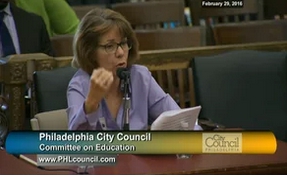
Lisa Haver - City Council - 2-29-16

Video of APPS member Lisa Haver testifying at the Education Committee of the Philadelphia City Council – February 29, 2016.

The full transcript of Lisa’s testimony.


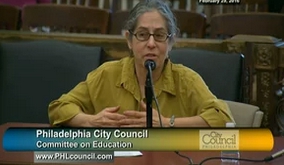
Karel Kilimnik City Council 2-29-16

Video of APPS member Karel Kilimnik testifying at Education Committee of the Philadelphia City Council – February 29, 2016.

The full transcript of Karel’s testimony.


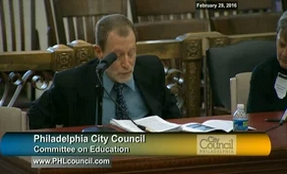
Coleman Poses - City Council - 2-29-16

Video of APPS member Coleman Poses testifying at the Education Committee of the Philadelphia City Council – February 29, 2016.

The full transcript of Coleman’s testimony.


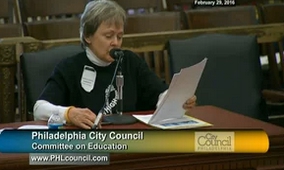
Barbara McDowell City Council 2-29-26

Video of APPS member Barbara McDowell testifying at the Education Committee of the Philadelphia City Council – February 18, 2016.

The full transcript of Barbara’s testimony.