
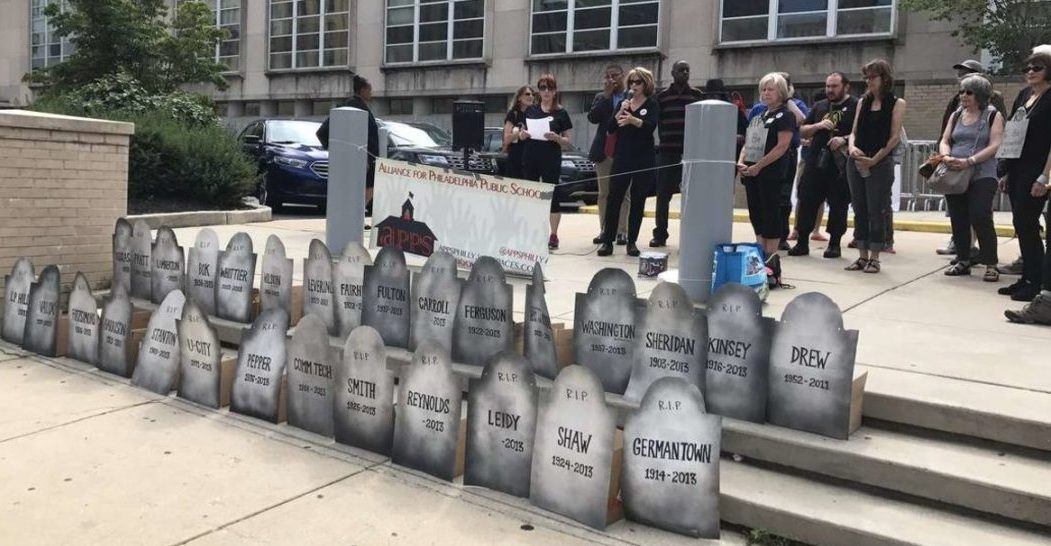
by Alliance for Philadelphia Public Schools and Philly Power Research
The privatization of public schools has never been about improving education. The goal was to create opportunities for businesses while diminishing the political power of parents, educators and the community. In that respect, the expansion of charter schools in Philadelphia has been an undeniable success.
The privatization of public schools, though a reform agenda funded by wealthy corporations, individuals, and foundations, has been devastating to school districts across the country. The school privatization movement has been funded by right-wing billionaires including Jeffrey Yass, the richest person in Pennsylvania; it is a major plank in the Republican party platform. The strategies and methods of the corporate reform agenda have been incorporated into both the curricula and pedagogy of both public and charter schools, including standardized testing of children in every grade after third and the requisite test prep classes that edges out creative teaching and learning. Students are judged on how well they can take a standardized multiple-choice test, not on creative thinking and problem-solving. Schools whose students score lower, for a number of reasons including poverty, inadequate resources and understaffing, are labeled “failing”. Schools in underserved neighborhoods have found themselves on the chopping block, either handed over to a charter company in a hostile takeover or closed for good.
Charter schools were sold as the answer to struggling schools. They promised to improve student achievement. Some investors even contended that more charter schools would lead to the elimination of poverty and violence.
None of that has come to pass. By every measure, including those instituted to justify the creation of charter schools—data-driven education—charter schools have failed to keep the promises they made. The median Philadelphia charter school in 2022-2023 had a lower percentage of students who scored at least proficient in PSSA math than the median Philadelphia public school. (1) Charter schools excuse their failure to meet standards by saying they are educating children in underserved neighborhoods, despite the fact that they sold themselves as a means to educate those very children.
To read more about how charter companies have profited, continue here.
 Alliance for Philadelphia Public Schools