Do Communities Truly Have A Say in the Future of Priority Schools?

src

by Lisa Haver

In mid-September, just weeks after the start of the new school year, Superintendent William Hite announced this year’s list of schools targeted for some type of turnaround through his “System of Great Schools”: Rhoads Elementary, Steel Elementary, Feltonville School of Arts and Sciences, Penn Treaty Middle/High School, Gideon Elementary, and Wagner Middle School. This is the second year the district has engaged in a months-long process of data collection, choice of schools, community hearings, in-school focus groups, and determination of the fate of these schools. The district has again contracted with Cambridge Education for consulting services, this year for $100,000, to conduct focus groups with teachers and students. Temple University has been hired for $70,000 to conduct the public outreach and facilitate meetings.

Last year, eleven schools were designated Priority Schools. After the hearing and focus group period, three schools forced out principals and most faculty after being placed in the district Turnaround Network. Two other schools developed internal turnaround plans which mandated that teachers reapply for their jobs.

Some schools, including Harding Middle, have put into place an all-blended learning curriculum in which students spend a significant amount of time learning on the computer rather than interacting with the teacher and other students. The district hired ISA (Institute for Student Achievement) to be embedded year-round for intensive professional development and teacher coaching at Fels, Overbrook, and Kensington Health Sciences Academy high schools. [The resolution approves a contract with Education Testing Service (ETS) as ISA is now a subsidiary of ETS.]

The district also contracted with Jounce Partners (see Resolution B23) for similar intervention at McDaniel Elementary.

The plans implemented at many schools ignored the stated wishes of the parents who attended the community meetings. At both Blankenburg and KHSA, principals were removed over the objection of the parents and educators. At none of the hearings we attended did parents call for the reconstitution of faculty. No district representative mentioned the contracting of outside consulting companies.

Community members who attended last year’s meetings are experiencing a strong sense of déjà vu at this year’s meetings. The district is using the same Power Point presentation, with the same disclaimer that the schools are not performing “despite investments” made in them. Again, the district does not explain what the options involve unless specifically asked by community members. The district has attempted to place the onus on the public to give them information without any explanation of what could happen to the school.

One difference between this year and last is the haste in getting public participants into separate “breakout” rooms—even before any real information is provided. People at several meetings refused to move into those rooms until questions were answered by the district. At the second round of meetings, there was no general auditorium meeting; people were directed immediately into separate rooms. It seemed to be a deliberate strategy to keep educators, parents and community members from forming alliances. There were reports that teachers at three of the schools were told by principals not to attend community meetings.

As defenders of public education, APPS members are attending community meetings and posting reports from each school.

We will be updating information on the Priority Schools as the meetings continue and when Dr. Hite makes his decision.

APPS reports on Priority School meetings (in progress)

Gideon Elementary School

Penn Treaty Middle/High School

Rhoads Elementary School

Wagner Middle School


Defenders of public education testify at the October 19th meeting of the Philadelphia School Reform Commission

SRC 10-19-17

Click on the picture to view the video of selected speakers defending public education at the October 19, 2017 meeting of the Philadelphia School Reform Commission. Speakers are listed in order of appearance before the SRC.

At this meeting the SRC announced they are exploring the dissolution of the SRC. See the video at 0:36. Also see:

What comes after the SRC? City likely to move soon on new Philly school board | Philadelphia Inquirer – October 20, 2017


Eyes on the SRC: October 19, 2017

S1190010

by Karel Kilimnik

As we contemplate this new round of increasingly familiar resolutions, several things stand out.  One is the continued funding of vendors of questionable quality to provide professional development, even after the recently approved PFT contract was characterized as “fiscally irresponsible” by members of the SRC.  Another is the need for a fair and equitable funding formula so that schools do not have to rely on the largesse of foundations, non-profits, and universities to provide necessary resources and fund programs of their choosing. The voices of the district’s true stakeholders—students, educators, parents, community members—are diminished by those of private entities who have no obligation to be transparent or accountable to the public. Public schools are not charities.  They must be supported by public money.

October’s resolutions demonstrate the growing influence of both Drexel and Temple universities in the district’s business. Two of the five SRC commissioners are employed by Temple. Temple was awarded a $70, 000 contract by the SRC to facilitate the community outreach component of Dr. Hite’s latest Priority Schools process currently underway. Temple has also acquired a $2.7 million dollar federal grant dealing with ELLs (B1) as well as managing a Music Education Project (B5). Drexel expands its involvement with the Powel School (A6) that raises the question of resources allocated within a certain zip code. The “Hunger Games” continue as schools scramble for resources that should be mandated and supported by the district. More professional development money lines the pockets of vendors such as Carnegie Learning (B16), again reinforcing the message that the problem is ineffective teaching and not the dearth of resources provided to struggling schools.

 What If…?

The 3.5 million raised by the Fund of the Philadelphia School District was used to bring back Certified Librarians instead of “classroom libraries”.  A Certified School Librarian works with every child in a school, not just students who have classroom libraries. They get to know the child over a period of years and guide students with research skills, a wide array of books both fiction and non-fiction, and developing an analytical perspective. 

Next SRC meetings: Thursday October 19 at 4:30 PM; Thursday November 16 at 4:30 PM.  Call 215 400 4180 by 3p.m. the day before in order to register to speak.  Please consider attending even if you are not speaking.

Click here to read the entire post.

Ears on the SRC: September 14, 2017

S1190010

by Diane Payne
September 25, 2017

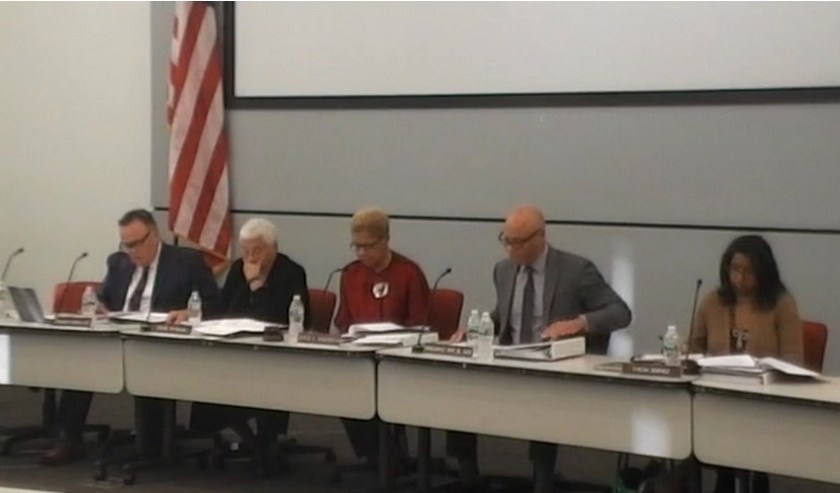
Chair Joyce Wilkerson and Commissioners Farah Jimenez, Chris McGinley and Estelle Richman were present for the entire meeting.  Commissioner Green was absent for the first two hours; he arrived at 6:45 for a meeting that started at 4:30, without explanation, when there were four speakers left. Green was absent during the testimony of forty-two speakers,  Superintendent Hite’s remarks,  the Policy Committee report from Dr. McGinley, and the presentation from Student Services Director Karen Lynch on the school selection process. He did, however, vote on all of the resolutions.

Before the vote on resolutions, APPS’ Lisa Haver stood and approached the front table, asking Chair Wilkerson:  Can you please read the rules concerning Commissioners voting after missing most of the meeting?  How can Commissioner Green miss the entire proceeding, arrive at the conclusion of the meeting, and be allowed to vote?  Although those questions were addressed to the Chair,  Green asked Miles Shore, Interim Chief of the district’s Office of General Counsel, to cite the rules about when Commissioners can vote on resolutions.  Shore stated that since Green was present he was entitled to vote.  Shore did not cite any policy number when giving this opinion.

Green also missed most of the SRC Action Meetings on April 20 and May 1 of this year.  He did not hear the majority of the public speakers, the staff presentations or Superintendent Hite’s remarks–yet he still voted.  As Haver said, Green personifies the SRC’s disregard for the public they are entrusted to serve. Green missed most of the April 27 2017 and May 1 2017 meetings also.

APPS again calls on Chair Wilkerson to address this issue. (See timestamp 1:58:00 in this link.) If Green cannot serve in a responsible manner, he should resign.

Sixteen members of APPS were present for this meeting; fourteen testified.

[To view their testimony, please go to APPSphilly.net.]

Our City Our Schools: SRC Must Go

Click here to read the rest of the post.