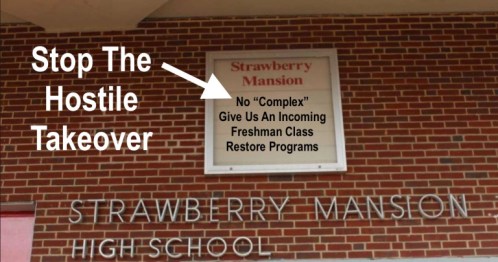
Why does Philadelphia’s Strawberry Mansion High School only enroll 235 out of 2,267 eligible students?

The following article was published by the Philadelphia Public School Notebook.
Due to space limitations the Notebook article was limited to 800 words.
Below is the full 1217 word version of the post.

strawberry-mansion

by Ken Derstine
May 8, 2018

At the School Reform Commission Meeting on April 26th, Philadelphia School Superintendent William Hite stated that of 2267 students in its catchment area only 235 students are enrolled in the Strawberry Mansion High School. His theme echoed a flyer the School District has circulated in the Strawberry Mansion community “Envisioning the Future of Strawberry Mansion High School”. The premise is that the Strawberry Mansion community is not supporting the comprehensive High School and therefore it must be phased out and replaced with a yet to be defined “Education Complex”.

The very first paragraph of the flyer is titled “Strawberry Mansion is NOT closing.” Apparently this is to reassure the community that Strawberry Mansion will not become an abandoned building, thereby contributing to a downward spiral like so many seen in so many low-income communities that have lost their community school, but, after it has been emptied of students and community control, it will be replaced with such corporate entities such as what Hite called in his SRC statement the Energy Performance Pilot School. (Note the corporate company Hite keeps to bring this about.)

The next claim is that current students will graduate from Strawberry Mansion. The District has already announced that there will be no ninth grade next year so that is not true for all students since what would have been the ninth graders will not graduate from Strawberry Mansion.

Click here to read the entire post.

APPS News 2018

APPS-Facebook-Banner-8-18

by Karel Kilimnik
May 7, 2018

Lame-Duck SRC Continues Spending Spree

The lame-duck SRC, moving towards its final day on June 30th, continues to hold fast to its worst practices of lack of transparency and public notification.  After several emails from APPS to SRC Commissioners, the Resolution List for the April 19thmeeting finally appeared on the district website on April 12.  According to the negotiated, court-ordered settlement between the SRC and APPS on the district’s pattern of violations of the PA Sunshine Act, Resolutions must be posted at least 14 days before the meeting. It is truly baffling as to why this occurred for this particular meeting as this was posted: The heading on the Description simply states:  “This meeting of the School Reform Commission is a Budget Hearing for the purpose of hearing public comment on the FY19 Budgets. There are no action items. The School Reform Commission is scheduled to vote on the FY19 Budget at its Action Meeting on May 24, 2018.”  We expect the incoming School Board to do a better job of informing the public without having to be reminded.

As Diane Payne reportedin the April 26 edition of Ears on the SRC, “Part-Time Commissioner” Bill Green arrived an hour and a half after the meeting began.  Despite missing staff presentations on the two charters up for a vote (Eastern University and Franklin Towne Middle CS), as well as almost all public speakers, Green voted on all resolutions, including one to approve the deeply flawed Franklin Towne Middle Charter School’s “revised” application. Despite the Charter Schools Office report citing almost thirty instances of FTCMS failing to address concerns in the original evaluation, and despite CSO Director DawnLynne Kacer stating that there were few “substantial” differences in the revised application, the SRC voted 3-1 to approve “with conditions”, with Commissioner Marge Neff voting to deny. The actual revision came from the SRC, who took it upon themselves to come up with almost twenty conditions, most of which were not read into the record and were not revealed to the public until the day after the meeting.

What none of the commissioners ever told the public was WHY they felt the need to go to such lengths to approve this new charter. It seems they are sending a message to other charter applicants: Denied at the first charter school application hearing? No problem. Submit a barely modified revised application and you can count on us to approve, with no justification or explanation, and guarantee your CEO and investors years of funding.  So far, Philadelphia Hebrew Charter and APM Charter have submitted revised applications to the SRC; they will probably be voted on in May.

Strawberry Mansion High School Supporters Fight Back

Click here to read the rest of the post.

Should the rich rule the schools in Philadelphia and beyond?

rich high school

The following column appeared in the Philadelphia Inquirer on April 20, 2018.

The story of how one wealthy man engaged in secret negotiations with officials to impose his will on one suburban high school became front-page news for days. Commentaries expressed outrage about the district’s rushed vote to rename Abington Senior High School in exchange for a $25 million gift from billionaire businessman Stephen Schwarzman, along with several other conditions,  including changes in curriculum and technology.  “Someone coming in with a lot of money can have a whole lot of influence over a public school,” warned one parent at a subsequent school board meeting. One Inquirer columnist expressed uneasiness  “that public schools could become beggars at the table of the uber-rich.”

To these suburban parents and pundits, we say: Welcome to our world.

In November 2011, the state-imposed School Reform Commission (SRC), absent any public deliberation, approved a multimillion-dollar grant from the Bill and Melinda Gates Foundation. In return, the SRC agreed to several conditions, including yearly charter expansion, implementation of Common Core standards, more school “choice” and testing, and permanent school closures. No one elected Bill Gates, typically portrayed in the media as just a very generous rich guy, to make decisions about Philadelphia’s public schools. But his mandates have had devastating and lasting effects on the district, much more than renaming one school.

Abington residents were shocked to learn of the district’s covert establishment of a foundation that would make decisions, rather than the elected school board, about how to spend money from donors. Here in Philadelphia, the Gates Compact conferred authority upon the Philadelphia School Partnership (PSP) “to provide funding …to low-performing or developing schools.” PSP has since raised tens of millions from a stable of wealthy donors; most has gone to charter schools, in keeping with Gates’ pro-privatization ideology.

Read more: Public Eduction shouldn’t have to rely on private money

PSP’s influence has grown in the last seven years: the group now funds and operates teacher and principal training programs, oversees a website rating all Philadelphia schools, and holds the district’s yearly high school fair. PSP’s money, like Schwarzman’s, always comes with strings attached, whether that means changing a school’s curriculum or a complete overhaul of faculty and staff, as its 2014 grant to two North Philadelphia schools mandated.

Meetings of the PSP board, where decisions about funding, curriculum, and staff training of public schools are made, are closed to the public.   This board, composed mostly of wealthy suburban businesspeople, often has more influence over city public schools than the residents do.

This practice of ceding public decisions to private investors on a large scale first reared its head in 2001, when Philadelphia came dangerously close to privatizing the entire district and handing over the reins to the for-profit Edison Schools founded by media mogul Chris Whittle.

>> Read more: Many public institutions, like libraries, are funded by private money, but caution is key 

Gates, whose Compact has been adopted in several other cities, including Baltimore, Boston, Chicago, Denver, Nashville, and New Orleans, is just one member of what education writer Diane Ravitch calls the “Billionaires Boys Club” of corporate education reformers. Real estate developer Eli Broad is using his wealth and political power to stave off community opposition to his push to charter-ize half of Los Angeles’ public schools. The family of Secretary of Education Betsy DeVos, heirs to the Amway fortune, have used their billions to privatize public education through the unregulated proliferation of for-profit charters in Detroit and other cities throughout Michigan. Facebook founder Mark Zuckerberg gave $100 million toward then-Gov. Chris Christie’s 2010 plan to transfer Newark students from neighborhood schools to charters. Newark residents, who learned about this massive cash infusion when it was announced on Oprah, had never been consulted about what they wanted in the “One Newark” plan.

Abington residents were justifiably angry about the board’s intention to rush through a vote without full public disclosure.

Like the opioid crisis, it seems to have taken a less urban and more middle-class population to alter the media’s perspective on the damage inflicted. This appears to be a brushfire in Abington, while rule by the rich has been a fact of life for almost two decades in Philadelphia, where the less affluent, mostly minority community continues to be disenfranchised in matters of school governance.

Lisa Haver is a retired Philadelphia teacher and cofounder of the Alliance for Philadelphia Public Schools. Deborah Grill is a retired teacher and school librarian and a research coordinator for the alliance. appsphilly.net.


APPS News: April 2018

APPS-Banner-851px-2

by Karel Kilimnik
April 13, 2018

End of the Line

As the lame-duck SRC limps towards the finish line, millions  of taxpayer dollars continue to flow into the pockets of  private vendors. Case in point: Carnegie Learning contract to provide professional development services to approximately 1500 K-8 Algebra I teachers in support of the District’s annual summer mathematics initiative” received another $3 million at the March 15 SRC meeting  (B-3). Carnegie has pocketed $15 million from District contracts over the past two years. Carnegie has little investment in public schools other than increasing their own corporate footprint. Why can’t those funds be used to hire experienced Math teachers and coaches who work for the district and know the students, the schools and the curriculum?

Vacant school buildings are being sold for pennies on the dollar and converted to marketplace housing. Despite community efforts, Ada Lewis Middle School, once the largest middle school in the city, was closed almost twenty years ago; the District allowed it to become a neighborhood eyesore.  Developers eye school buildings as potential profitable housing projects. At the March 15 SRC meeting, it was revealed (Resolution A-10) that the developer added a contingency clause to the sale of this property for rezoning to include residential and mixed-use development”.

 SRC to Vote on Charter Do-Overs

Click here to read the entire post.