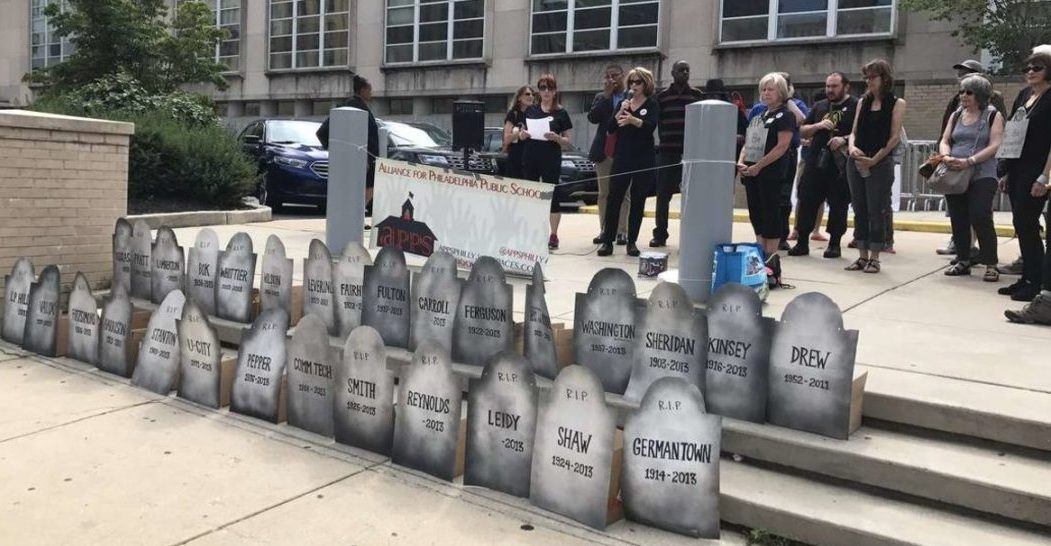
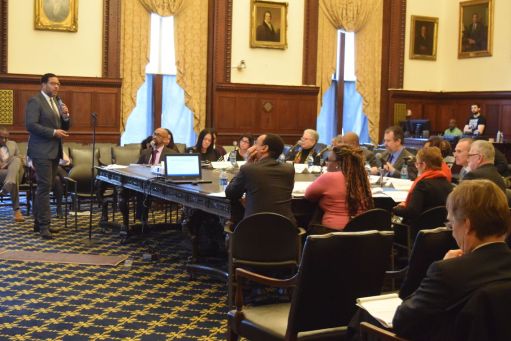
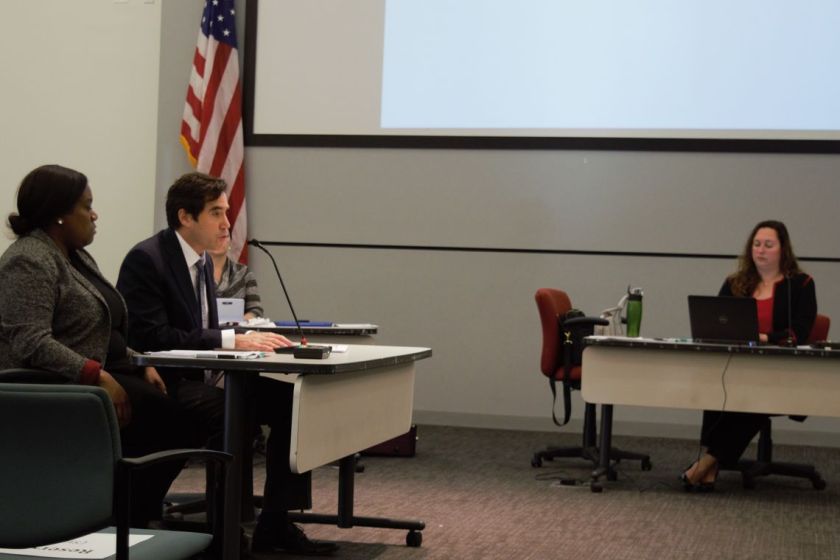
The School Board nominating panel holds its first meeting. APPS protests blatant violations of the Sunshine Act.

390887482217432814-nominating-panel.full

The following is an excerpt from the Philadelphia Public School Notebook article The School Board nominating panel holds its first meeting. APPS protests blatant violations of the Sunshine Act.

A point of for the Alliance for Philadelphia Public Schools (APPS) is transparency. APPS members sued the SRC in 2014 for violating the state’s Sunshine Act, which sets rules for the the conduct of government business,  and won a settlement that reshaped the way the SRC dealt with issue of transparency—although APPS is  quick to point out it’s a settlement they feel has not been consistently honored. For instance, the SRC often posts full descriptions of SRC resolutions after they have been voted on instead of in advance.

“The [nominating] panel is convened under the rules of the City Charter,” Haver said. “They are not an advisory panel. They are charged with selecting candidates for public office. They are city officials, and were addressed as such by members of the Mayor’s office.”

“As such, all of their meetings, including any committee meetings, must follow the provisions of the PA Sunshine Act,” she said. “Selection of candidates, and any deliberation about candidates, for this panel, is official action.”

The Mayor’s office disagrees with this interpretation of the Act.

“We appreciate the Alliance’s understandable desire to conduct as much public business as practicable in public,” Peterson said in a statement. “But the Alliance’s reading of the Sunshine Act is far from complete.”

She cited a section of the act that allows for deliberations involving political appointments to be conducted in closed-door executive sessions.

“A candid discussion about the strength and weaknesses of potentially hundreds of possible candidates cannot effectively be conducted in public,” she said. “It is also very likely that candidates will be more forthcoming about potential issues or conflicts of interest in private discussions.”

Haver suggested her organization is considering further action.

“APPS members have not fought against the lack of transparency by the SRC only to sit by and watch another board conduct its business in the same manner. We will be addressing our concerns to the panel and to the Mayor in the coming days.”
First hearings held for nine proposed new charters

priority schools

First hearings held for nine proposed new charters | Philadelphia Public School Notebook -December 19, 2017

See the above article for a description of each of the proposed nine new charters. The article concludes with testimony of APPS members:

Aspira had to settle several suits brought against the company because of the sexual harassment perpetrated by Aspira Philadelphia CEO Alfredo Calderone. Unbelievably, he is still CEO… [Dawn Lynn Kacer, head of the CSO] testified that the financial improprieties had not only not been resolved, as promised by Kenneth Trujillo in May 2016, they had actually gotten worse,” Haver said in her public comment. “For the SRC to agree to put the education of more young people into the hands of Aspira would be a clear dereliction of duty.

She ceded the floor to several other activists from the Alliance for Philadelphia Public Schools (APPS), familiar faces to anyone who regularly attends the SRC.

“Corporate charter schools continue to fight the SRC even today challenging the District’s right to oversee our public school students’ academic progress in their schools,” Lynda Rubin said during her public comment. “The SRC was put in place to purportedly shore up the financial supports for real public education in Phialdelphia. Not to hold a fire sale, selling or giving away its parts to private companies masquerading as public education stakeholders.”

Karel Kilimnik took issue with the argument made by SRC commissioners like Bill Green, that the SRC is not legally allowed to consider the financial impact that authoizing new charter schools would have on the District, since students take state dollars with them when they leave to attend a charter.

Kilimnik read from the 2015 SRC testimony of David Lapp, who was then an attorney with the Education Law Center:

I testified to the District that, when reviewing new charter school applications, the factors the District should consider cut against approval of new charters in the current fiscal and educational climate. This is especially true given the dearth of evidence that the charter sector has achieved superior results.

There have been recent public comments that suggest a mistaken belief that the charter law requires the SRC to approve new applications without considering the impact on District students. To the contrary, since the District has been declared to be in fiscal distress and the state constitution still requries that there be a ‘thorough and efficient system of public education,’ the impact of charter expansion on all students should be the most important consideration of all. But since questions have been raised, I wish to briefly clarify why such considerations are also legally valid.

The bottom line is that there has never been a [Charter Appeals Board] or court holding that a fiscally distressed school district is prevented from considering the educational impact on all students, including students in District schools and existing charter schools, when deciding whether to approve a new charter school application. In addition, no cases have addressed these issus since the charter reimbursement was eliminated. As you identify problems with the merits of a partricular charter application, you should be sure to also include, in the alternative, evidence and findings that approving the charter would negatively impact the educational experience of all students, including District students.

APPS News: November 2017

APPS logo

by Karel Kilimnik

 Unofficial SRC Watchdogs Going Nowhere
For the past five years, APPS has acted as the unofficial watchdog of the School Reform Commission. Our members have attended every Action Meeting, as well as Policy Committee meetings and the Strategy, Policy, and Priorities (SPP) meetings (until they were abruptly discontinued without explanation two years ago). Our first edition of Eyes on the SRC debuted August 2015, and Ears on the SRC appeared in November 2015. We have written articles about many of the vendors hired by the district, including Relay Graduate School of Education, Cambridge Education, The New Teacher Project, and now Jounce Partners. We have questioned the SRC’s propensity to hastily approve contracts, with no public deliberation, including: a $10 million contract with Catapult Schools to take over the troubled Wordsworth Academy students; contracting out the highly valued Nutrition Educators who were PFT members, also given to Catapult; almost $1 million to Educational Testing Services for teacher training at the Priority/SGS Schools; the $8 million and counting to outside legal firms. This list is but a snapshot of how the District, with SRC oversight, spends its limited funds.

As a member of the Our Cities Our Schools Coalition, we joined forces with labor unions, faith-based groups and other public education advocates to lobby Mayor Kenney and Governor Wolf to return our School District to local control.

The research and writing posted on our website as observed, recorded, and analyzed decisions by the SRC proved to be invaluable in crafting our message. How did the people of the city know how destructive state control under the SRC has been? By hearing the testimonies of APPS members at SRC meetings, by reading our commentaries in the local media, by talking to our members at countless community forum first-person accounts on our website. This return to local control is a huge victory, but we will continue to fight to end the disenfranchisement of the people of Philadelphia until we have the right to vote for an elected school board—as all other Pennsylvanians do.

 Victory for Philadelphia: SRC Votes to Dissolve

Click here to read the entire post.

APPS Celebrates the End of the SRC, Calls for Elected School Board

APPS-Banner-851px-2

For immediate release                                                            November 2, 2017

Members of the Alliance for Philadelphia Public Schools celebrate the impending dissolution of the School Reform Commission. We thank Mayor Kenney and Council President Clarke for their leadership in bringing this state-imposed body to an end.  State control of our schools has brought devastation to this city: precious funds have been diverted to non-public schools and over 30 neighborhoods have seen their schools closed permanently.

Since 2012, APPS members have attended every session of the SRC, including special meetings and Policy Committee meetings.  We have spent those five years fighting and organizing against the reckless spending, lack of transparency and disregard for the public exhibited by the many iterations of the SRC.  In 2014, APPS sued then-Chair Bill Green and the SRC in federal court for violating the public’s First Amendment rights when Green ordered the police to confiscate signs from members of the public—and won. The following year, we filed suit in Commonwealth Court to stop the SRC’s continual violations of the PA Sunshine Act.  Our settlement resulted in significant changes in SRC policy, including posting the resolutions to be voted on two weeks before the meeting instead of only 72 hours, and allowing the public to speak on resolutions posted just before or during the meeting.

We now have a unique opportunity to end the disenfranchisement of the people of Philadelphia.  The stakeholders in our public school system—that is, every person who benefits from a thriving public school system—should have the same rights as those in every other district in the commonwealth to elect the officials who will be entrusted to represent them in matters of school governance.

The dissolution of the SRC is not contingent on changing the City Charter.  The Charter now provides for mayoral control, as it did before SRC. The Mayor can select an interim school board for a year, during which time the city should hold community forums, as it is presently doing for the Rebuild initiative, to hear from the people whose voices were shut out during the reign of the SRC about how best to create a truly representative body for the critical task of educating our children.

Trading in one unelected, unaccountable board for another is not a progressive solution to the problems facing the district.