Ears on the Board of Education: August 15, 2019

by Diane Payne

The Board continues to vote on all charter matters in secret after negotiating with charter operators on conditions acceptable to them. Is it the Board’s position that charters are not public schools so votes on charter applications, renewals and amendments are not required to be taken in public?

Present

President Joyce Wilkerson, Julia Danzy, Leticia Egea-Hinton, Lee Huang, Angela McIver, and Chris McGinley were present.  Vice-president Wayne Walker participated via phone. Board members Maria McColgan and Mallory Fix Lopez were absent. Wilkerson announced the addition of a baby girl to the Fix Lopez family. Congratulations and best of luck to Ms. Fix Lopez!

Nine APPS members attended the meeting; six testified in defense of public education.

This entire Board meeting can be viewed on the District website here.

Eastern University Charter School Closes

President Wilkerson delivered a statement outlining the legal steps that led up to the school’s closing this summer. Omar Barlow, EU’s CEO, had made statements in the press that the district is profiling minority-led charter schools for closure and had withheld information about EU.  The SRC voted not to renew the school’s charter in 2018 due to consistently declining academic outcomes, along with failure to meet organizational and financial standards. Legal hearings were held, and Hearing Examiner Rudy Garcia recommended that the District move toward a final vote for closure, and a vote to close EU was passed.   In June, the state Charter Appeal Board, in a unanimous vote, upheld the District’s decision. Eastern will not be opening this school year. Wilkerson noted the District’s concern for the EU families; she said that letters were sent in July and again in August informing those families on how to enroll in a new school.

Wilkerson remarked on how painful and difficult it is for the families involved when a charter school closes. What all too frequently goes unsaid is how many charter schools are in fact doing poorly in one or all of three performance categories: academic achievement, financial health, and organizational compliance. Charters are renewed again and again with “conditions” for improvement that the Charter School Office (CSO) negotiates in private meetings with charter operators, followed by a CSO recommendations for 5-year renewals, some with conditions.  Reviews of subsequent charter evaluations show that there is little enforcement. Those conditions remain a secret until after the meeting because the Board, continuing the SRC’s practice, takes secret votes on all charter matters. The Board posts only the title of the official Item; there is no content. The full Item is not posted until the day after the meeting. That is a blatant violation of the Pennsylvania Sunshine Act. APPS co-founder Lisa Haver stands up and objects each time the Board conducts this illegal vote, as is her right under Section 710 © of the Sunshine Act. The Board ignores her and has yet to explain why other votes are public but all charter votes are not.

Wilkerson also reported that Action Item 66 was a “walk-on”  (ratification of Unite Here’s union contract) and members of the public could register then to speak on this Item.

Minutes from the June Action Meeting and the July TRANS meeting were approved.

Schools Are Not Charities

At the beginning of his written remarks, Dr. Hite encouraged the public to participate in the “Ring the Bell” challenge and post videos of themselves ringing a bell to welcome in the new school year.  He encouraged families to visit the District website to know what is needed and expected for a good beginning to their children’s school year. Hite also announced that the District was unveiling a new version of the SDP home page.  (APPS members frequently access the website and have pointed out areas that are not user-friendly with hopes of District improvement. We’ll see if this “refresh” addresses ease of information access.)

Hite next asked the Board to approve Action Item (AI) 22, Amendment of Contract with the Fund for the School District of Philadelphia: “The purpose of this Action Item is to enable the District to continue to contribute to the operating costs of the Fund by supporting the salary/benefits of its President and CEO as it develops capacity.”  This Item would increase the compensation the District provided to the Fund by $200,000, thereby increasing the total compensation to $1,040,000.

The president and CEO of The Fund is Donna Frisby-Greenwood.  The most recent federal tax information—the 2016 IRS “990” form—shows a combined salary/compensation of $177,717 for Frisby-Greenwood. (The 990s contain the only publicly available information about the salaries of top paid non-profit administrators.)  Hite said that the funding from the District to the Fund doesn’t support one person’s salary but a “structure” that will allow the fund to develop. Actually, the Item specifically states that it will be “…supporting the salary/benefits of its President and CEO.”  So what is this additional $200K for? What does the District’s $1 million to the Fund pay for? What is the current salary of this non-profit CEO?  Salary information for all District employees is publicly posted? If the public is paying Ms. Frisby-Greenwood’s salary, why is that not posted also?

Since its inception, APPS members have challenged the lack of public oversight of funds that are distributed through private channels.  The Fund’s Board is a Who’s Who of the wealthy and powerful, representing local and global corporate interests.

Are these the people we want deciding how to fund public schools?  Hite’s endorsement of The Fund’s support of “classroom libraries” to support literacy is a case in point.  Why isn’t the Fund supporting actual school libraries—staffed by Certified Teacher Librarians—which have been proven to improve academic performance? Hite has resisted bringing back school libraries, so The Fund creates a diversion with classroom libraries.

One APPS member who recently contacted The Fund about attending its next meeting received a written reply that “…our Board of Director meetings are not open to the public.  These are closed, private meetings.” Is this new Board of Education okay with wealthy and powerful corporate representatives deciding in private which schools and which programs are deserving of financial support? Hite proudly pointed to the $16 million The Fund has raised over four years. (Why don’t Fund salaries come from the money raised by The Fund?)  There was no mention of the need for a public discussion about the growing influence of entities like The Fund and the Philadelphia School Partnership (another corporate player making big decisions about Philadelphia schools). Schools are not charities and should not be funded as if they were.

Board and Staff Presentations

Board member Angela McIver, who has supported voter registration drives in high schools, cited Item 61 on National Voter Registration Day before introducing Philadelphia City Commission Chairwoman Lisa Deeley.  Deeley has been working with staff in a number of city high schools to encourage, educate, and register eligible seniors. Deeley presented information on efforts already underway, and she requested Board approval in designating September 24th as National Voter Registration Day, a non-partisan effort directed at registering and engaging seniors in the voting process. In answer to a question from Wilkerson, Deeley confirmed that students 17 or older can receive training and are paid to work the polls.  This action represents the culmination of the efforts of teachers, students and community members who have advocated before the administration and the Board for an organized effort to register of-age students.

Charter School Office Interim Chief Christina Grant presented partial information on three Charter School Action Items: 62, 63, and 64. The CSO recommended a 5-year renewal for Inquiry Charter, part of the Belmont Network; that renewal had been postponed since 2017 because Belmont officials refused to accept any conditions for improvement. The CSO did not update the 2017 Evaluation Report in its recommendation. On the District’s webpage, Inquiry is listed as a K-3 school; in Grant’s presentation it was listed as a K-5. The last School Progress Report (SPR)  listed on the CSO webpage for the 2016/17 School Year cites “Insufficient Data” on the categories of Overall Performance, Achievement, and Progress. Only Climate had a rating of Reinforce. Why is there no information for a school that has 3rd grade and higher?  How can the Board take a vote on a school with no information provided on the webpage about SPR ratings and incomplete information provided in the CSO presentation?

Real estate developer Michael Karp serves as Board of Director of all Belmont schools, including Inquiry (which was renamed a few years ago).  Karp was given control of the two schools in 1998 and 2002, in a pre-Renaissance program move, because he claimed that as a rich person he had the expertise to operate elementary schools in poor neighborhoods. When trying to look for news articles on Karp’s expertise as a school operator what one finds is backroom dealing with a City Council member for a Market Street property, a multi-million dollar purchase ($20 million) of a vintage Greenwich Village Townhouse in NYC ,  and most recently the suspicious Harrisburg insider deal that benefited ONLY Karp’s Belmont school. One is hard pressed to find those educational credentials.  Shouldn’t the Board be safeguarding our students and our tax dollars?  The information about Inquiry’s performance should be front and center; instead it is nowhere to be found.  The school’s Financial Health overall rating was a red color coded Does Not Meet Standards.  Inquiry’s Board compliance was also in the red. Why did the Board vote to renew? None of the Board members offered an explanation of why they were voting to spend tens of millions more for a clearly low-performing charter. Our calculations, based on figures from the District’s 2019 budget, show that the District will be allotting a minimum of  $13, 972, 885 to operate Inquiry Charter for the next five years. 

The presentation on KIPP DuBois charter—postponed since last year—ended with the CSO recommending a 5-year renewal without conditions. The 2016/17 SPR ratings for this school are: Overall – Watch, Achievement – Intervene (2%), Progress – Watch, Climate – Reinforce, College & Career – Watch.  No mention was made in the CSO report of the Achievement score at 2%. None of the Board members questioned the recommendation or asked for any detailed information. If enrollment and Special Education services remain constant, the District will be spending a minimum of $38, 389, 680 to operate KIPP Du Bois for the next five years. 

The last presentation on Action Item 64, KIPP Philadelphia Charter School’s mid-cycle amendment request for location change, was presented in conjunction with Action Item 65, the sale of the former John Whittier school building to a financial agent for KIPP, to complete that location change. Whittier was one of 23 neighborhood schools closed by the SRC in 2013; the building has been vacant since that time. KIPP’s agent proposed a $775,000 cash sale for the building according to District Chief Operating Officer Danielle Floyd. The building will be bought by a separate, for-profit entity: KIPP Whittier Development, LLC MIS Capital LLC.  This represents yet another circular lease agreement common in the charter sector.

Board member McIver, in stating her opposition to the Item, asked whether there was a provision in the agreement that if KIPP were to no longer operate a school in that building, the SDP would have first right to buy the building back. Floyd said there was no such provision.  McIver expressed concern that 5 or 10 years down the road, the private corporation that owns the building could turn it into condos if they wanted. Wilkerson then enumerated her reasons for supporting the Item. (More to follow on this Item during the voting process.)

Public Speakers

It matters who the District takes money from and for what purposes. This Board, like the SRC, unquestioningly approves grant money and contracts with outside firms and corporations for a variety of services. This erodes our vision of public education committed to the common good and conducted through a democratic process which engages the voices of the staff, students, families, and stakeholders.

Two members of APPS spoke against Action Items 16 and 17. Both Items would accept grants to partially fund the salaries and benefits for two additional Fellows (for a total of four) from the Broad Foundation to work on “projects” with the Hite administration.  The Broad Foundation is one of many vehicles that billionaires use to set their own agenda of what education should look like. The influence in District administration of Fellows from this corporate model cannot be understated.  Hite himself is a graduate of the Broad Superintendent’s Academy. Even though this is an unaccredited institution with no ties to any recognized university, Broad graduates have been hired in districts across the country.  It was distressing to see this on the agenda, and even more distressing to see the Board, with the one exception of Chris McGinley, vote to approve it.

Two APPS members spoke against the sale of Whittier School, a public asset, to a private entity.

Two speakers—one APPS member and one member of the Philadelphia Federation of Teachers’ Caucus of Working Educators—testified on the deplorable conditions of the Extended School Year (ESY) program for special needs students.  They noted the lack of materials and curriculum, grossly oversized classes, the serving of frozen food to students, and more.  Hite said that he would look into the conditions at the locations mentioned by the speakers. McGinley then advised Hite that this is a system-wide issue and would be put on the agenda for the Student Achievement and Support Committee.  McGinley said that he had personally heard from numerous sources that the ESY program had the same issues the speakers brought up at sites across the District.

Block Voting, Outsourcing, and Abstentions 

After the testimony of public speakers on Action Items, the Board voted on all Action Items.

AI 2: No vote, for review only.

AI 1 through 15; AI 18; AI 21 through 59: passed unanimously except for abstentions from Huang and McIver on Item 30 (they both have connections with Penn Alexander).

AI 16 and 17 were removed from the previous block at the request of McGinley, who urged the Board to vote No for the “ reasons expressed by the public speakers”.  Both passed, 6-1. The Broad privatization ideology will continue to deepen in the Hite administration.

AI 19, 20, and 60: passed unanimously.

AI 61: passed unanimously.

AI 62: Before the roll call for the charter renewal votes, APPS co-founder Lisa Haver stood up and addressed President Wilkerson and the Board, telling them she was raising an objection, under Section 710 © of the PA Sunshine Act, to the Board’s failure to inform the public of what they were voting on. The charter items were not posted online, and there was nothing in the documents at the meeting.  APPS had sent a letter to the Board earlier that day, once again explaining the requirements of the Sunshine Act and the public’s right to raise an objection when any Board or government agency violates it.

President Wilkerson ignored Haver’s legal right to object, talked over her objection, and continued with the vote.  Haver informed Wilkerson that she had an obligation to listen to the objection and respond to it. None of the other Board members responded to Haver’s objection. All charter Items passed unanimously. The following day, all of the charter Items were posted in full on the District’s website.

AI 63:  passed unanimously.

AI 64: passed unanimously.

AI 65 (Sale of Whittier building): This vote was interrupted when Board member McIver again questioned the sale of this property to a private entity without any protections built into the agreement for the return of the building to the District should the school cease operations there.  She received support from members Danzy and Walker who asked if the vote could be tabled until it could be explored further. A motion was made and seconded to table the vote. McGinley objected to the delay because the matter had been on the agenda at the May Finance and Facility Committee meeting. (Not all Board members are on that committee, and not all members of the public can attend Committee meetings held at 1 PM. The purpose of Committee meetings, according to the Board, is to have more discussion, not less.)  Hite, in the middle of the Board vote, asked Christina Grant and Danielle Floyd to return to the table for their perspectives.  (None of the Board members objected to Hite’s interruption of the vote.) Both Grant and Floyd defended the steps taken by District staff on this Item.  They cited efforts to engage the community and the staff presentation at the F&F meeting in May. Grant noted that a delay in the vote would affect KIPP’s start date for the school year.

McIver pointed out that she was not opposed to the sale but to the lack of protection built into the agreement. She wanted to ensure that the for-profit purchaser could not turn around and sell the building for a profit.

Wilkerson then announced that the Board would take a 7-minute recess to discuss this matter and consult with counsel.  The Board did recess, but for much longer than 7 minutes. APPS questions the Board’s meeting in executive session to discuss this matter. While it is technically about real estate, the issue was not the sale price but whether the District could have a say in the use of the building.

When the vote resumed, APPS member Rich Migliore objected that members of the public should be able to speak on this Item since the Action Item had changed.  President Wilkerson ignored Migliore’s objections, talked over him and voted on the motion to table the Item. The vote failed with four members voting No; Letitia Egea-Hinton, Lee Huang, Chris McGinley, and Joyce Wilkerson.  Wilkerson then called a vote on AI 65 when Egea-Hinton made a motion to amend the Item to include a provision that the property would be used for education purposes and in the event the school closes the SDP would have the first right of purchase at an appraisal value determined by the District.  This Motion to amend passed with a unanimous Yes vote.

The vote was then called on the amended Item which passed with 6-1, McIver dissenting. (When questioned, Floyd stated that if the purchaser does not agree with the amended provision there would not be a sale.)

AI: 66: Unite Here contract approved unanimously

September Board Meetings

Next Board Action Meeting:  September 19 at 5 PM in the 2ndfloor auditorium at 440 N. Broad Street.

Student Achievement Committee: September 5 at 5 PM in the Committee Room.

Finance and Facility Committee: September 12 at 3 PM in the Committee Room.

Policy Committee:  September 12 at 5 PM in the Committee Room.

Special Public Meeting: September 26 at 5 PM in the Auditorium. Details not yet available on SDP website, but this is one of the two meetings required under the City Charter for public comment on any matter of concern to the community on District issues.

 

Ears on the Board of Education: June 27, 2019

by Diane Payne

Before the Board began the call to vote on the three charter school renewals on this agenda, APPS co-founder Lisa Haver stood and raised an objection to the proceedings, under Section 710 © of the Sunshine Act, about a clear violation of the Act as the Board was poised to vote on four official Items which contained no text or details—a de facto secret vote.  Despite APPS raising objections in letters and testimony, this Board continues the SRC’s practice of voting on Charter School matters and posting the text after the vote and after the meeting concludes. That constitutes a falsification of the public record as it implies that it was available to the public before the vote. In fact, there is no written acknowledgment that it was posted the day after the meeting.  President Joyce Wilkerson did not respond to Haver’s objection, nor did any of the other Board members, and the votes were cast illegally.

APPS contends that this Board consistently violates the Sunshine Act by not providing full information on charter school Items and by falsifying the records by placing text sometime after the vote as though it was available at the time of the vote. [Note: the Items in question were posted in full two days after the meeting.]

Present

Seven of the nine Board members were present as well as the two student representatives.  Absent were Leticia Egea-Hinton and Mallory Fix Lopez. Eight members of APPS were present; seven spoke in defense of public education.  The video of this meeting can be viewed by going to the BOE page of the SDP website.

Minutes of the May 30, 2019 Action Meeting were approved.

The two student representatives, Julia Frank and Alfredo Practico, read a statement about their experience serving on the Board, and they encouraged the public to view their report which should be available on the District website by the weekend.  APPS wishes them well in their college endeavors and appreciates the work they did in giving students a voice.

Belmont Bombshell

President Wilkerson made an announcement about Action Items that had been withdrawn.  For Action Item 1 with multiple policy items, one item, Policy 007 was withdrawn because new information was received and the Board needs to review it.  Wilkerson then stated that Action Item 40, the sale of the “unused and unnecessary” school district property at 4030 Brown Street to Belmont Futures, was also being withdrawn.  This property houses Belmont Charter School, so this designation of “unused and unnecessary” was incorrect from a legal standpoint. Belmont Charter CEO Michael Karp is a wealthy and politically connected real estate mogul; he controls the operation of three schools in the Belmont network. Karp testified at the May 2017 SRC meeting that Belmont would not be signing the new charter because he objected to “conditions” imposed on the school. Belmont had failed to meet any standards in that evaluation; in fact,  Belmont received a “Does Not Meet” rating in academics. Since Belmont had not been successful in any category, the conditions were simply the CSO’s attempt to make Belmont responsible for the terms of its contract.

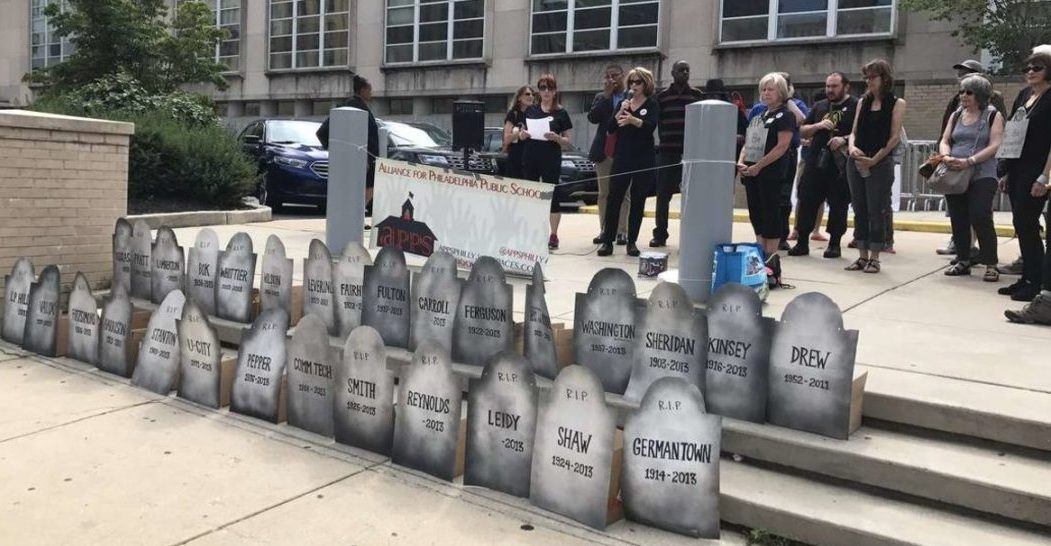
Charter School Office Interim Director Christina Grant announced at the May 16 2019 Finance Committee that the CSO had been negotiating (in private) with the Belmont administration who were now willing to sign the new charter. Why? Because the sale of the 4030 Brown Street property was contingent on that renewal.  Apparently, Belmont officials would not improve the academic, financial, and organizational deficiencies for the sake of the Belmont students and families, but they are willing to do so in order to accumulate real estate. Chief Operating Officer Danielle Floyd also told the Committee that her office had been in talks with Belmont about the sale of the building. Not only had a sale price been negotiated, an August closing date had already been scheduled! Board member Chris McGinley pointed out that this school is a Renaissance School, which means it serves a District catchment area; he also stated that the building is neither unused nor unnecessary. Selling this building to a charter operator would be one more in a long list of the District selling off its public buildings, creating more “school deserts” in struggling neighborhoods. The District has sold off public school buildings for a song—look at Bok, Smith School, University City, and Germantown, to name a few.

APPS members immediately began to testify, research, and write the Board expressing the problems inherent in this “deal.”  It seems that our efforts were having an effect, as newspaper stories reported that Board members were skeptical of the deal. We were optimistic that the Board would vote to keep that public building out of the hands of a private concern. But lo and behold, Harrisburg seems to be rallying to facilitate the interests of Michael Karp. Speaker of the House Mike Turzai (R, Allegheny) had introduced House Bill 1615 just prior to the Board meeting which would in essence allow Karp’s schools to secede from the School District of Philadelphia.  Money talks. Turzai is no friend of Philadelphia and no friend of public education. Details are sparse at this point but the public needs to be aware of this transaction.

Behind this story is the history of developer and landlord Michael Karp, notably his influence and wealth.  He has served on the PICA Board (Pennsylvania Intergovernmental Cooperation Authority) since he was appointed by Governor Tom Ridge in 2000, one year before the state takeover of Philadelphia’s public schools.  Per the PICA website: PICA was created in 1991 to assist the City of Philadelphia in overcoming a severe financial crisis. The Authority was created through the joint efforts of concerned Philadelphians and State officials who envisioned a structure which would assist the City in putting its revenue collection and spending processes in order and at the same time reach a consensus on its future priorities, assets and limitations.”   In other words, an appointed board has the power to override the decisions of the duly elected representatives of the city.

In 2015, Karp bought a vintage Greenwich Village townhouse for $32 million.

In February of this year, the Philadelphia Tribune reported that City Councilwoman Jannie Blackwell allegedly tried to aid Karp in the purchase of 4601 Market Street.  Blackwell served on Belmont’s board for many years.

Indicating the range of Karp’s political influence, Philly Power Research found:  “In 2018, the top real estate donors to current City Councilmembers and City Council candidates were: Joseph Zuritsky, Chairman of Parkway Corporation; The Building Industry Association; and Michael Karp, head of University City Housing Company and the Belmont Charter Network.” 

We ask again: Is this about educating needy children or is it about real estate deals?

Superintendent’s Remarks

Dr. Hite began by congratulating the senior class of 2019, thanking the out-going student representatives, and by recognizing the  commitment of teachers and staff to the week-long summer institute training, [He did refer to it as a “boot camp” but did not mention that many who attend have no choice, e.g., those in the Acceleration Network.) Hite also addressed the U S Supreme Court decision to strike the Trump administration attempt at including a citizenship question on the 2020 Census form.  Hite stressed that it is extremely important that the community gets the word that answering the census is not a threat and that billions of federal dollars hang in the balance if incorrect counts result due to incorrect information.

Hite shared information regarding the District’s efforts at voter registration geared to District seniors.  A packet has been developed in conjunction with the Committee of 70 for all Social Studies teachers, and professional development will be available. Next year, certain high schools will be targeted for voter registration events.  APPS speaker Coleman Poses has been advocating for District engagement in getting high school seniors registered to vote. In his remarks Thursday, Poses asked Hite if a database could notify school personnel when students turn 18 so that district officials can provide the forms immediately.  Hite did not have an answer to Poses’ query but said he would get back to him.

Committee Reports 

Chairs of each committee–Student Achievement, Finance and Facilities, Community Engagement, and Policy–gave a brief update from their last meetings.  APPS reports for each of these meetings can be viewed on our website.  There were no District presentations at this Action Meeting. In the past, the CSO would present information about charter renewals and applications at the full Board meetings; that seems to no longer be the case. It is part of the pattern of keeping charter issues out of the public eye.

Speakers

Three members of APPS spoke in opposition to the amendment hidden in Action Item 91–MaST II’s request for an enrollment increase of 650 students as part of its renewal agreement.  Only those who attended the June Student Achievement Committee had any knowledge of the increase. Even after we notified the Board and the Board staff, no information about enrollment increases as part of any charter renewal was posted on the District website.  APPS members highlighted MaST’s blatant school segregation. Some examples across its two current campuses: MaST’s poverty levels are 26% & 43% compared to SDP’s 74%; African/American student percentages are 8% & 24% compared to SDP’s 50%; and White percentages are 68% & 41% compared to SDP’s 14%.

The topic of the District’s involvement in increasing the segregation of schools has been addressed at multiple Committee and Action Meetings by a parent from the Northern Liberties community.  Stephanie King brought graphs, data, and noted her past attempts to engage the District in discussion about this ongoing problem. Board member Angela McIver agreed with King that it was an issue that needed a hard look.  King stated that the District is engaged in “willful segregation.” Yet even in the face of MaST’s demographics, the Board voted 6 in favor and 1 against to approve the renewal and the 650 seat enrollment increase. There was no discussion or even acknowledgement of why such an increase should be approved–even when APPS member Diane Payne called out from the audience asking the Board to explain why they were voting to approve this increase.  Why the secrecy?

MaST CEO Charles Swoyer III pulls in a salary of $335,147 for overseeing two schools, MaST I and MaST II.  (Dr. Hite makes $311,000 for overseeing 210 schools.) The MaST Board approves all MaST salaries, which are paid by taxpayers who have no say in that decision–or knowledge, unless they are able to pore over federal tax information.  An additional MaST II campus is under construction along the Delaware River near the Tacony Palmyra Bridge. Since the SRC approved MaST for a mega-third school on a 30-acre tract on Roosevelt Boulevard, that means that these three new campuses will be in remote locations.  None of these campuses will qualify as a “great school close to where children live” as Dr. Hite often says because there are no neighborhoods by any of these campuses. The MaST II new campus and the third MaST school are both located in industrial areas.

Although two campuses are in the Achievement category of Reinforce, the high school is in the Watch category.  Even with the skewed demographics, not a great success.

The CSO report unabashedly states that “the CSO anticipates the enrollment increase to positively impact the Charter School’s ability to borrow money for construction.”  Apparently using our children as bargaining chips so this powerful organization can increase its holdings is not even something to feel shame about.  This raises the specter of a Ponzi-like scheme of continually filling in the bottom to keep the top afloat. As APPS member Deb Grill told the Board in her testimony: “ It is not your responsibility to facilitate profitable real estate deals for charter operators or universities.”

Finally, the Board failed to answer the question of whether secret bartering between the CSO and the Charter School resulted in a quid pro quo.  MaST dropped its Multiple Charter School Organization (MCSO) application, which Chris McGinley specifically asked about at the June Student Achievement  Committee meeting, along with the reference to the enrollment increase. APPS co-founder Lisa Haver asked the Board directly if this was the case but no answer was given nor was there any indication an answer would be forthcoming.

This was a disheartening vote to increase the real estate footprint of a charter school that is directly  linked to school segregation, overpaid executives, remote school locations, and state of the art facilities to provide that private school vibe for their select group of students.  This while children at schools like Gideon, Sheridan, Harding, and more struggle for resources, safety, and non-toxic buildings.

Deal for Drexel–Who Benefits Most?

Drexel President John Fry gave a 40-minute presentation at June’s Finance and Facilities meeting.  He laid out all the good that Drexel has done for the public school communities near Drexel, most notably Powell Elementary.  His mission was to have the District put $7 million into the kitty to fund construction of a new building, owned by Drexel, intended to co-locate Powel and SLA Middle School (SLAMS). According to Fry, Drexel has already secured $29 million from various sources for the new building–to be constructed on the site of the former University City High School at 3601 Filbert Street. Uni City, along with the adjacent schools Drew Elementary and the Walnut School, were closed by the SRC in 2013, the property purchased by Drexel, and the buildings quickly razed. So…the District sold the property to Drexel, Drexel bought it and will now lease it to the District. One group strongly advocating for the 23 school closings that year was the Philadelphia School Partnership (PSP), when Fry was a member of the Board. Fry continues to be a major contributor to PSP (as is Michael Karp).

The 2016 Memorandum of Understanding between the District and Drexel details the level of control Drexel will have over this new school.  There were promises by Drexel to guard against the gentrification and other issues that resulted from the University of Pennsylvania’s involvement in Penn Alexander. One question not posed by any member of the Board in either the Committee or Action Meeting: why does Drexel want to build this school in its backyard? Who stands to benefit?  And wouldn’t the District benefit every year if Drexel would pay its PILOTs (Payments in Lieu of Taxes)?

Fry’s presentation was never posted on the District website.

Action Item – 41 – passed with 6 Yes and 1 Abstain insuring the involvement of another wealthy institution that will “partner” with the SDP.

Board Votes

The Board took block voting to a new level at this meeting.  President Wilkerson separated the Items into 5 blocks (not in order),  and 83 Items were passed in 5 votes.

Action Items 1 – 3

Action Items 9 – 16

Action Items 20 – 39

Action Items 42 – 88

Action Items 92 – 96

McGinley and Wilkerson abstained on Action Item 14; it passed 5 Yes and 2 Abstain. Huang abstained on Action Item 75; it passed 6 Yes and 1 Abstain.  The remaining items in this block passed unanimously.

Action Items 4 – 8 passed unanimously.

Action Items 17 -18 passed unanimously.

Action Item 19 was withdrawn.

Action Item 41 Drexel vote passed with 6 Yes votes, I Abstain from Huang and comments from McGinley, Wilkerson, and McIver about why they were voting yes.

Action Item 89 passed unanimously.

Action Item 90 passed with 6 Yes votes and 1 Abstain from McColgan

Action Item 91 passed with 6 yes votes and 1 No vote from McGinley

The Action Meeting adjourned and the Intermediate Unit convened. The Board passed three Action Items unanimously.


Ears on the Board of Education: May 29, 2019

by Diane Payne

APPS will keep calling out the Board on its lack of transparency until the members acknowledge that true community engagement cannot be accomplished by withholding public documents. Placing four binders on a table in the rear of the auditorium with a warning in red–”DO NOT REMOVE BINDERS FROM TABLE”–means that those who come to the meeting and want to follow the proceedings would have to stand in the back of the room for the entire meeting. The usual announcement that materials are available online is insulting and insensitive. As one parent activist reminded the Board last week, many families do not have online access.  And for those who do–are we supposed to memorize the entire agenda and all 85 Action Items? The Board is voting on Items that affect the future of the community and allot millions in taxpayer spending. This is not transparency and it is not public inclusion. Is the Board’s answer to just bring your computer (if you don’t have one–too bad) and balance it on your knees if you want the full descriptions about how they spend tens of millions of taxpayer dollars?

All meeting materials and videos from this and every meeting can be found on the SDP website, Board of Education page.

Present

All nine Board members were present as were the two student representatives.  Hill-Freedman World Academy provided the student musical presentation. As always, the talent and dedication of the students and their music teachers was inspiring and impressive.

The Minutes of the April 25, 2019 Action Meeting were approved.

A total of 54 speakers, 80 Action Items, and 6 Intermediate Unit Action Items presaged a long night.  Ten of these speakers were students. The initiative and commitment these young people exhibit in coming before the Board to share their concerns and demands is heartening. Seven members of APPS attended and six members testified in defense of public education.

Click here to read the rest of the post

Ears on the Board of Education: April 25, 2019

by Diane Payne

Last month’s March 28th Action Meeting ended abruptly when the Board left the room after a hasty vote to recess.  Sponsors and students from the Philadelphia Student Union (PSU) had disrupted the meeting after the Board voted to pass a policy that mandates metal detectors in all high schools.  PSU had testified at Action and Committee meetings over the past the past three months and had met with District administrators to discuss the issue. (See APPS March 28th Ears for that report.) The Board never returned; without notice, they reconvened in another room and voted on the remaining Items there.  Thus, many public speakers did not get to give their testimony. The Board had said that those people could go first at the April Meeting, but  APPS members asked that they get their three minutes from March in addition to their three in April. Board President Joyce Wilkerson agreed to our request.  A total of 78 speakers were listed.

Present

All members of the Board were present for this meeting.  Seven members of APPS attended; six testified in defense of public education.

Prior to the start of business, the Board read a tribute to longtime education activist Marciene Mattleman, one of the founders of the After School Activities Partnerships (ASAP), who passed away in March.  Students from the various clubs who have participated in local and national competitions came with their trophies. Tributes were read by Board member Angela McIver, the current ASAP director, and Mattleman’s daughters. The importance of these non-athletic activities was later the subject of testimony by those who came to advocate for funding for their various clubs, including Chess, Scrabble, and Debate.

Click here to read the rest of the post