Are Charters Under Attack? Facts Show Otherwise

Philadelphia charters

by Lisa Haver
January 30, 2018

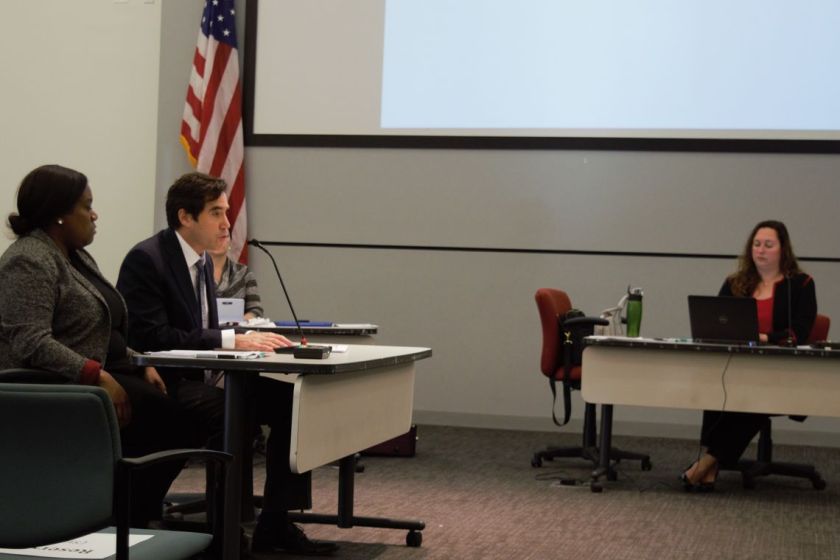
Charter CEOs and supporters held a rally at City Hall on Tuesday January 30 to ask for a “seat at the table” when the new school board replaces the School Reform Commission. Several City Councilpersons attended the event, held in the Mayor’s Reception Room.

APPS members have said consistently that district budget problems stem not just from a lack of funding, but from the spending priorities of the SRC which keeps resources out of classrooms. Consulting fees, faux graduate school, training by outsourcing by unqualified and inexperienced people: Teach For America, The New Teacher Project, Relay Graduate School of Education, Cambridge, Boston Consulting, Jounce, Institute for Student Achievement, etc.

But the biggest waste of money in the SD budget is the funding of malfunctioning charters. Report after report, including the latest from Philadelphia Citizens for Children and Youth (PCCY), shows that district schools outperform charters. Charter supporters say that they only support “high-quality” charters, that they want the failing charters closed. But when they have the opportunity to prove that, they are nowhere to be found. Some examples:

Click here to read the rest of the article.


First hearings held for nine proposed new charters

priority schools

First hearings held for nine proposed new charters | Philadelphia Public School Notebook -December 19, 2017

See the above article for a description of each of the proposed nine new charters. The article concludes with testimony of APPS members:

Aspira had to settle several suits brought against the company because of the sexual harassment perpetrated by Aspira Philadelphia CEO Alfredo Calderone. Unbelievably, he is still CEO… [Dawn Lynn Kacer, head of the CSO] testified that the financial improprieties had not only not been resolved, as promised by Kenneth Trujillo in May 2016, they had actually gotten worse,” Haver said in her public comment. “For the SRC to agree to put the education of more young people into the hands of Aspira would be a clear dereliction of duty.

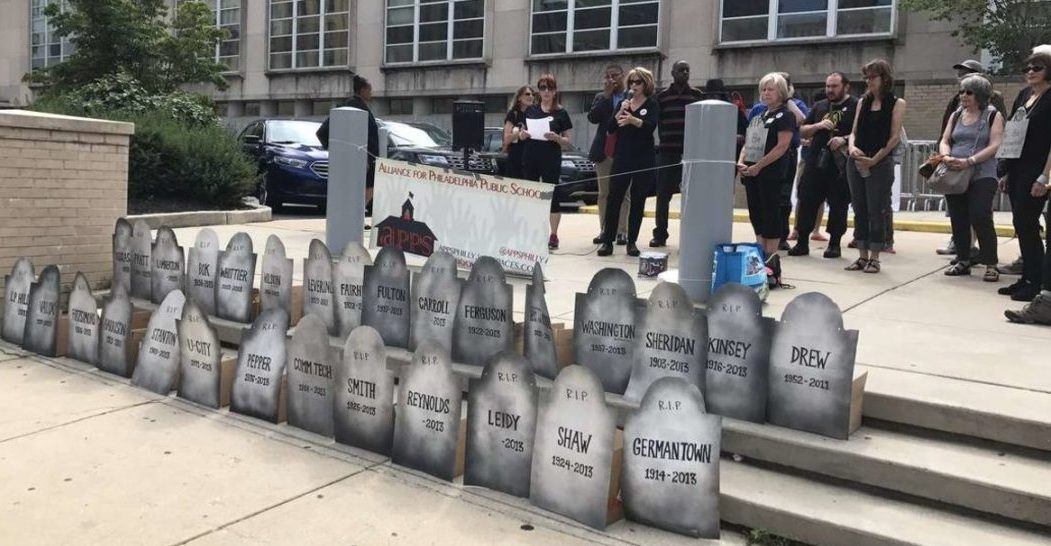
She ceded the floor to several other activists from the Alliance for Philadelphia Public Schools (APPS), familiar faces to anyone who regularly attends the SRC.

“Corporate charter schools continue to fight the SRC even today challenging the District’s right to oversee our public school students’ academic progress in their schools,” Lynda Rubin said during her public comment. “The SRC was put in place to purportedly shore up the financial supports for real public education in Phialdelphia. Not to hold a fire sale, selling or giving away its parts to private companies masquerading as public education stakeholders.”

Karel Kilimnik took issue with the argument made by SRC commissioners like Bill Green, that the SRC is not legally allowed to consider the financial impact that authoizing new charter schools would have on the District, since students take state dollars with them when they leave to attend a charter.

Kilimnik read from the 2015 SRC testimony of David Lapp, who was then an attorney with the Education Law Center:

I testified to the District that, when reviewing new charter school applications, the factors the District should consider cut against approval of new charters in the current fiscal and educational climate. This is especially true given the dearth of evidence that the charter sector has achieved superior results.

There have been recent public comments that suggest a mistaken belief that the charter law requires the SRC to approve new applications without considering the impact on District students. To the contrary, since the District has been declared to be in fiscal distress and the state constitution still requries that there be a ‘thorough and efficient system of public education,’ the impact of charter expansion on all students should be the most important consideration of all. But since questions have been raised, I wish to briefly clarify why such considerations are also legally valid.

The bottom line is that there has never been a [Charter Appeals Board] or court holding that a fiscally distressed school district is prevented from considering the educational impact on all students, including students in District schools and existing charter schools, when deciding whether to approve a new charter school application. In addition, no cases have addressed these issus since the charter reimbursement was eliminated. As you identify problems with the merits of a partricular charter application, you should be sure to also include, in the alternative, evidence and findings that approving the charter would negatively impact the educational experience of all students, including District students.
Who is Afton Partners?

imgres-1

by Ken Derstine
March 14, 2017

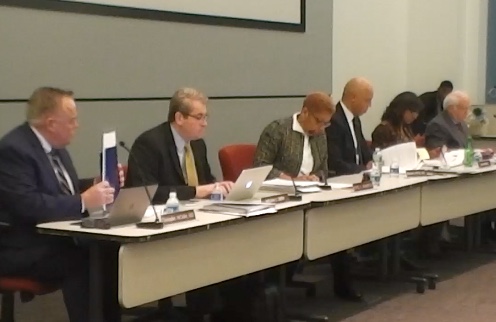
In a recently released report by Afton Partners, the cost of students leaving Philadelphia public schools to transfer to charters was examined. The study had been commissioned in February, 2015 by the School Reform Commission which functions as a school board and makes all final decisions for Philadelphia schools.

Click here to read the entire Afton report.

In “is the glass half full or half empty” coverage, the Philadelphia Inquirer published Report: Philly schools still face costs when students go to charters vs. the Philadelphia Public School Notebook’s Students leaving Philly schools for charters less costly than once thought.

According to The Notebook article, the resolution calling for the contract with Afton said the analysis would take place between February 20, 2015 and May 1, 2015. SRC officials claim the report “got lost in the shuffle as old administrators left and new administrators replaced them.” The District’s Chief Financial Officer Uri Monson, appointed February, 2016, said he first got word of the report last summer and has been working with Afton “to make sure the report addressed all questions.”

Why is the report being released now? Could it have something to do with a bill in the Pennsylvania House introduced by Speaker Mike Turzai on March 6th which would require the Philadelphia School District to add 3,000 charter seats per year? This bill would undercut the charter oversight authority of the Philadelphia School Reform Commission (SRC). The establishment of the SRC in 2001, as part of the state takeover of the School District, abolished local control of public schools, along with any hope of any type of democratic process. A 2014 bill passed by the legislature imposed a $2/pack cigarette tax for school funding; it included a last-minute provision that the SRC consider applications for new charters each fall.  Rejected applicants would be able to appeal to the state Charter Appeal Board.

Now, invoking the state rights’ provisions of the Every Student Succeeds Act (ESSA), Turzai wants to completely take even this oversight from any local influence. He has been aggressively intervening in the SRC’s charter approval process lobbying for approval of charters that the SRC has rejected. The SRC’s Uri Monson said the bill is unnecessary because in the SRC’s five-year financial plan presented last year there is an already projected annual growth of charter enrollment of between 2,700 and 3,000.

Click here to read the entire article.

Philadelphia Charter School Application Reports

src-1-19-17-2

January 23, 2017

The School District received five applications for new charters to open September 2017. One applicant has already dropped out. APPS members attended all four Charter School Hearings held on Thursday Jan 5 and Monday Jan 9th.  The SRC will vote on these applications on February 8th.  The Charter School Office will post its evaluation reports  on its website approximately one week before the vote.  We have researched each applicant. Links to our research follows this Executive Summary of issues and concerns.  The four applicants are Metropolitan Philadelphia Classical Charter School (MPCCS); Deep Roots Charter School (DRCS); Friendship Whittier Charter School (FWCS); and KIPP Charter School. Our reports are quite lengthy and detailed so we are highlighting some essential points.

* Three applicants have detailed Attachments that are inaccessible to the public.  Representatives  of the SRC office told APPS that we would have to file an official Right to Know request to access any of the attachments.  That would take months, and it would be unlikely that the district would release the information before the SRC votes in February.

*MPCCS and FWCS applicants are from outside of Philadelphia. FWCS and MPCCS have no connection to the intended community.

*All four applicants used pre-packaged, scripted curricular materials.

*3 out of 4 have limited or no parental involvement.

*FWCS and DRCS are opening in district school buildings closed due to under-enrollment.

*FWCS and DRCS have management contracts with outside businesses. The  FWCS management fee is 12% of its budget. This goes to the Charter Management Operator.

*All four are top heavy in management positions.

*Student privacy and the rights to student information are not addressed by any of these Charter Management Organizations.

*There is no job security for teachers at DRCS, KIPP, and FWCS. As it says in the KIPP Parkside Charter School application, employment “is “at-will” meaning that either the employee or the school may end the employment relationship at any time, with or without notice, with or without cause.” At MPCCS all teachers will be recruited from Hillsdale College. The College “considers itself a trustee of modern man’s intellectual and spiritual inheritance from the Judeo-Christian faith and Greco-Roman culture…”

To read the reports on individual charter applications click on the links below:

Deep Roots Charter School

Friendship Whittier Charter School

 KIPP Parkside Charter School

Metropolitan Philadelphia Classical Charter School


The School Reform Commission will hold a special meeting on Wednesday, February 8th to consider and vote to grant or deny these new charter applications. The meeting will be at 4 p.m. in the auditorium at the 440 N. Broad Street. If you wish to speak you must register by calling the SDP Office of the SRC at 215-400-4010 by 4 p.m. on Tuesday, February 7th.