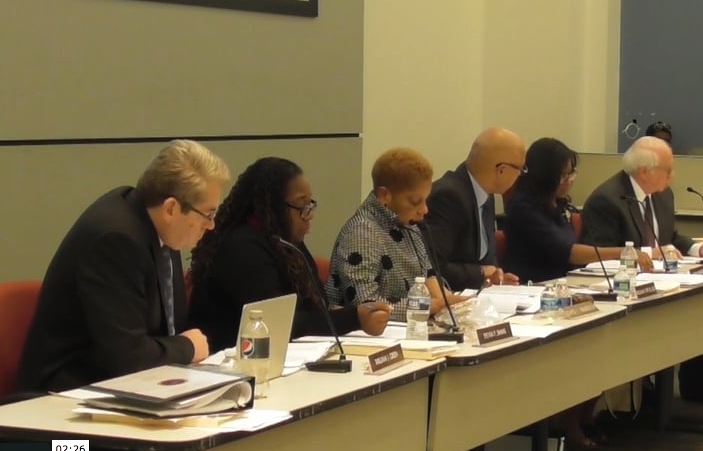
APPS reports on the final meetings on Priority Schools

src-12-15-16-4
Philadelphia School Reform Commission

Over the past two months, APPS members have attended meetings at six of the eleven schools selected by the school district to be “Priority Schools”. This initiative would affect the futures of these schools in a significant manner, but no presentation has been made by the Hite administration at any SRC meeting. The options presented to the schools have not been explained in detail; in fact, they were not mentioned at the final meetings unless APPS members asked about them. Neither Dr. Hite nor any member of the SRC has attended any of the focus group meetings at any of the eleven schools.

Again, there was no mention at the final meetings of the five options proposed at the initial meeting. Only because APPS members asked for an explanation was any given at the final meetings. At Benjamin Franklin High, however, neither district nor Cambridge representatives would answer that question. Parents attending these meetings are asked what would make learning better for their children, but they are not told how any of the five options would restore services.

Bartram High School

Benjamin Franklin High School

Blankenburg Elementary School

Harding Middle School

Hartranft Elementary Schools

Kensington Health and Sciences Academy


Click here to read APPS Reports for the initial Priority Schools meetings.

Eyes On The SRC – December 15, 2016

src-11-15-16-5

Eyes on the SRC:  December 15, 2016

by Karel Kilimnik

As 2016 draws to a close and we contemplate what the next four years may bring, we need to pay close attention to the ways in which the public continues to be shut out of decision-making at the SRC. The SRC is a governmental body overseeing a $2.8 billion budget. This is our tax money at work. Although we successfully negotiated a resolution to our lawsuit charging the SRC with violating the Pennsylvania Sunshine Act, there remain many hurdles with transparency.

APPS members are proud to have achieved what no individual or organization has done in the fifteen years since the SRC was imposed on the city: making that body more transparent and accountable through a court agreement. Highlights of the settlement include provisions to publish official resolutions two weeks in advance of the monthly Action Meeting and ensuring that the public has a reasonable opportunity to speak on every resolution, whether posted just before the meeting or during. Thus, anyone attending the meeting will be able to sign up at the meeting on “walk-on” resolutions, which are those posted within 48 hours of the meeting, and resolutions “from the floor” which may be introduced during the meeting by an SRC commissioner (as Sylvia Simms did in January, thus clearing the way for Mastery to take over Wister Elementary).

Of course, issues of accountability still remain.   The SRC now fails to include any text with an increasing number of resolutions deemed “quasi-judicial”  (e.g., Resolutions SRC-5 and -6). Those resolutions are blank except for the title. How can anyone make a comment, or even ask a question, about a resolution that doesn’t say anything?  The SRC has never publicly explained what “quasi-judicial” means or why charter renewals have been classified as such. The dictionary gives this meaning:  “noting, pertaining to, or exercising powers or functions that resemble those of a court or a judge”.  Renaissance charter schools are actually contract schools: they agree to provide services in exchange for payment. Does a judge get involved when a contract is signed between two parties? If not, then why is the SRC hiding these contracts behind a wall of secrecy and refusing to allow the public to view them?

Something new this month: Resolutions SRC-1 and SRC-2 are “For Review”. By whom—the people attending the meeting or just the six people at the table? How can anyone ask questions when no information is provided? The only testimony the public can give is to query the SRC Commissioners who routinely fail to answer.

The resolution to hand over $23 million to Big Picture Inc. to reopen Vaux High School and operate it as a “contract school” for six years has reappeared. Again we must ask: why is this huge sum necessary to reopen one high school? Where is the money coming from? What is a contract school? We hear that the district is too broke to have a full support staff in every school, then we hear that it has a surplus.  Teachers are told that they must “face reality” when they ask for a fair contract, then the SRC allots $23 million for one school. When will the SRC give the public some straight answers?

In October, Dr. Hite announced his newest turnaround category, “Priority Schools”, but we are still waiting for him to make a public presentation at an SRC meeting on what that might mean for the future of those schools, as well as what this will cost the district.

Renewal resolutions for Mastery schools Gratz, Clymer, and Shoemaker are MIA once again. We can only assume that Mastery does not want to agree to the conditions which the Charter School Office recommended. Again, the SRC has a responsibility to update the public on what has been happening for the past eight months.  These resolutions have been appearing and disappearing since April.  Mastery Gratz and Mastery Clymer were to have been renewed in 2016. Does this mean they receive an extra year for their next contract?

Renewal resolutions for Universal’s Audenried and Vare have not been seen, or even mentioned, since April. Those for Aspira, Inc.’s Olney and Stetson also come and go without explanation.  The SRC apparently feels no obligation to the community to tell us what is going on with these schools.

Next SRC meeting:  Thursday December 15 2016, 4:30 PM at 440 N. Broad Street.  Do you want to testify? Call 215.400.4180 before 3 PM Wednesday to ensure that your voice will be heard.

Click here to read selected resolutions relating to policy changes, revised charter applications, the reopening of Vaux and more.


Ears on the SRC – November 15, 2016

src-11-15-16-5

by Diane Payne
November 29, 2016

Joyce Wilkerson made her first appearance after being sworn in by Mayor Kenney and appointed Chair by Governor Wolf.

Wilkerson, currently an administrator at Temple University, has a long history of public service; she served as Chief of Staff for Mayor John Street. We are hopeful that she will steer this commission toward more transparency, accountability, and democratic values. We also hope that she will actively engage with those advocating for stronger public education.

Superintendent’s Remarks
Dr. Hite’s addressed the following topics: Priority Schools; the reintroduction of the school TV station; gratitude for Office Depot’s support of Student and Teacher of the Month; announcing the first Middle College High School at Parkway Center City; and the ongoing support of the Cole and Heidi Hamels Foundation for W B Saul High School.

 Few Answers to Concerns about Priority Schools
At October’s SRC meeting, APPS member Diane Payne asked Dr. Hite about his plan to designate eleven struggling schools “Priority Schools”, thus targeting them for some type of turnaround: You stated in the October 10, 2016 Public School Notebook article that these schools were not performing “despite investments we have made” in them. What are the specific investments you made to support these struggling schools? And please define merging, managing on a contractual basis, and restarting with significant staff shifts?

Dr. Hite responded that those questions would be answered at the November SRC meeting when he would give a full presentation about these schools, but no answers were provided by Dr. Hite at this meeting. Payne again pressed Hite to identify the resources provided to those schools. His one example was a new dental lab at Kensington Health Sciences Academy. He didn’t explain how a dental lab would raise test scores in Math or Reading for all or most of the school’s students.

It is important that the public understand the district’s failure to make the necessary investments into these struggling neighborhood schools. We read these types of statements by Dr. Hite in the press, but often there is no perspective from the teachers and students trying to teach and learn under the “Doomsday Budget” passed by the SRC year after year.

Click here to read the rest of the article.

Eyes on the SRC – November 15, 2016

src

by Karel Kilimnik

November’s meeting is the first to be chaired by Joyce Wilkerson, sworn in by Mayor Kenney on November 3 and appointed as Chair by Governor Wolf. Ms. Wilkerson was Chief of Staff for Mayor John Street and has extensive experience in government. She stated publicly that she favors or a return to local control.

The resolutions for November embody recurring themes, fully supported by the SRC, of Superintendent William Hite’s administration. One is the issue of the resolutions that have been appearing and disappearing since last April. Resolutions for renewals of Mastery Clymer, Mastery Shoemaker, and Mastery Gratz are posted—as they have been every month since April. The SRC has tabled, postponed or withdrawn these resolutions, without explanation, for seven months.

At September’s meeting, the SRC approved the reopening of Vaux High School, which had been closed in 2013, as a “contract school” to be operated by Big Picture Philadelphia. The proposed school would serve up to 500 students through 2022. Just before October’s meeting, the SRC withdrew Resolution B-10 which would have approved a six-year, $23 million contract with the education vendor to manage the school. That resolution also stipulated an option for a five-year renewal through 2017. There was never any staff presentation to explain what that program entailed or why it cost $23 million. Once again, we ask: What is happening behind the scenes that resulted in the resolution to be withdrawn? Where is this money to operate one small high school coming from?

On October 11, Dr. Hite announced that eleven schools have been designated “Priority Schools”. Details about the initiative have been sketchy. There is a list of five options for some type of turnaround, at least three of which would include major staff overhauls. One of the options is “restarting the schools”, which would imply that the school would be closed. Dr. Hite has repeatedly said that no schools would be closed this year. How do you restart a school if you haven’t closed it? In September, the SRC approved a $200,000 contract with “The Cambridge Team”, an education vendor based in Massachusetts, to conduct “school quality reviews” over a period of three weeks. Cambridge will hold three community meetings at each school and conduct two days of site visits. The contract resolution stated that part of the SQR process will be “to identify strengths at these schools which can be built upon, and will provide additional, on-the-ground data to inform which strategic investments would be most likely to drive sustained school improvement.” Of course, it is the teachers and principals who have been developing these strengths—in spite of lack of resources, teacher vacancies, the substitute debacle last year, and cutbacks in support staff. If the district observed good pedagogy, those teachers and principals would remain in these schools while the district replaced the services which have been cut by the Hite administration over the past four years. APPS has attended and written reports on many of these meeting.

Dr. Hite will announce his recommendation for all eleven schools in January 2017. Perhaps at the time he will also tell us how much the Priority School initiative will cost.

One set of Resolutions raises the issue of what happens to the buildings of shuttered schools. In 2013, there was a massive closing of 24 schools. Several of these properties are located in gentrifying neighborhoods. Bok High School, the only Philadelphia school building financed and constructed by the Works Progress Administration in 1938, and included on the National Register of Historic Places, has gone from providing “a core academic curriculum where students have been able to study accounting, bookkeeping, carpentry, health/medical assisting services, commercial/advertising art, computer systems networking and communications, engineering technologies, and culinary arts” into a space filled with a private preschool program, a range of small non-profits, working space for artists and craftspeople, as well as a summer rooftop bar. These programs may fill a need, but so did Bok High School—as a vibrant educational institution that provided opportunities for our young people. There are many other vacant buildings that would provide space for non-profits and artists, such as the Budd building in Nicetown. The neighborhood surrounding Bok is gentrifying and the services lodged within the building reflect that reality. How many more shuttered buildings are part of this gentrification of our city? Our neighborhood schools have served generations of families who expected that their children and grandchildren would be able to continue that tradition. How many of these closed schools are slated to become mixed-use buildings with market-value residences replacing residents who can no afford the rent? The SEPTA strike has shown us the value of having a neighborhood school within walking distance. What happens to a community stripped of its school?

This month, we see the continued use of non-profits to replace school staff. Partners are invaluable but should be supplemental, not primary. Volunteers are wonderful, generous people, but our students need educated and experienced staff who at the school every day. Our students need school librarians, counselors, nurses, reading specialists, art and music teachers. They deserve the best, and we should do everything we can to ensure that they receive it. Rather than close or charterize or turnaround our schools, the Hite administration needs to institute real reforms, beginning with putting back so many of the resources which have been taken out:

  • A full time school nurse to help in assessing any health issues (such as vision and auditory screenings)
  • Classroom aides to provide support in the classroom
  • Reduced class size that enables classroom teachers to support every child
  • Reading Specialists who can diagnose and remediate reading issues
  • Reading Recovery teachers in elementary schools
  • A flourishing ESOL program to support our English Language Learners
  • Small class size and supports for Special Needs students

Please note that November’s SRC Action Meeting is Tuesday (not Thursday) November 15th at 4:30 PM.

Click here to read selected resolutions relating to the ongoing expansion of charter schools, real estate interests purchases of closed Philadelphia public schools, contracting out of custodial services in violation of the SEIU contract, and more.