Eyes on the SRC – February 16, 2017

src-2-8-17-3

By Karel Kilimnik
February 14, 2017

Introduction

At this meeting, Dr. Hite will announce the fate of the eleven Priority Schools targeted for this year’s version of turnaround. Four out of the five options presented (with few details) at public meetings involve pushing teachers out of their schools—without due process—by having them re-apply for their jobs.

Last fall, the SRC approved $200,000 to hire Cambridge Education to do what the Superintendent’s staff should have done: assessing what is working in these eleven schools and how the district could make them work better. The Cambridge report offers very limited data based on meetings with an undetermined number of parents, students, teachers, and community members. APPS members who attended the meetings reported very small turnout at most schools. Cambridge Education did not earn that fee and the SRC should demand a refund. You can read our reports on the Priority Schools and Cambridge Education here.

These Priority Schools are the latest phase of the demolition derby playing in our school district. Last year it was placing three schools into the Renaissance Charter Program. Pushback from the community was so fierce that one of the charter companies dropped out of the running. The previous year it was allowing parents to vote on staying with the district or being turned over to a charter management company. They voted overwhelmingly to remain with the district. As a result parents are no longer allowed to vote on the fate of their children’s schools. Who knows what next year’s cohort of schools to be “turned around” will be called.

We list the resolutions below which illustrate the continued destabilization of the district. Our schools have been stripped of essentials, most of which have not been restored, since Hite’s 2013 Doomsday Budget. There is no guarantee that every school will be able to have an adequate number of counselors and nurses after this year. If a school does not have an outsider donor like the Philadelphia School Partnership (PSP) showering them with money it is difficult to survive. But these funders come with their own agenda that silences parent, student, and teacher voices.

Our comments are not meant in any way to criticize the specific schools mentioned but the inequities in allocated resources . Both Hill-Freedman World Academy and SLA-MS appear to offer many opportunities to their students and families. We firmly believe in the necessity of having a high-quality and equitable district where every single student is valued, where every school is fully resourced. We envision a district where private funders supplement rather than providing necessary resources, such as purchasing a teacher for one school chosen by them (see Resolution A7).

Note: Because of the district’s change in formatting the Resolution Summary, we have experienced technical difficulties in producing this issue of Eyes. The SRC staff, in answer to our question, has said that due to the high volume of pages posted for the February 16th SRC meeting they cannot post it in Word format as was done previously. That makes it impossible for us to copy individual resolutions without transcribing each one.

In the December 2016 Eyes we noted that Resolutions SRC 1 and 2 referred to policies with no description. This month we have policy descriptions that involve numerous pages. Next month, the SRC should post them as an addendum and not as part of the actual resolutions. They certainly have far more resources than we do to resolve this technical issue in the interest of greater transparency.

(Eyes December 2016) APPS Analysis:  If the public is to review this information, then links should be provided for the policies listed here on the district’s website. Where is the description for each item? The PA State Sunshine Act states that the public has the right to comment on matters of concern”. The wording here may be an effort to provide more information but it falls short of providing enough background for the public to comment.

The next SRC Action meeting is Thursday February 16th at 4:30 PM. Call 215.400.4180 before Wednesday February 15, 4:30 PM to sign up to testify.

Click here to read Resolutions of Note and the APPS analysis.
 

Ears on the SRC – February 8, 2017

src-2-8-17-2-2

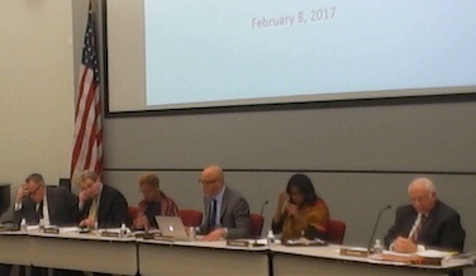
Ears on the SRC: Special Meeting February 8, 2017

by Diane Payne
February 14, 2017

This special meeting of the School Reform Commission was held for the sole purpose of voting on the three remaining charter school applications. A total of five applications were submitted to the district by the November 15th deadline, but the Metropolitan Philadelphia Classical and the Wilbur Wright Aerospace and Aviation Academy applications were subsequently withdrawn. The three remaining applicants were Deep Roots Charter School, Friendship Whittier Charter School, and KIPP Parkside Charter School.

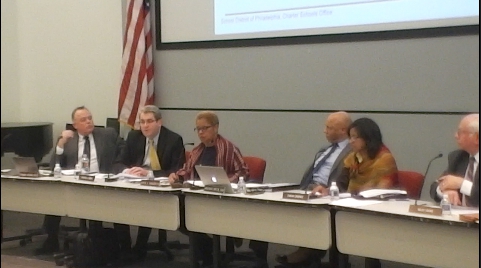
Commissioners present included Chairwoman Joyce Wilkerson, Commissioners Farah Jimenez, Bill Green, and Christopher McGinley. Governor Wolf’s newest appointment, Estelle Richman, has not yet been confirmed by the State Senate, but she did attend the meeting as an observer.

Hearings to analyze the applications were held in December and January by the Charter School Office (CSO) with outside hearing officers overseeing a panel for each applicant. The only notice for these hearings were buried on the district website, so APPS members were not present at the December hearings. However, one or more APPS members attended the January hearings for four applicants (Wilbur Wright Aerospace withdrew before the hearing process, Metropolitan withdrew after).   APPS’ Research Committee has written analyses of each charter based on the application itself, information given at the hearing, and independent research.

The CSO also had significant concerns about each of the remaining three applicants. Their reports can be found here on the School District website.

Resolution from the Floor

Click here to read the entire Ears on the SRC – February 8, 2017.


APPS Review of Cambridge Education Reports on Priority Schools

priority-school-mtg-cambridge-education
A Philadelphia School Reform Commission Priority Schools meeting at Kensington Health Sciences Academy. Chris Finn of Cambridge Education is on the left side of the picture.

by Lisa Haver
January 9, 2017

After attending several focus group meetings at six of the eleven schools designated by the Hite administration as Priority Schools, after reviewing Cambridge Education’s contract with the district, and after closely reviewing the Cambridge final reports on the eleven schools, there is no other conclusion for us to come to: the Cambridge reports cannot be considered reliable on any level, including anecdotally.

In every one of the eleven reports, Cambridge states that teachers do not use data to inform their lessons. This is a surprising criticism from a company that has produced a report so lacking in data that its findings are meaningless. They have come to conclusions based on random comments from various members of the school community without specifying how people were contacted or how many they spoke to, whether in person, in focus groups, or by canvassing.

Although the district’s contract with Cambridge Education states that “classroom observations are the cornerstone” of their School Quality Review, the reports don’t state how many classrooms they visited in each school, which subject was taught in observed classes, how long the visits lasted, or what criteria was used to come to their conclusions.

The resolution passed by the SRC which approved its contract with Cambridge states: “The vendor’s purpose in the School Quality Report is to provide additional on the ground data to inform which strategic investments would be most likely to drive sustained school improvement.” However, the reports do not include any additional data, only that which is available through the district itself. Cambridge has been paid $200,000 by the district for conducting the SQR.

The purpose of Cambridge’s report, as presented in the initial focus group meetings and the district’s October press release, was to determine which of five options would improve eleven neighborhood schools: Blankenburg, McDaniel, Heston, Hartranft and Marshall elementary schools; Harding Middle School; Bartram, Benjamin Franklin, Overbrook, Kensington Health Sciences Academy, and Fels high schools. The five options, according to the district’s October press release, include:

Click here to read the entire article.


Who is Cambridge Education?

by Ken Derstine
January 9, 2017

cambridge-education

On September 15, 2016, the Philadelphia School Reform Commission approved a $200,000 contract with Cambridge Education for investigation of the cash-strapped Philadelphia School District that stated:

RESOLVED, that the School Reform Commission authorizes the School District of Philadelphia, through its Superintendent or his designee, to execute, deliver and perform a contract with Cambridge Education, to develop, manage, and execute a comprehensive School Quality Review process, to gather data and develop qualitative reports on school quality and to engage the school community and gather community input, for an amount not to exceed $200,000, for the period commencing September 16, 2016 through June 30, 2017.

The description the SRC provided of the Resolution said:

The information gathered during the School Quality  Review process will be used to inform recommendations on appropriate measures to be taken to promote sustained school improvement through the System of Great Schools process. The vendor’s purpose in the School Quality Review Process will be to provide additional on-the ground data to inform decision-making. All final recommendations on the investments and interventions to be made in schools will be made by the District.

See SRC Resolution A-3 for the full description of this resolution.

Since the September 15th, 2016 meeting, the SRC has held hearings at its eleven Priority Schools.They were deemed low performing based on test scores. All are in low-income communities. No consideration of the economic status of the student population or lack of resources for the schools due to underfunding was considered.

The SRC will look at five options for these eleven public schools:

•  Entering the school into the District’s Turnaround Network
• Merging the school with a nearby high-quality school
• Engaging a contract partner
• Initiating an evidence-based plan for academic improvement
• Restarting the school

Overseeing the SRC’s Priority Schools meetings is Chris Finn of Cambridge Education. The leadership page of Cambridge Education shows they are all about business. Joining Cambridge in the Philadelphia Priority Schools hearings is Educators 4 Exellence, a corporate education reform group funded by the Gates Foundation.

According to its website, Cambridge Education has 350 consultants:

We work with academies, schools and colleges to develop appropriate strategies to bring about sustainable and embedded practice, improving life opportunities for future generations. We recognise all educational institutions have unique needs and we collaborate with you to develop tailored approaches to some of today’s urgent questions.

A central part of their school reviews is “educator accountability” which includes a great deal of “delivering, supporting, and monitoring the implementation of improvement strategies across classrooms, schools, and districts.” They have trained and “calibrated” 1,000 teacher evaluators. Of its long-range strategy, Cambridge Education says:

As education systems grow in independence and sophistication, we can help to track and manage them. Wherever you are, we are your local company – but with global backing.

Cambridge Education’s recent activities in the U.S. are listed on its parent company Mott MacDonald website:

Our education experts at Cambridge Education worked with Springfield Public Schools to provide 130 administrators and district staff with training to meet the new Massachusetts Educator Evaluator Rubric and supporting the design and implementation of a curriculum alignment plan. The District is now able to provide more targeted professional development customised to requirements of individuals.

For Hillsborough County Public Schools we helped implement the Empowering Effective Teachers initiative, requiring that teachers are observed by administrators, peer evaluators and mentors. In 2013, we collected and analysed over 2,500 lesson observation scores with the resulting analysis being used by the county to help inform its decision making.

Through a partnership with Dr Ronald Ferguson of Harvard University, Cambridge Education delivered The Tripod Project®, a system for US educator evaluation using staff and student surveys. These surveys have been an integral part of the Gates-funded Measures of Effective Teaching project, which is improving results in English and Mathematics.

Cambridge Education is based in England with international offices including a subsidiary in the US. They have several offices in the U.S.and eighteen offices worldwide. Cambridge Education’s goals in the U.S. are described on its parent company Mott MacDonald’s website. The description follows the usual privatization stealth method of corporate education reformers of speaking in vague generalities, but never giving specifics about the privatization objective for public schools.

The British website British Expertise says:

Cambridge Education has been in existence for more than 30 years, and was originally a joint venture between Sir M MacDonald and the University of Cambridge. We still maintain close links with the University, but are now part of the Health and Education arm of Mott MacDonald, a major, international multi-disciplinary consultancy company with more than 12,000 employees worldwide. Cambridge Education itself has over 160 staff members at its HQ in Cambridge and 220 worldwide, of which about a third are educational professionals.

The Mott MacDonald Group Executive Board

A current report of Mott MacDonald says it employs over 16,000 people in 150 countries. Education, with its subsidiary Cambridge Education, is only one sector of its portfolio. Others include aerospace, bridges, buildings communications, environment, health, industry, international development, city development, oil and gas, power, railways, transportation, water.

The Our Hertage page of Mott MacDonald Group highlights some of the companies developed by MMG.

Mott MacDonald Group’s current projects in North America says they are expecting “unprecedented growth in North America.”

The article “Transforming teacher education and learning” shows that they are aiming to become an international leader in digital learning. They are using their Raspberry Pi system and tablets to “demonstrate the value of technological resources and digital learning in teacher education, helping colleges see the value of embedding these practices into their teaching curriculum.”

Members of the Alliance for Philadelphia Public Schools attended many of the Cambridge Education focus group meeting for the Priority Schools. In their APPS Review of Cambridge Education Reports on Priority Schools they concluded:

After attending several focus group meetings at six of the eleven schools designated by the Hite administration as Priority Schools, after reviewing Cambridge Education’s contract with the district, and after closely reviewing the Cambridge final reports on the eleven schools, there is no other conclusion for us to come to: the Cambridge reports cannot be considered reliable on any level, including anecdotally.