Board Must Protect Constitutional Rights of Public School Educators

Board of Education Action Meeting: December 4, 2025

by Lisa Haver
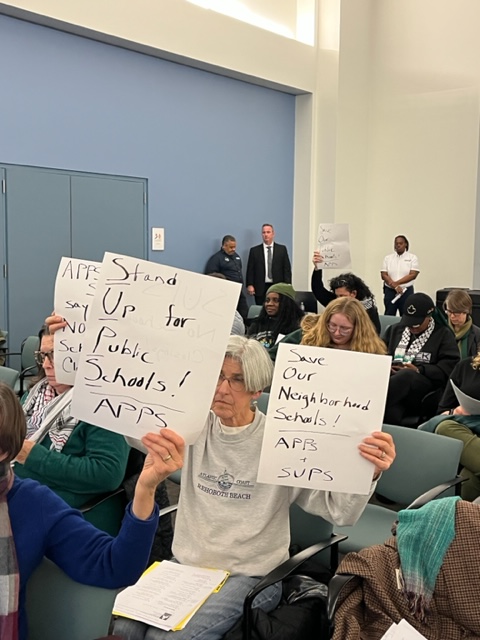
APPS members support Stand Up for Public Schools speakers.
(Photo: Lisa Haver)

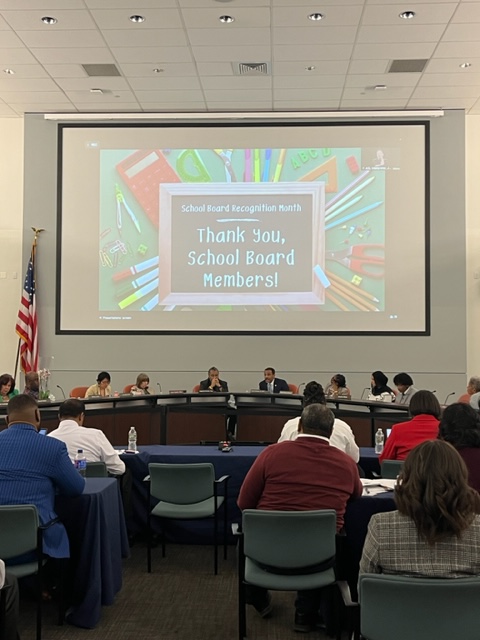
The Board of Education says little of consequence. They create the illusion of deliberation, but most of what they say is directed not to members of the public but to the administration–not to question Superintendent Tony Watlington Sr. but to thank him and his staff for doing their jobs. At this action meeting, Board President Reginald Streater called on every board member for questions or comments after Watlington’s announcement of the new contract with members of the principals’ union (CASA). Except for Board Member Chou Wing-Lam, who asked one question, the rest simply echoed each others’ thanks to Watlington and his negotiating team. That took eleven minutes.  But real deliberation? Almost none. Prior to every action meeting, the board members agree to move most items into a “consent agenda” (likely a Sunshine Act violation), then take one vote–whether it’s for ten items or ninety–without any deliberation. At most action meetings, the entire process takes less than one minute. Streater calls this “efficiency. Parents, students, educators and community members who come to be heard and to get answers have never demanded “efficiency”. They ask the board and the administration to answer them and to take the time to address issues and solve problems that affect their children. The board is the governing body of the School District of Philadelphia. Their constituents include every person in the city–who deserve answers from board members. 

Continue reading here for December 4, 2025 action meeting.
Board Rigs Meeting for Special Interests

Board of Education Action Meeting: May 29, 2025

by Lisa Haver

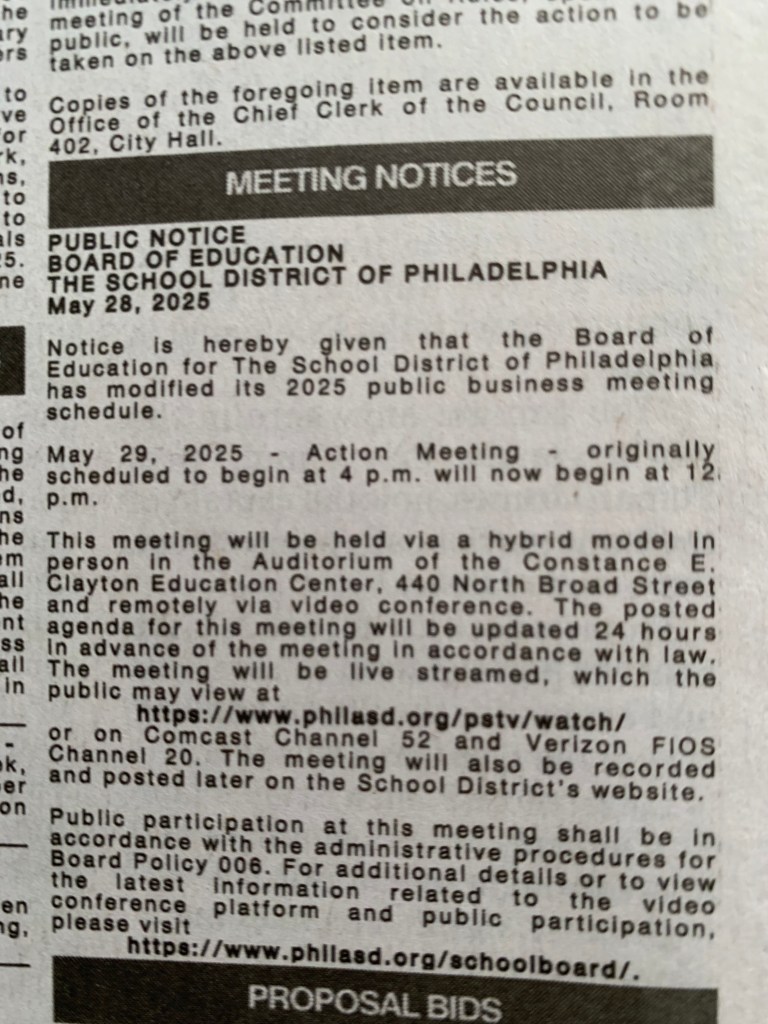
Legal Notice on page B2 in May 28,2025 Philadelphia Inquirer

In this era of authoritarianism, the will of the people is too often subverted to the will of the wealthy and powerful. Despite polls that show a majority of Americans do not support the privatization of public schools, and the overwhelming defeat of voucher proposal referenda in several states, politicians have found a way to overrule the voters and impose anti-public school measures. And despite the growing evidence that an increasing number of the city’s parents are rejecting charter schools, including under–enrollment at over half of the city’s charters, Philadelphia’s Board of Education voted to approve a new application, one they had previously voted to deny. Their convoluted and dishonest justifications served only to underscore how much they had betrayed their constituents for the benefit of the politically connected special interests. That reason, among others, is why APPS members called on Mayor Cherelle Parker to ask for the resignations of the members of the board. 

Continue reading here.

Board Unresponsive to Concerns of Parents and Students

Board of Education Action Meeting:  January 30, 2025

by Lisa Haver

Photo: Lisa Haver

Members of the Board of Education, at their January action meeting, spent more time congratulating  themselves and the administration than they did deliberating on action items or responding to public speakers. Board members offered no questions or comments on any of the 27 action items before passing them unanimously. Several board members praised Superintendent Tony Watlington for his data-centered report on the state of the district, but none inquired as to the inconsistencies in that data. Not one board member answered questions from any of the 38 students, parents, educators, or community members about what the board intends to do about bringing back school librarians, protecting students from ICE raids, repairing dangerous facilities at a district high school, or voting on two new charter applications. Every year, they bask in self-congratulation just for showing up. Have they lowered class size? Brought back school librarians?  Taken steps to rein in rampant charter corruption

Continue reading full APPS report of Board of Education January meeting.

District’s System of Great Schools Decision Leaves Many Unanswered Questions

by Karel Kilimnik

After holding six community meetings at each of the three schools in the 2018 System of Great Schools (SGS) cohort, the District announced one more at each school during the week of February 4th in which the option for each school would be revealed.  APPS members attended meetings at all three SGS School last Fall. Our reports can be found here.

The two possible options for the schools were either placement in the Acceleration Network (formerly the Turnaround Network) or allowing each school to develop its own Academic Improvement Plan (AIP) . The main feature of the first option is the requirement that teachers and principals reapply for their positions in their school. Chief of Schools Shawn Bird told the Board’s Student Achievement Committee that teachers had to reapply so that the District would know whether they were willing to attend the additional monthly and summer professional development. If this is true, then the District changed its policy; it has not been true for the previous two years of this program. But why not just ask the teachers if they will attend the PD? Why would they have to go through a re-application and re-interview process just to answer one question? When questioned by the Committee about this, Bird said he wasn’t sure and would have to check.  Who would he be asking when he is in charge of the SGS process? Another last-minute policy change: this year, the AIP option could also include a requirement for teachers to reapply. This was not disclosed until the last meeting at Harrington in answer to a question from APPS. The other school communities, as far as we know, have not been informed of this.

Superintendent Hite waited until the 2017/18 SPR scores were reported until making the final decision on whether Harrington, Lamberton, and Locke Schools would enter the Acceleration Network or develop their own Plan. Ultimately, he decided to place all three schools into the AIP Option.  Each school would have a Planning Committee selected by the Principal. No criteria was provided as to how Planning Committee members would be selected, only that the Principal would choose them.

As part of the District’s stated plan to “gather information on school strengths, challenges, and ways to improve”, Temple University was awarded a contract to gather input from parents and community members about the strengths and weaknesses of each school. The “Parent. Family, & Community Input Report” (listed under Download Focus Group Report on the SGS website) noted the extremely limited involvement of families. Given that all three schools list student enrollment at over 400, there was paltry parent attendance at each school. The total for parents/community members for all six meetings came to 29 at Harrington, 23 at Lamberton, and 38 at Locke–fewer than ten at each meeting. Their report does not indicate whether Special Ed and/or English Language learners were part of their sample nor what grades were included.

Click here to read the rest of the report