APPS News: November 2017

APPS logo

by Karel Kilimnik

 Unofficial SRC Watchdogs Going Nowhere
For the past five years, APPS has acted as the unofficial watchdog of the School Reform Commission. Our members have attended every Action Meeting, as well as Policy Committee meetings and the Strategy, Policy, and Priorities (SPP) meetings (until they were abruptly discontinued without explanation two years ago). Our first edition of Eyes on the SRC debuted August 2015, and Ears on the SRC appeared in November 2015. We have written articles about many of the vendors hired by the district, including Relay Graduate School of Education, Cambridge Education, The New Teacher Project, and now Jounce Partners. We have questioned the SRC’s propensity to hastily approve contracts, with no public deliberation, including: a $10 million contract with Catapult Schools to take over the troubled Wordsworth Academy students; contracting out the highly valued Nutrition Educators who were PFT members, also given to Catapult; almost $1 million to Educational Testing Services for teacher training at the Priority/SGS Schools; the $8 million and counting to outside legal firms. This list is but a snapshot of how the District, with SRC oversight, spends its limited funds.

As a member of the Our Cities Our Schools Coalition, we joined forces with labor unions, faith-based groups and other public education advocates to lobby Mayor Kenney and Governor Wolf to return our School District to local control.

The research and writing posted on our website as observed, recorded, and analyzed decisions by the SRC proved to be invaluable in crafting our message. How did the people of the city know how destructive state control under the SRC has been? By hearing the testimonies of APPS members at SRC meetings, by reading our commentaries in the local media, by talking to our members at countless community forum first-person accounts on our website. This return to local control is a huge victory, but we will continue to fight to end the disenfranchisement of the people of Philadelphia until we have the right to vote for an elected school board—as all other Pennsylvanians do.

 Victory for Philadelphia: SRC Votes to Dissolve

Click here to read the entire post.

Priority School Updates

src

Do Communities Truly Have a Say in the Future of Priority Schools?

by Lisa Haver

In mid-September, just weeks after the start of the new school year, Superintendent William Hite announced this year’s list of schools targeted for some type of turnaround through his “System of Great Schools”: Rhoads Elementary, Steel Elementary, Feltonville School of Arts and Sciences, Penn Treaty Middle/High School, Gideon Elementary, and Wagner Middle School. This is the second year the district has engaged in a months-long process of data collection, choice of schools, community hearings, in-school focus groups, and determination of the fate of these schools. The district has again contracted with Cambridge Education for consulting services, this year for $100,000, to conduct focus groups with teachers and students. Temple University has been hired for $70,000 to conduct the public outreach and facilitate meetings.

Last year, eleven schools were designated Priority Schools. After the hearing and focus group period, three schools forced out principals and most faculty after being placed in the district Turnaround Network. Two other schools developed internal turnaround plans which mandated that teachers reapply for their jobs.

Some schools, including Harding Middle, have put into place an all-blended learning curriculum in which students spend a significant amount of time learning on the computer rather than interacting with the teacher and other students. The district hired ISA (Institute for Student Achievement) to be embedded year-round for intensive professional development and teacher coaching at Fels, Overbrook, and Kensington Health Sciences Academy high schools. [The resolution approves a contract with Education Testing Service (ETS) as ISA is now a subsidiary of ETS.]

The district also contracted with Jounce Partners (see Resolution B23 at the bottom of the page) for similar intervention at McDaniel Elementary.

The plans implemented at many schools ignored the stated wishes of the parents who attended the community meetings. At both Blankenburg and KHSA, principals were removed over the objection of the parents and educators. At none of the hearings we attended did parents call for the reconstitution of faculty. No district representative mentioned the contracting of outside consulting companies.

Community members who attended last year’s meetings are experiencing a strong sense of déjà vu at this year’s meetings. The district is using the same Power Point presentation, with the same disclaimer that the schools are not performing “despite investments” made in them. Again, the district does not explain what the options involve unless specifically asked by community members. The district has attempted to place the onus on the public to give them information without any explanation of what could happen to the school.

As defenders of public education, APPS members are attending community meetings and posting reports from each school.

These are updates (at the end of each report) of previously posted reports on Priority School meetings. We will be updating information on the Priority Schools as some meetings continue and when Dr. Hite makes his decision.

APPS reports on Priority School meetings
(To read the updates scroll to the end of each school post.)

The Growing Influence of Jounce Partners

Gideon Elementary School

Penn Treaty Middle/High School

Rhoads Elementary School

Wagner Middle School

Steel School


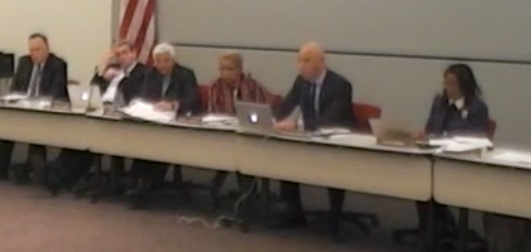
Ears on the SRC: November 16, 2017

SRC demise celebration

by Diane Payne
November 27, 2017

Victory!

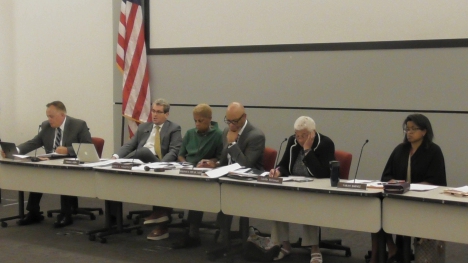
All five Commissioners were present for this historic meeting of the School Reform Commission. Resolution SRC-3— Recommendation of Dissolution of the School Reform Commission was passed at 7:35 p.m. with a 3-1-1 vote. Commissioners Wilkerson, Richardson, and McGinley voted in favor, Commissioner Green voted against, and Commissioner Jimenez abstained. This joyous occasion ended sixteen years of state-imposed control of our city’s schools. There were cheers, hugs, dances, and high-fives when the resolution passed. The tireless and persistent effort of the Our Cities Our Schools coalition of parents, teachers, students, unions, and community advocacy groups made this happen. [See APPS’ statement on the end of the SRC and what should come next.]

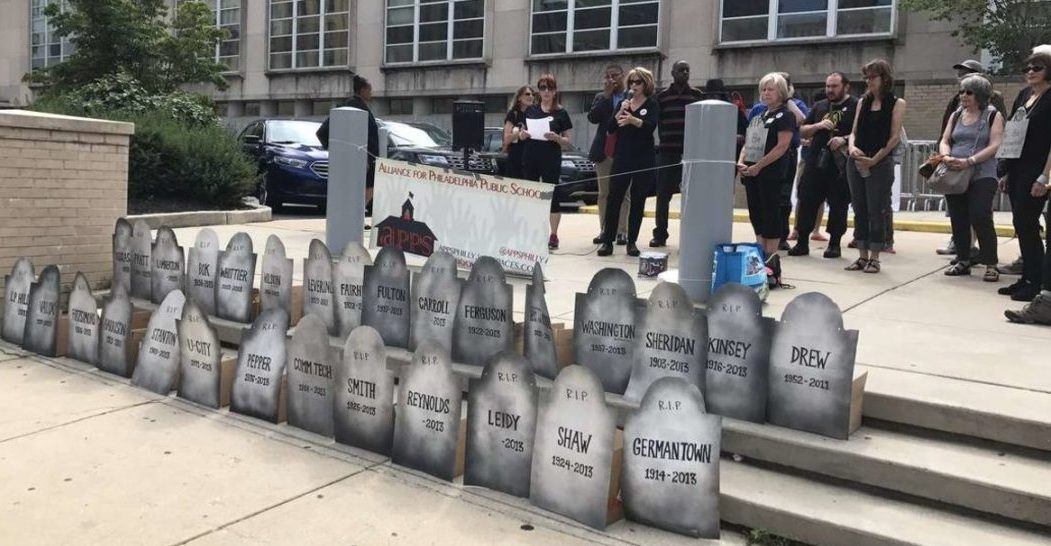
Our City Our Schools (OCOS) and the Philadelphia Federation of Teachers (PFT) organized a celebratory rally outside district headquarters just before the meeting. APPS co-founder Lisa Haver addressed the crowd, along with Councilwoman Helen Gym, State Senator Vincent Hughes, PFT leaders, parents and community members. There was much to celebrate on this new day, one that signaled the end of a state-imposed system that brought austerity and corporate reform for a perfect storm of devastation to the city’s public schools

Having worked for the preservation and improvement of public education for over five years as an organization, and for many years as individuals, APPS members know that this is not the end of challenges for our school system. We will continue to advocate for the what other districts in Pennsylvania have had for many years: schools that provide the education our children deserve governed by a democratically elected school board.

Some of the Philadelphia news outlets and their coverage of this important event:

Click here to read the rest of the post.
The Growing Influence of Jounce Partners

jouince parntersby Lisa Haver and Lynda Rubin
November 24, 2017

It would be safe to say that no public school teacher in Philadelphia has seen or heard any colleague forcing a student to face the wall and repeat the same phrase 25 or 30 times. Any principal who witnessed such an occurrence would be within his or her rights to formally reprimand that teacher.

Wall Practice:
1. After giving feedback and monitoring to the point of automaticity, have teacher(s) turn toward a wall in the room to practice the skill 10-20 more times (primarily used for multi-teacher PD sessions).
2. Frame as optimal practice because greatest number of reps can be achieved this way.

3. Emphasize the importance of every rep being executed perfectly and with exaggeration of nuances.

Incredibly, that is precisely what teachers in some district schools are being forced to do. It is but one of the tactics developed by Jounce Partners as part of its intensive coaching and professional development plan, already in use at McDaniel Elementary, one of the eleven schools designated last year as “Priority Schools”. The district has approved Jounce as a partner for principal and teacher training in schools that have been included in its “System of Great Schools”.

The district hired Cambridge Education to conduct surveys of the parents, teachers, students and community members at last year’s Priority schools. APPS members heard these stakeholders ask for more staff, return of NTAs and librarians, more counselors, smaller class size, less standardized testing and more after-school activities. We did not hear any member of any the eleven school communities ask for the removal of teachers and principals or more training for teachers. Nevertheless, the SRC approved a resolution to enter into a $70,000 contract with Jounce Partners for “Implementation of High-frequency teacher Coaching for School Transformation” at McDaniel Elementary”. That resolution, one of 142 approved by the SRC at its June 2017 Action Meeting, stated:

Click here to read the rest of the post.