
Board of Education Action Meeting: March 26, 2026
by Lisa Haver
“The truth is, this plan was created by too many people who are not from here and do not understand this wonderful and complicated city.”
APPS Member Kristin Luebbert
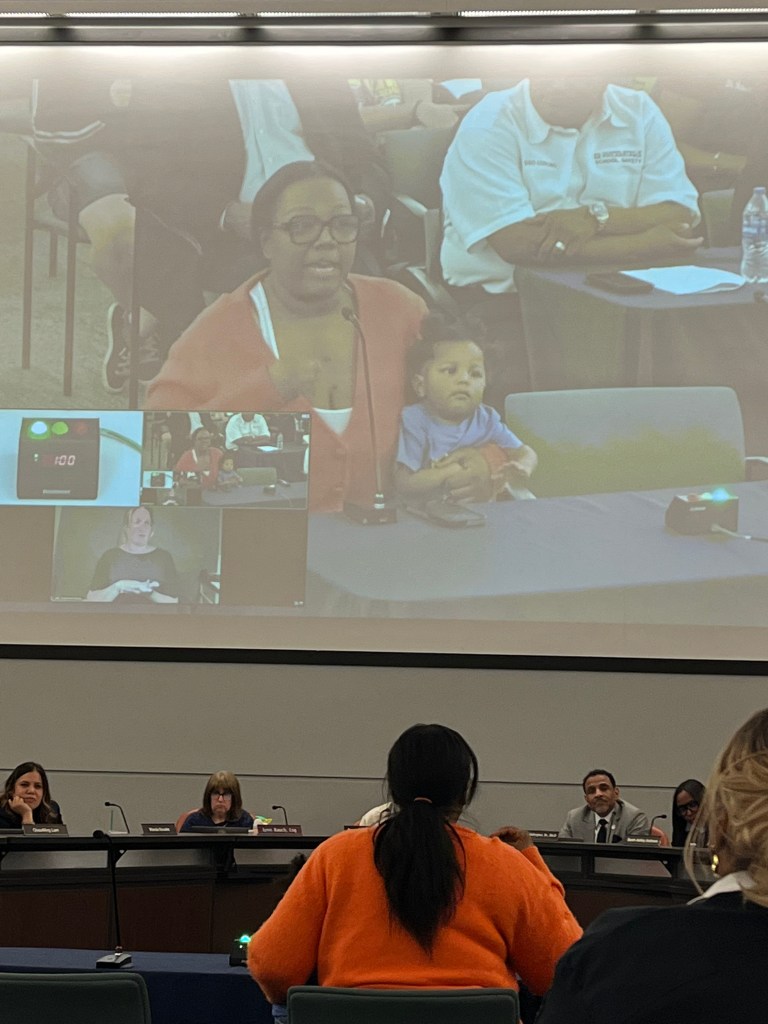
Students, parents, teachers, graduates and community members returned to the board of education with one message: We love our schools. Do not close them. The board has heard this same message from hundreds of people at board meetings, town halls, City Council hearings, district community meetings, and from the thousands who responded to district surveys. Yet the board has still not said when it will take the vote. At the March 12 town hall, 125 people spoke against the recommendations in the plan; one parent from another school testified in favor of the changes recommended for Moffett Elementary. At this meeting, one Masterman staff person endorsed the plan’s recommendation to expand Masterman; she didn’t mention that this necessitated the closing of Waring elementary to make room for the magnet school students. So perhaps it’s more accurate to say no one wants this plan–except for two people who want disruptions at schools other than theirs. The people have spoken: the board must reject this Facilities Master Plan.
APPS Digs for Truth in Facilities Report
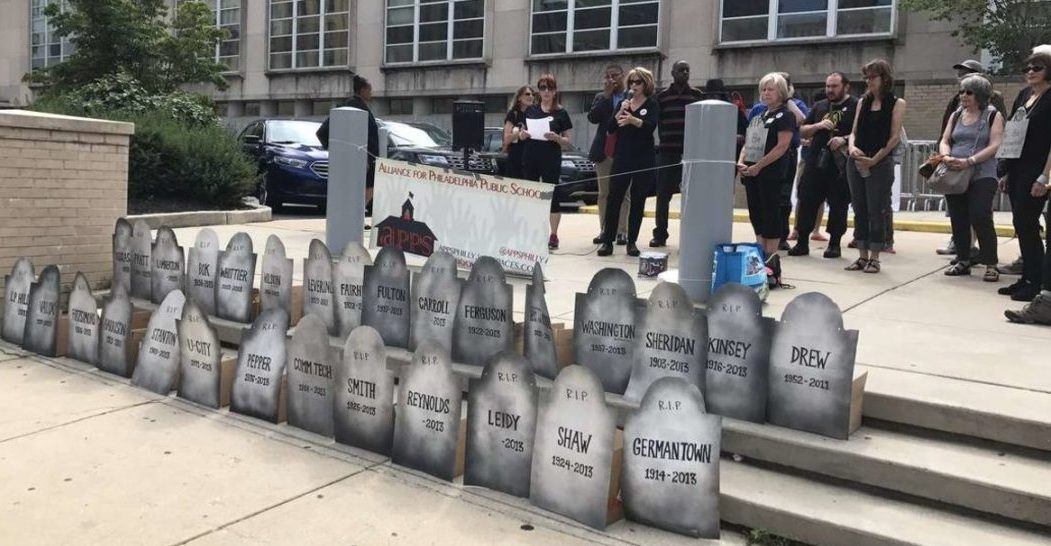
Since 2024, APPS members have been testifying to counter the misinformation presented at district and board meetings. For example, district presentations have clearly said that the facilities process was not based on budget issues. Superintendent Tony Watlington Sr. has never said that the district can’t afford to keep schools open. Yet Board President Reginald Streater now alludes to underfunding from the state in answer to facilities questions. In addition, the district continues to suggest that schools would “merge” when one closes. There is no truth to that. At this meeting, teachers and staff from several schools again testified that the district’s data on capacity, utilization and project alignment are inaccurate. APPS took a deep dive into the Facilities Master Plan (FMP) released last month and its recommendations for the district’s 200+ schools. In addition to the 18 closures, the plan includes these recommendations: 12 co-locations, 8 buildings to be given to the city at no cost, 34 grade band changes, 16 catchment areas redrawn affecting approximately 33 schools in over 20 zip codes, and modernization projects at 159 schools to begin in 2032. Yet the district held no hearings on any of these changes, and it appears they have no intention to hold any before the board votes–whenever that is. The APPS analysis shows that the district’s facilities master plan is anything but. The Watlington administration has put together a collection of incoherent recommendations lacking sufficient data, based on non-existent funding, that would inflict devastation on public schools and trauma on our students.
Parents, Students, Educators, Community Return to Protest Plan
APPS member Deborah Grill, who co-wrote APPS’ analysis of the FMP, testified that she had the “displeasure” of reading through hundreds of pages for a plan based more on conjecture than reality. The plan recommends building improvements that have no funding source and won’t even begin for almost ten years–perhaps, Grill said, “in time for the next round of school closings.” Grill told the board that the district has learned nothing after the devastation of the 2013 school closings: “Our students, on the other hand, have learned that they will be punished for the district’s mistakes and neglect and that real estate is so much more important than their education.”
Parent Katy Hoffman-Williamson, along with several other members of the Moffett Elementary community, returned to urge the board to vote No on closing the school. Hoffman-Williamson spoke of the “uniquely diverse, high-performing school with strong community support and high academic achievement.” There is no logic to the FMP recommendation, she told them, especially with their high building utility score. Closing the elementary school and replacing it with a middle school would force young children to travel much farther, some as far as 1.5 miles. In addition, fewer families would be able to attend concerts and award ceremonies. Hoffman-Williamson told the board: “Our Moffett kids, who are over 70% Black, Hispanic, Muslim, Palestinian, Asian and multi-racial are being punished by this plan, kicked out of their school, their safe space, in order for a majority white school in an entirely different neighborhood to gain a more palatable middle school.”
Jade Colon, Stetson Middle School 8th grader and co-president of her school’s student council, returned to tell the board that closing Stetson means throwing away the place that students see as home. “Stetson is a beautiful place,” Ms. Colon told the board, “if you actually visited you could see our pride.” She asked why the school was being punished because the district promised to fix the roof but never did. “If something is broken, you fix it”, Ms. Colon testified, “you don’t throw it out.”
Alexis Gitman, “proud music teacher” at Stetson MIddle School, spoke of the “sword of Damocles” hanging over their school. Previous speakers had reminded the board of what Stetson has been through over the past 20 years, including a hostile takeover in 2011 by Aspira Charter company; Aspira’s mismanagement of both Stetson and Olney High School led the district to regain control of the schools. Gitman testified that the district’s utilization score is misleading as the school is “85% usable on our usable floors”, that is, all floors except for the 4th. That floor has been damaged by a leaky roof that the district should have fixed years ago. Rather than displace an entire school community, Gitman testified, the district could make the repairs to the roof and the building, then put their swing space on the 4th floor.
Overbrook Elementary Art Teacher Katherine McQuade returned with parent Rhemar Pouncey to testify about the school’s close-knit community at their “little castle on the hill”. The school has been a fixture in the community for over 100 years. Like Moffet, she told the board, Overbrook also has an autistic support program whose students’ futures will be in doubt. As an art teacher, McQuade urged the board to find a more creative solution for Overbrook than just closing it forever.
APPS member and former district teacher Kristin Luebbert told the board to “throw this plan in the shredder” and start over. She gave copies of the Waring Elementary catchment area map to board members and to Watlington. She urged them to walk that distance themselves from its southeastern-most point at City Hall, Broad Street and JFK Boulevard, to the northwestern end at Bache-Martin Elementary, 22nd and Brown Streets. Only then would they realize that displaced young Waring students would have to cross several busy thoroughfares including Vine Street, Spring Garden Street, and Fairmount Avenue. “Many of you ‘leaders’ and those in power keep saying, ‘We have to do something’”, Luebbert told them, “but that does not mean you have to do just anything.”
For almost three hours, members of many school communities asked the board to reject the facilities plan, including several from schools targeted for closure. None of the board members responded to any of the students, parents or educators. President Streater did not call on the board for questions or comments in response to the public testimony.
No Deliberation on Action Items
The board took one minute to take one vote on 28 official items totalling $118,967,250. There was no deliberation on any item including Action Item 26, $84.5 million for contracts with several providers of pre-K programs.
The meeting adjourned at 7:42 PM.
Next board action meeting: Thursday, April 23 at 4 PM.
Next board Policy Committee meeting: Thursday, April 30 at 4 PM.
[Published: March 30, 2026]
 Alliance for Philadelphia Public Schools