Board of Education Action Meeting: June 26, 2025
by Lisa Haver
“The Party told you to reject the evidence of your eyes and ears. It was their final, most essential command.” George Orwell, 1984
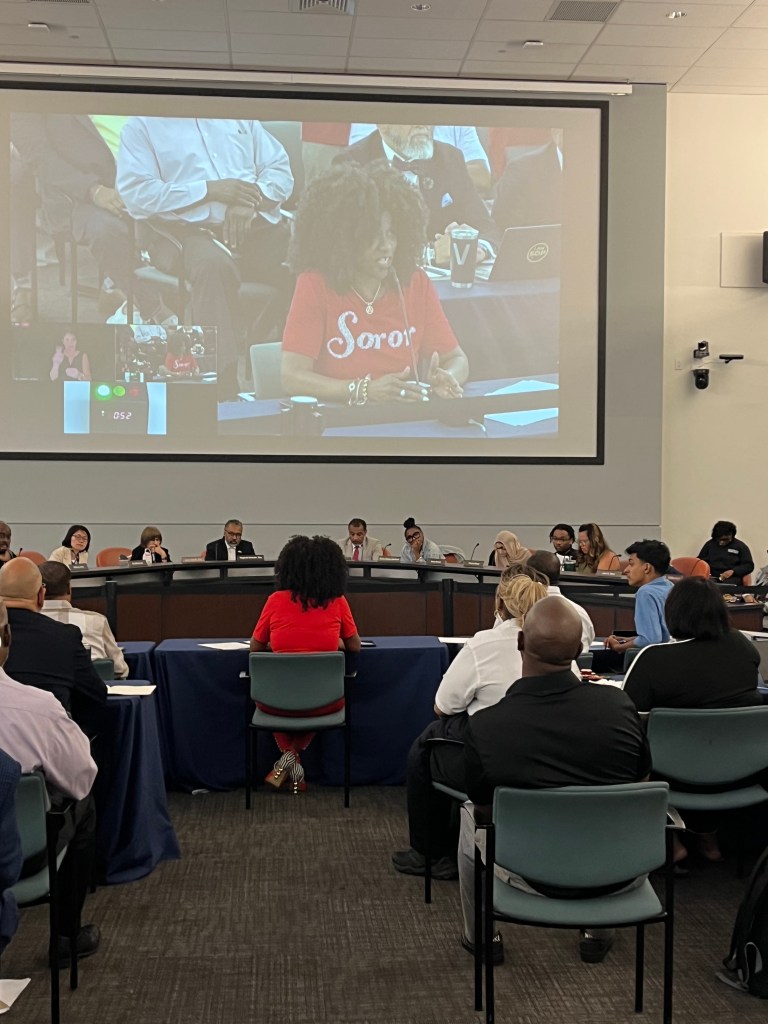
A governing body convenes an action meeting. They listen to a presentation from the director of a department they oversee. The president of the board raises each issue, and members of the board comment and question. The president then calls on each member to give their position. He tallies the responses, then directs the department chief to carry out the action that the majority of the board voted for. Except when the Philadelphian Board of Education does this, according to Board President Reginald Streater, it’s not voting. True, the terms “motion”, “roll call” , and “vote” were not used. But the board came to decisions on the futures of six charter schools in the renewal cohort after listening to Charter Schools Chief Peng Chao and deliberating on the information presented. Streater called on each member to state their position on whether the school would be granted a 5-year renewal, a 1-year renewal, or no renewal. He counted their responses, then directed Chao on what type of document to draw up. How is that not voting? Every time APPS members called out that the board was voting, even though none of those charter items had been placed on the agenda, Streater insisted they were not. The dictionary definition of the word “vote”: a formal indication of a choice between two or more candidates or courses of action, expressed typically through a ballot or a show of hands or by voice. The public’s faith in this board continues to erode because of its lack of transparency and public engagement, along with its reluctance to hold the administration accountable. Now they want to tell people not to believe what they see and hear with their own eyes and ears.
Ilene Poses contributed to this report.
Board’s Speaker Suppression Policies Again Exclude Public
Last month, the board changed the time of its May action meeting from 4 PM to noon at the last minute, without any notice on its website or on social media, with no email sent to educators, with no press release to the media. Thus, students, educators and most parents were unable to attend. That made room on the speaker list for supporters of the Early College Charter, who took fifteen of the thirty slots. This month, the board compiled a list in which 24 of the 30 approved speakers represented charter schools, including charter CEOs who have daily access to the board’s Charter Schools Office. Not one person opposing charter renewal was placed on the list. Security staff told people awaiting admission downstairs to come forward only if their names were called from the speaker list. APPS members asked him whether the board would be replacing the 100 seats they have removed from the auditorium so everyone could come up; he had no response. So if you can’t get on the speaker list, you can’t get into the auditorium, and you can’t be seen or heard. The board’s speaker suppression policies allow them to pack both the speaker list and the auditorium with charter supporters. CASA President Robin Cooper asked in her testimony why her members, the district’s principals and administrators, were blocked from speaking once again. Why, Cooper asked, is this public school board barring public educators from speaking?
Board Renews More Substandard Charters
During the board’s voting on renewals, Streater stated that the board wants to show that “the academic domain has teeth.” Actually, the board’s votes demonstrated the toothlessness of the board’s enforcement of their own standards. Fourteen of the charters they renewed failed to rate a “Meets” in Academic, including four in the lowest category, Does Not Meet, with scores below 45%. Frederick Douglass Mastery, for example, has not met academic standards since Mastery took the school over ten years ago; the board renewed the school for yet another year. Deep Roots with 37% in Academics and Russell Byers with 41% both received 5-year renewals. Both CSO staff and board members repeated talking points given by charter administrators in their testimony. It was disappointing that none of the board members asked charter CEOs about their exorbitant salaries or their failure to meet academic, organizational, and financial standards. BM Crystal Cubbage asked what the purpose of the conditions is. Chao’s response did not include the fact that there are no consequences for failing to meet conditions, which the board demonstrated yet again with their renewals. Streater also said that his reading of the charter law is that charters “should outperform district schools”. He then voted to renew schools that had never done so.
Board Remains Silent on Why It Is Closing Public Schools
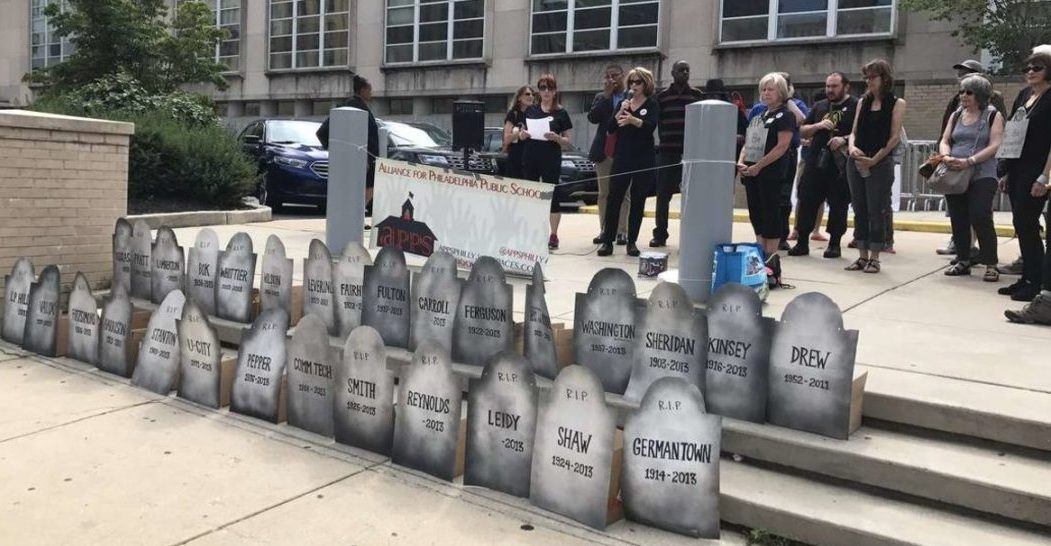
The board has yet to say why it is planning to close more neighborhood schools. APPS members have asked in testimony and in letters to the board why the “public engagement” committees appointed by the district are not open to the public. The board had posted its facilities process timeline which included no public meetings after Fall 2024 until after they released their recommendations, including the names of schools they intend to close later this year. Last month, APPS emailed the board to ask why meetings of the Facilities Team Project Committee (TPC) are closed to the public and reminded them that the Pennsylvania Sunshine Act stipulates that all committees appointed by any governmental body or agency be open to the public and allow public testimony. The board did not respond. APPS also filed an official Right to Know request for the minutes of TPC meetings; that request was denied. Last month, members of the district’s Community Partners advisory group spoke out about the administration’s failure to provide requested information, for canceling meetings at the last minute, for overall lack of support for the Council’s efforts. Last night, Superintendent Tony Watlington Jr. announced the addition of more public meetings on facilities. (It was disconcerting to hear Watlington invoking the “successful” co-location of Science Leadership Academy to Ben Franklin High as a model for the current facilities program. That project was so mismanaged by Superintendent Wiliam Hite that its final price tag was five times the original projected cost. Several students and staff had to be taken to the hospital after inhaling toxic dust from construction materials.) Despite the district’s stonewalling the public on closed meetings, some board members took on a chiding tone when addressing the audience. They seem to be implying that if parents didn’t attend one of the meetings just added to the calendar, they shouldn’t complain if their children’s schools close. Were any of these board members around in 2013 when the district closed 23 public schools? APPS members witnessed students from University City High, Carroll High, Germantown High and others beg and plead with the School Reform Commission to save their schools. Their cries were ignored, and their schools were closed anyway. Now the vultures are circling once again: the board approved two items (Items 17 and 18) on this agenda contracting with firms who will “serve as real estate brokers on property sale transactions” and real estate appraisers who “will be used to evaluate surplus properties, when needed, for sale purposes.”
Board Approves Spending of $300 Million without Deliberation
In one minute and 23 seconds, without any discussion or deliberation, the board approved 50 Action Items and spending totalling $309,084,028.
The meeting adjourned at 9:06 PM.
Next board action meeting: 4 PM on August 21, 2025 at 440 N. Broad Street. (First day of school for staff is August 18, 2025; first day for students is August 25, 2025.)
 Alliance for Philadelphia Public Schools