
Board of Education Action Meeting: February 26, 2026
by Lisa Haver
“Passing this facilities plan would be an egregious breach of trust by the board.”
West Philadelphia Community Member Leah Clouden
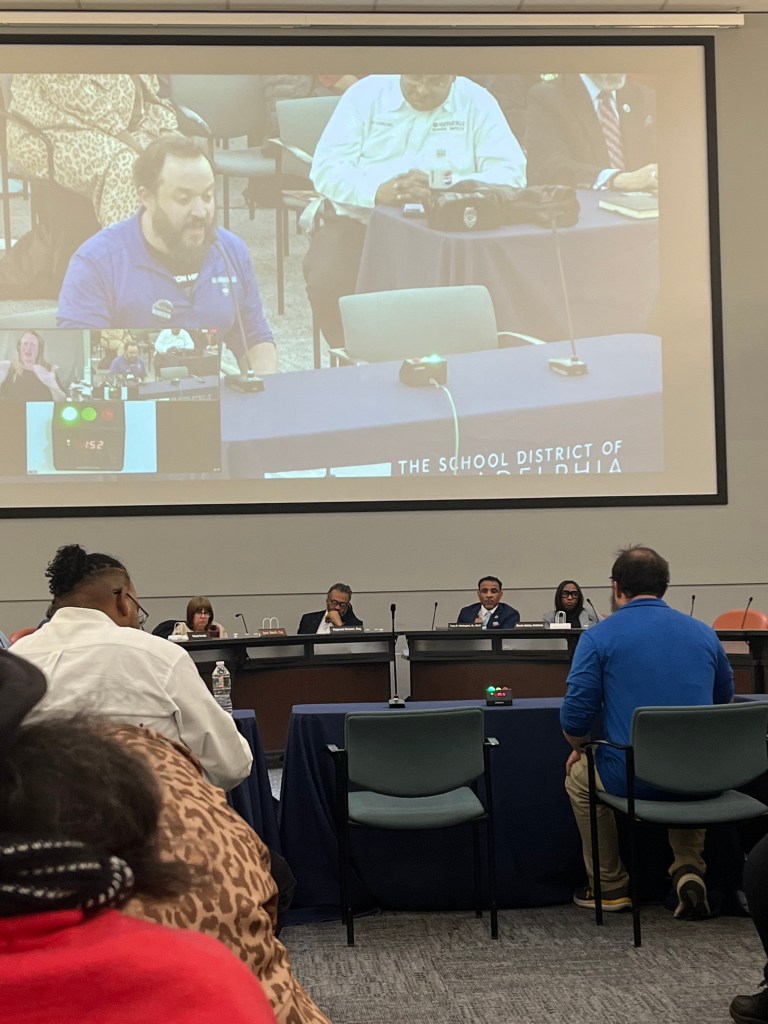
Not for the first time, Philadelphia students put the adults in charge to shame. They came with facts and data that disproved the district’s misinformation. They came with well-reasoned arguments about why closing their school makes no sense. They came with charts and maps that clearly illustrate their position that their schools should remain open. They presented data that showed that Black students would be harmed most by losing their schools. This in contrast to Superintendent Tony Watlington, whose rambling, tangent-filled 31-minute speech was one of the reasons this meeting did not adjourn until early Friday morning. Parents, educators, and community members packed the meeting. They were joined by elected officials including City Councilmembers Jamie Gauthier, Jeffery Young, Quetcy Lozada and Cindy Bass, along with State Senators Anthony Williams and Sharif Street and State Representative Daresha Parker. All spoke against the plan and any school closings. The board, for the second month in a row, violated its own by-laws by marking present one board member, Chou-Wing Lam, despite the fact that she was seen by the public on screen for less than half an hour total during the 8-hour-plus meeting. She was not present for the public testimony, yet she was allowed to cast a vote for all action items. APPS did score one victory: after repeated emails to the board, they restored to the auditorium the almost 100 seats they had removed last year.
Ilene Poses and Deborah Grill contributed to this report.
District Continues Stonewalling on School Closings
One question that APPS members have asked of district representatives at schools slated for closure: Why are you closing this school? Their plan makes allusions to the average age of district buildings, but has never cited age as the reason to close any one school. They talk about underenrollment in some schools, but can’t explain why they are closing a school that is close to 100% enrolled. The reality is that they have no reason. It’s just part of the master plan that has been rolled out with recommendations that make almost no sense. As many speakers at this meeting pointed out, the district is closing schools having heard not a single person say they wanted it. Watlington touts the district’s community engagement, but doesn’t mention that no one in any of those meetings advocated for closing schools or for co-locations or grade reconfigurations. In fact, most of the schools affected by the plan have had no meetings with district officials and there are none scheduled. Board members commented on the plan, but none indicated that they would vote against it. .
Board Will Probably Pass the Plan Next Month
Dr. Watlington presented the final draft of the Facilities Master Plan to the board at this meeting. The hard copy, with recommendations for all 217 district schools, is hundreds of (unnumbered) pages long. Watlington’s presentation, however, contained only 31 slides. Is the board going to read every page and consider every recommendation before they vote? There is not a single recommendation in the plan that anyone in any public meeting asked for. Some schools didn’t find out about proposed changes for their schools until they got an email, sent the day after this meeting, that told them the board will be voting on those changes. The district has held no meetings at those schools, and there are none scheduled. Anne Frank Elementary in the Northeast, for example, found out via a February 27 email from 440 that the district intends to convert the school from a K-5 to a K-4. That came as a surprise as no one at the school asked for that or had any representative come to Anne Frank to present that recommendation and ask for their reaction to it. This is happening to schools across the district. John Moffet Elementary in Olde Kensington was informed via email from 440 about two weeks ago that their elementary school would be removed from the building and replaced with a middle school. The Moffet community considers this a closing and has asked why they only got district representatives to come out after several requests. Yet the board appears poised to pass the plan at next month’s action meeting. APPS members asked last night, as we have in every community meeting and in City Council, when the board will be voting on the plan. They refuse to answer. If the board won’t deny that they will vote next month, we assume that they will. City Councilmember Jamie Gauthier, who appeared at community meetings fighting to save Robeson and other schools in her district, stayed until the action meeting adjourned after midnight. She asked the board to postpone any vote on the plan until Council and the community can read the plan closely and try to assess the totality of the changes. Both PFT President Art Steinberg and CASA President Robin Cooper echoed that request. Nicole Hunt, President of 684 Cafeteria Workers Union, reminded Watlington that he is in charge of the city’s schools, not the city’s housing, and that his job is not to prioritize the mayor’s agenda.
School Communities Speak Out
Parents, teachers, students, principals and community members from schools slated for closure waited for hours to testify: Lankenau HS, Robeson HS, AMY NW HS, Parkway NW HS for Peace and Justice, Stetson MS, Harding MS, Waring Elementary, Ludlow Elementary, Morris Elementary, and Overbrook Elementary. One Harding teacher who was called up at 10 PM opened her remarks by noting that she had waited for 6 hours to be heard–and there were many more after her.She and others from Harding enumerated the positive programs Harding had developed and noted its importance to the neighborhood. She also disputed the district’s data on the building and programs. We can only include some of the speakers here, unfortunately, but you can watch the video of the full meeting here.
Stetson Special Education teacher Kathryn Lajara testified about the “disruption layered on top of disruption” that has been inflicted upon the middle school over the past 20 years. About 25 years ago, Stetson was turned over to Edison Schools, a for-profit management company who “profited off of our students”. The district took control back but failed to make repairs in the wake of Edison’s neglect. In 2011, the School Reform Commission approved a hostile takeover by Aspira Charter Schools, whose management was so disastrous the district took it back in 2022, again failing to make repairs. Lajara told the board that the school was now being asked to accept a permanent closure that fails to take any of this into account and, in addition, uses incorrect data about the condition and capacity of the Stetson building. “If equity truly guides this board’s decisions,” Lajara asked, “then why is a school that has endured systemic disruption being penalized for the very instability imposed upon it?”
Parkway Northwest HS student Melody Jenkins asked why the board would dismantle a school that is working so well. She recommended that the district replicate the school.
Robeson teacher Andrew Saltz testified that he had nothing against Sayre HS, where his students are supposed to go if Robeson closed; Sayre students deserve all of the resources and programs they need and deserve. But you don’t have to gut one school, Saltz told them, to improve another. Several Robeson parents and Councilmember Gauthier reminded the board that a current Harvard student was a graduate of Robeson.
Lankenau’s principal, teachers and many others rejected the district’s last-minute change to the Lankenau recommendation which now claimed to be merging the school with Saul HS instead of Roxborough. (The reality is that there is no “merger” as Watlington and his staff keep saying. When a school closes, it is gone. Creating a new program at another school doesn’t change that.)
Several speakers defended AMY Northwest. One parent noted that while the enrollment had declined recently, that was not the school’s fault but was a direct result of the district’s disastrous admissions policy changes.
Teachers from Blankenburg Elementary in West Philadelphia testified about their struggle to maintain the school while being surrounded by charters. (A branch of Global Leadership Academy is across the street; the CEO of that school was paid over $500,000 in salary and compensation last year.)
Fitler Elementary Principal Kate Sylvester testified that the Southwest Germantown school is on the rise for a number of reasons including improving academics. Fitler parents and staff spoke about Fitler’s historic significance as one of the oldest school buildings in the city.
Waring Elementary parents testified that the district would be creating a school desert in that Brewerytown neighborhood as they had Ludlow Elementary and Morris Elementary also recommended for closure. Children would have to travel much farther, and parents feared that they would end up in overcrowded classrooms.
APPS members Lisa Haver, Lynda Rubin and Barbara Dowdall testified after midnight. (Deborah Grill and Ilene Poses couldn’t wait to be called up as their car was in a lot that closed at 11.) Haver reminded the board and those still in attendance that in the end, Mayor Parker, who appoints the board, would be the decider on whether the plan moves forward. Parker’s biggest backers include real estate developers and the building trades.
Board Passes Official Items Without Deliberation
In less than one minute, and without any deliberation, the board voted unanimously to approve spending of $164,326,555.
The meeting adjourned at 12:21 AM Friday.
Next Board Meetings
Facilities Town Hall Meeting: Thursday, March 12, 4 PM at district headquarters, 440 N. Broad Street.
March action meeting:Thursday, March 26, 4 PM at district headquarters, 440 N. Broad Street.
[Published: March 2, 2026]
 Alliance for Philadelphia Public Schools