Board of Education Action Meeting: October 19, 2023
by Lisa Haver and Deborah Grill
For the second time in a week, charter operators held a rally in front of school district headquarters. At the first, State Senator Anthony Williams, speaking on behalf of the African American Charter School Coalition, targeted a district employee, disparaged Board President Reginald Streater, and called for violence at the next board meeting.
Williams, a frequent beneficiary of charter supporter Jeffrey Yass, accused Streater of harming children while acting “like he’s Mr. Black Man of America”. Williams also issued a veiled threat to Charter Schools Office Director Peng Chao, calling for his removal. He then incited violence against board members, district staff, and community members when he told charter supporters that he wanted to see “chairs flying around” at the next board meeting.
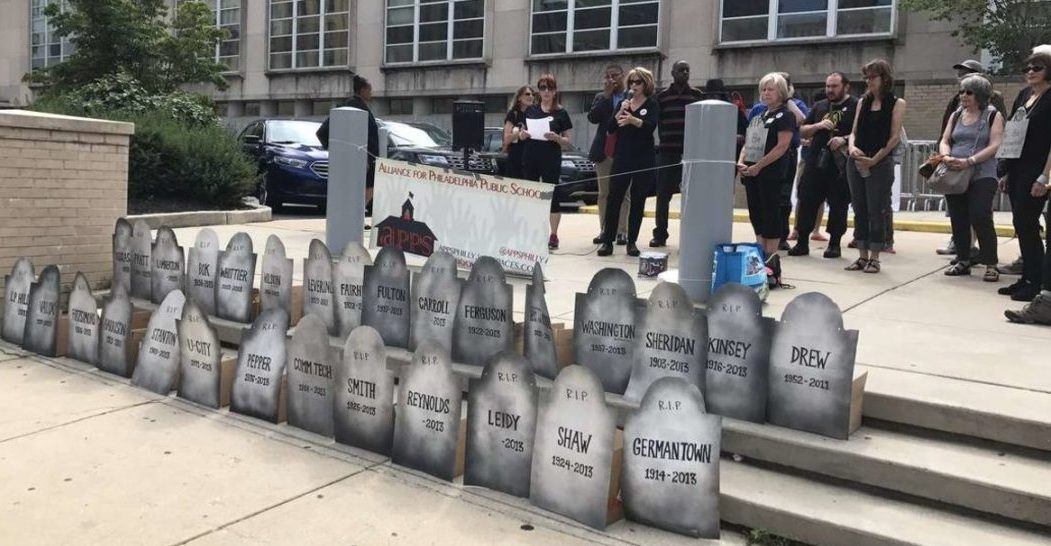
No member of the Coalition disavowed Sen. Williams remarks when they returned to the steps of 440 just before Thursday’s action meeting. In her testimony, Lisa Haver reminded board members that this was not the first time that the charter operators had made unfounded accusations against Charter Schools Office staff and that the board failed then, as it does now, to defend them. She urged board members to have the “decency” to stand up for their own employees against these attacks. None of the board members responded.
APPS members have urged the board for years to hold public charter renewals. When the public can see and review the renewal evaluations that show charters failing to meet basic standards, the misinformation put out by charter operators can easily be refuted by the facts. One question that the board and the public could ask: why are so many charter administrators paid so highly, including those whose schools are below basic? Attorney and charter researcher Susan DeJarnatt wrote in an Inquirer letter to the editor: “Charters must be accountable for the millions in public money they receive. Which charter does [Sen.] Williams think should have stayed open? New Media, whose founders went to prison for stealing from the school? Leadership Learning Partners, which was ordered to repay over $1 million in tuition overcharges? Or the others that were inadequate by the metrics that Pennsylvania imposes on all public schools? The CSO appropriately holds charters and their boards accountable. It should be praised, not vilified.”
Last Minute Agenda Change
Just hours before the meeting, board staff members sent out emails and called people who had registered to speak that day, telling them that they had to be there by 4 PM or earlier. Apparently, the board had decided to rearrange the agenda, although their online agenda did not reflect any change. No reason was given. When APPS members asked why, the staff member could not answer. We wrote to the board, telling them that expecting people to change their schedules and leave work even earlier was not acceptable. We told them that we expected every speaker, no matter when they arrived, would be allowed to speak. It turned out that two items concerning the sale of bonds, according to the board’s explanation at the beginning of the meeting, had to be voted on because of the fluctuating stock market. The fact is that no one on the speaker list was addressing either of the items, so there was no need to rearrange the agenda or tell people they had to rush to get there. The board’s speaker suppression policies already deter public engagement, they don’t have to make it worse.
Watlington Authorizes Another Study
This year, and every year in recent memory, parents and students have testified before the board to protest the district’s practice of leveling. Leveling creates instability in classrooms and schools. It is a practice carried out for financial reasons, not academic ones. The board misses no opportunity to say that everything they do is “for the children”, but they have done nothing to stop this disruptive practice. In his remarks, Watlington promised to carry out an “in-depth” study on leveling. Does this mean that Watlington will hire more consultants? When students and parents pushed back on how the high school special-admission policy was changed and the confounding way in which it was carried out, Watlington promised to look into it. He then hired Accenture, Inc. at a cost of $298,000 to conduct a study. Watlington has put together a large leadership team. Why can’t he put together a team of those administrators to tackle this issue?
APPS and PARSL Advocate for More School Librarians
Two members of the Philadelphia Alliance to Restore School Librarians (PARSL) returned to testify at the meeting. PARSL CoordinatorJennifer Lowman told the board that PARSL was created because the district has only one full-time equivalent librarian for its 217 schools; that is, there are three librarians in the system, but none is in the library full-time. She told the board that PARSL has collaborated with the district’s Office of Grant Development on a Laura Bush 21st Century Librarian grant application, and she urged the District to appoint a point person to deal with restoring school libraries and certified teacher librarians. Deborah Grill, APPS’ liaison to PARSL, read from an item on this meeting’s agenda that acknowledged that “library services” have a positive impact on student achievement, reading comprehension and critical thinking. Grill urged the board to “put the librarian back into library services.” She also informed the board that PARSL is currently working with Pennsylvania Representative Tarik Khan, whose 194th district covers parts of Montgomery County and the Northwest section of the city, to open libraries staffed by a certified school librarian in two high schools in his district. PARSL is also working with Rep. Khan in his effort to create a pilot program to restore school librarians statewide.
Board Must Simplify Voting Procedure
Vice President Mallory Fix Lopez presided in place of President Reginald Streater, who did not attend. Unfortunately, she carried out the voting on items in the same confusing way that Streater does: by bundling almost every item into one vote, with board members specifying which items they are voting for, against, abstaining from or recusing. It is so confusing that when General Counsel Lynn Rauch read the final tally, she had to stop and correct herself, and some board members had to interject their own corrections. The board has a responsibility to make sure that the public knows how they are voting on every item. That should be the first priority, not rushing to save time for board members. The board voted to spend $8,212,597. The meeting adjourned at 7:40 pm.
 Alliance for Philadelphia Public Schools