APPS News: April 2017

APPS-Banner-851px-2

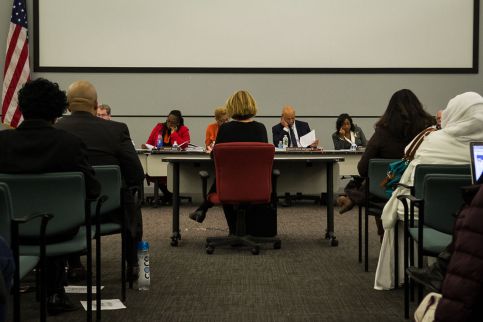
 We have entered the season of two SRC Action Meetings a month. It’s a grueling schedule, but we aim to cover it all and share our findings and analyses.

One trend continues in recent SRC Resolutions: the outsourcing of services and resources. At the March 16 meeting alone, over $18 million went into the pockets of outside vendors. Professional development continues to be turned over to contractors.  What could that money have purchased for the schools? Eighty counselors or nurses, 150 Assistant  Principals,  or 428 school aides.

Estelle Richman, Governor Wolf’s appointee to the SRC, still awaits confirmation by the State Senate. She has attended recent meetings as an observer.

SRC Spending Priorities
The  SRC approved yet another contract for the uncertified Relay School of Education, this time to train  highly qualified teachers”.  Relay is the creation of three charter school supporters who sought to create a pool of teachers for their no excuses” charter schools.  Philadelphia teachers entering this program will receive their graduate degree from a college in another state because Relay is not certified in Pennsylvania. For decades, students aspiring to become teachers have attended Cheyney, Temple, West Chester, Penn, or any of the many colleges and universities in the area.  Why is it now necessary for the district to spend money on a non-certified program?

 Freedom of Speech?
Videos of APPS members and allies testifying at recent SRC meetings show the result of SRC interference in our reporting. For the past several years, APPS’ videographer has filmed from a discrete space where there was little movement. A couple of months ago, with no explanation, he was told he had to move—to a place which has more noise and more traffic. Now the videos can show little more than the backs of  heads.  Last month, he was told to move to yet another space, even farther back.  It is hard to see this as anything other than harassment.  Why is the SRC against members of the public reporting what the public has to say at its meetings? Despite repeated requests to speak with the person forcing his relocation, no one has been identified as the decision maker.

 New SRC Committee
SRC Chair Joyce Wilkerson announced a new SRC Policy Advisory Committee, to meet quarterly,  to be chaired by the lone educator on the Commission, Dr. Christopher McGinley. Wilkerson and Dr. Hite are also on the committee, but no announcement has been made about any other committee members. The first meeting is scheduled for Thursday April 6 at 9 AM.  Several APPS members have objected to holding a public” meeting at a time that precludes attendance by the very people district policy affects—students, educators, and most parents.  Whose voices will be heard?  The history of the Strategy, Policy, and Procedure meetings, as a forum for stakeholders to address concerns,  was addressed in testimony by APPS’ Lynda Rubin. These meetings ended abruptly last year.

 Teacher Recruitment Drive, 2017
Dr Hite introduced this year’s exciting recruiting campaign to hire up to 1,000 new teachers.”  He didn’t explain why the district has to embark on yet another recruitment campaign, at a cost of $160,000,  after a major drive just last year, when the district claimed it had more than the number they had aimed for.  Part of the reason, obviously, is the lack of a PFT contract and no step increases or raises for the past four years.

 Charter Issues
Two teachers from Aspira Olney High School testified about their frustration over management’s failure to bargain in good faith with union members seeking a fair contract. It has been over two years since Aspira Olney and Aspira Stetson came up for renewal. Despite a strong recommendation for non-renewal from the district’s Charter School Office, the SRC has taken no action. Thus, Aspira Olney and Aspira Stetson continue to operate with taxpayer funds. In addition, the SRC has delayed action for over one year, on renewals of three Mastery Charters—Shoemaker, Clymer, and Gratz, and two Universal charters—Audenried and Vare.

 More Sunshine Act Violations
Last year, after a protracted negotiation process, the SRC and APPS settled the legal suit brought by APPS about a number of SRC violations of the PA Sunshine Act. However, the SRC has failed to honor the stipulation that it post official resolutions two weeks prior to each meeting.  February 16 resolutions were still posted under Current Resolution Summary” after that meeting.  There was no full resolution posted prior to the March 23 meeting. That means that the SRC voted to approve a $2.9 billion lump-sum budget about 45 minutes after the summary was distributed at the meeting.  The power-point presented by CFO Uri Monson was not posted prior to the meeting. The SRC is a governmental body responsible for a $2.9 billion budget. As such, they need to post a summary description for each resolution so that the public can make informed comments, ask questions, and raise any concerns. That is not only their obligation, it is the law. 

District and DHS Violate Due Process Rights of Teacher

marianne-kennedy-src-11-15-16
Marianne Kennedy testifying before the SRC on November 15, 2016

by Lisa Haver

This commentary was published by the Philadelphia Daily News on February 8, 2017
Commentary: Shame on those who tainted teacher who was only trying to do good

Although understandable fears have arisen recently that the constitutional rights we have taken for granted are under attack, Americans, for the most part, still have confidence that those rights remain intact. All citizens have the right to be considered innocent until proven guilty, to have an attorney present during any trial or hearing, to a fair and speedy trial before an impartial judge and to present evidence and witnesses. Both the Fifth and 14th Amendments state that no citizen can be “deprived of life, liberty or property without due process of law” and that all levels of government must adhere to these laws.

Many who read the article last month about the plight of Philadelphia teacher Marianne Kennedy were shocked to learn that those rights apparently do not apply to all Philadelphians.

After coming to the aid of a troubled student with a history of behavior problems last June, Kennedy was summoned by a social worker at the city’s Department of Human Services to come in and “have a conversation” about an incident at the school when the child lay on the floor, screaming and blocking access to a classroom. The DHS worker assured Kennedy she did not need to have an attorney present, and a colleague who accompanied her was barred from the interview. Kennedy explained that the child’s parents, who had just lost custody of him, had a history of drug abuse and that the school’s staff and administration had worked with his guardian to provide emotional and academic supports for him.

Kennedy was shocked to find a few weeks later that her employer had been notified by DHS that she had been identified as a child abuser and that the district was already taking steps to have her terminated – even though she was not, and still has not, been provided with any notice of allegations that specifically states what she could have done that could be construed as abuse.

Several witnesses, including the principal, submitted statements sent to DHS and the district that Kennedy followed proper procedure and never did anything to harm the child. Only the organized and vocal support by her colleagues and community members prevented Kennedy, a teacher with over 20 years of exemplary service to the students of the district, from being fired. There is no law that says that a preliminary determination by one DHS worker must result in the firing of any school district employee.

DHS scheduled a hearing six months after that initial interview, presided over by an administrative law judge hired by that agency. Kennedy has spent those six months in “teacher jail,” even though she had no formal hearing before the School Reform Commission – a clear violation of her tenure rights. Thus, Kennedy was guilty until proven innocent. Her reputation was damaged and her livelihood threatened without due process. She has had to raise thousands of dollars for attorney’s fees.

Kennedy is one of a number of Philadelphians who work with children in schools and day-care centers who now find themselves branded as criminals before they ever see the inside of a courtroom. Not only have they been denied their constitutional rights, many have lost their livelihoods and their reputations – not because they have been convicted or even arrested, but because one bureaucrat at the city’s Department of Human Services makes a determination based, very often, on hearsay.

Mayor Jim Kenney and other elected officials have shown courage and leadership in fighting to defend the constitutional rights of immigrants and other targeted groups. Those same officials must take immediate steps to prevent denial of due process and equal protection under the law by any city agency under their own authority.

Click here for more coverage of Marianne Kennedy’s case.

Also see:
As child abuse allegations in Philly schools rise, ‘teacher jail’ thrives and reputations are at stake https://tinyurl.com/y9a4ow9r – Inquirer – July 21, 2018


Shining a light on the SRC

755127497992049681-haver-testimony-lead-pic-full
Lisa Haver testifying before the SRC.

On December 22, 2016 The Philadelphia Public School Notebook published an article about APPS  scrutiny of the actions of the Philadelphia School Reform Commission. This is the article:

Shining a light on the SRC
by Darryl Murphy – The Philadelphia Public School Notebook
Picture by Darryl Murphy

Thanks to the School Reform Commission, Lisa Haver and other members of the Alliance for Philadelphia Public Schools now have a daily habit: reading the newspaper’s classified section.

Haver and five other members of the advocacy group were among the few people present on the morning of Monday, Oct. 6, 2014, at a quietly announced SRC meeting. The announcement of the meeting was made only in an ad placed in the classified section of the previous day’s Philadelphia Inquirer.

The purpose of the proceeding, as many suspected, was to cancel the School District’s contract with the Philadelphia Federation of Teachers.

Haver said she didn’t know about the meeting until another APPS member, Karel Kilimnik, called and asked her about it.

“Since then,” said Haver, “we have one member of APPS who, every single day, goes and looks at the classifieds to see if the SRC or the District is putting in these tiny notices that they don’t want people to know about.”

After a settlement with the SRC this fall, that kind of stealthy notice may be a thing of the past.

As a governing body for the city of Philadelphia, the SRC must adhere to the Sunshine Act of Pennsylvania, a law requiring “all meetings or hearings of every agency at which formal action is taken” to be open to the public with an opportunity for them to comment. This, according to lawmakers, is to create and maintain transparency in governing agencies for “increased public confidence.”

“If you don’t have an informed and active citizenry, government suffers for it,” said Melissa Melewsky, media law counsel for the Pennsylvania NewsMedia Association.

“Ideally, government and the public they serve work together for the best interest of everyone. And the public can’t help government do that if they don’t know what’s going on.”

Click here to read the entire article.

Lisa Haver’s Inquirer Op Ed: Public education could face major threats in a Trump presidency

imgresby Lisa Haver
December 1, 2016

The election of Donald Trump as president had an instantaneous effect when students in several schools became targets of racial and ethnic intimidation. High school students in Bucks County found swastikas and anti-gay slurs painted on walls; one girl found a note in her backpack telling her to “go back to Mexico.” African-American freshmen at the University of Pennsylvania were sent text messages with the greeting “Heil Trump” announcing the next “N-Lynching.” Immigrant and Muslim children wondered whether they would be rounded up like criminals and jailed or deported.

Whether or not the hate crimes continue, the long-term effects of a Trump presidency could cause irreparable harm to one of the bedrocks of our democracy: an open and equitable system of public education. Trump has made several pronouncements about wanting to break up the “government schools monopoly,” viewing it through the only perspective he understands, that of a corporate CEO. His outspoken support for more charters and “school choice” would not be a complete departure from his two predecessors, whose No Child Left Behind and Race to the Top initiatives made millions for edu-vendors and testing companies while doing little to narrow the achievement gap for poor and minority students. Trump, though, talks of diverting billions of public dollars to private schools via voucher programs, despite overwhelming evidence that they have done nothing to improve educational opportunities for most students.

Apparently, Trump wants to replicate Vice President-elect Mike Pence’s experiment in Indiana, where twice as many students attend charters than only five years ago. Nearly 60 percent of Indiana children are eligible for vouchers averaging about $4000 annually – which would not cover even half the tuition of most private schools, who, of course, are under no obligation to accept them. A recent study of the Indiana program conducted by the conservative Thomas B. Fordham Institute found that voucher students in private schools actually performed worse on standardized tests than those who remained in public schools.

Taxpayers across the country are already spending $1 billion for tuition to private and religious schools, including those in Cleveland, New Orleans and Milwaukee. Two-thirds of Wisconsin students receiving vouchers were not “rescued” from failing public schools, since they were already enrolled in private schools.

Trump’s nomination of Betsy DeVos as secretary of education signals his clear intention to ramp up the privatization of American’s public schools. An heir to the Amway fortune worth an estimated $5.1 billion, DeVos has no degree or experience in education, did not attend or send her children to public schools, has never been elected to any local school board. She has been a major contributor to right-wing organizations, particularly those working to dismantle public education through voucher programs.

“It is hard to find anyone more passionate about . . . steering public dollars away from traditional public schools than Betsy DeVos,” writes New Jersey taecher Mark Weber.

One impediment to the federal imposition of this free-market approach to public education could be the growing opposition on the local level. Voters in Montana, Utah and North Carolina elected strong pro-public education governors. Georgia’s voters overwhelmingly rejected a referendum, pushed by Georgia’s Republican governor with heavy financial support from the Walton Foundation and other pro-choice groups, that would have forced public schools with low test scores to be turned over every year to private management or charter companies. An effort to unseat judges in Washington state who upheld lower court decisions that the state’s method of funding charters was unsuccessful, despite millions poured into the campaign by Bill Gates and other corporate reformers.

And, in a stunning defeat for pro-privatization donors with deep pockets such as the Walton family, who poured $26 million into the campaign, voters in 241 of 255 Boston precincts rejected a charter expansion referendum by a resounding margin of 62 percent to 38 percent.

The new administration would do well to understand that voters are rejecting failed privatization policies. Parents don’t want to be forced to search for alternatives – they want fair and equitable funding for quality public schools in their own communities.

Link to the Inquirer article.