APPS News: June 2017

APPS-Banner-851px-2

by Karel Kilimnik
June 7, 2017

Fighting the Normalization of Turmoil

 Every year, Dr Hite introduces his latest “turnaround” plan. Over the past four years, we’ve seen the Transformation Plan, the Renaissance Plan, the Redesign Plan, the Innovation Plan. This year: Priority Schools. And with that the instability resulting from forcing the transfer, without cause or due process, of most teachers and some principals.

In addition, Dr Hite has said, in SRC meetings and before City Council, that he intends to close three schools a year for at least the next five years.

Fifteen more schools to be shuttered, thousands of students relocated, relationships disrupted, and vacant buildings becoming eyesores in our neighborhoods—or sold to developers to turn into private housing/commercial spaces or handed over to charter school operators.

We must stop the dismantling of public education in Philadelphia.

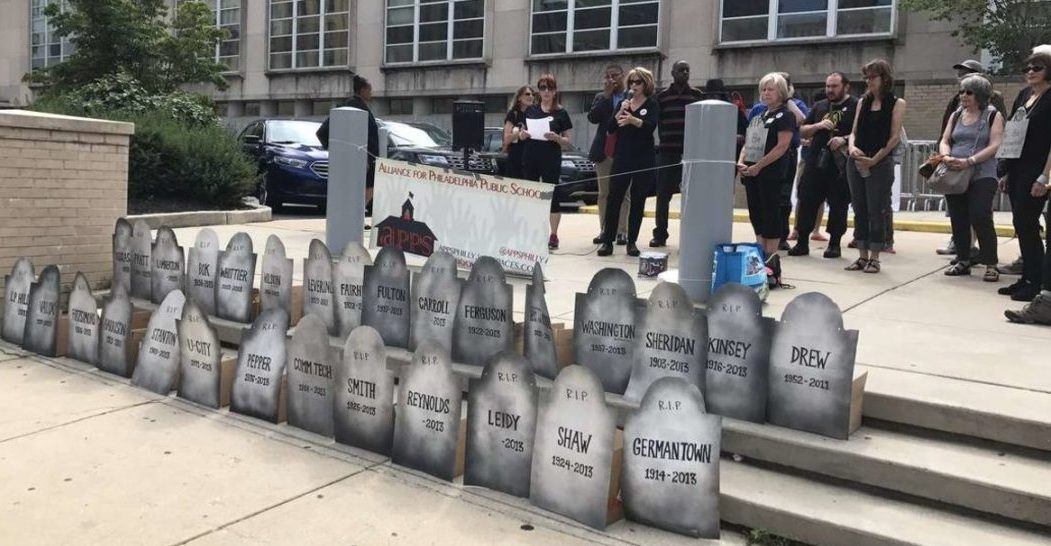
To that end, we want to honor the 29 schools closed since 2011. These neighborhoods are still reeling from the loss of long-established neighborhood schools. It’s time to stand up for our neighborhood schools. Linked is our flyer for the Requiem for Philly Schools Vigil to be held before the June 15 SRC meeting. We are ask people to wear black as we mourn these losses. There will be a display of tombstones (one for each school) displayed in front of the administration building. We are asking people to tell their stories at the SRC meeting about losing their neighborhood school. Call 215 400 4180 by 3 on Wednesday, June 14, to sign up to speak.

Changing Speaker Policies to Stifle Public Voices

 APPS members attended and testified at three SRC meetings in May: two regularly scheduled action meetings, plus one called with less than a week’s notice to rush through several charter renewals. At its April 27 meeting, the SRC passed a resolution to limit the number of speakers to 24 at its next meeting.

 Turns out that they meant 24 speakers from the community. A separate group of charter operators (no limit) was able to speak at the beginning of the meeting. The SRC also violated its own speakers policy by allowing one school, Laboratory Charter, to sign up for 14 of the 24 slots. Two of the five commissioners took pains to inform Laboratory Charter School supporters (recommended for non-renewal by the Charter School Office) of how they can get their charter renewed. Where was this support for Wister School parents faced with their school being turned over to Mastery Charter School last year?

New Idea for City Council

 APPS members Lynda Rubin, Barbara Dowdall and Lisa Haver testified at City Council’s May 17 hearing on the school district’s budget. Lynda urged Council members to pay closer attention to the questionable spending priorities of the SRC. APPS members will be urging every member of Council’s Education Committee to send a staffer to observe and report on all SRC meetings.

 District Losing More Qualified Teachers

 One thing we can count on at every SRC meeting? Funds will flow into the pockets of consultants, corporate non-profits, faux teacher training programs, and various other vendors. Dr. Hite has announced his intent to recruit 1,000 new teachers. District teachers have been working for over 1,300 days without a new contract. Several have testified that they simply can no longer afford to work in the district and have been forced to leave for economic reasons. Dr. Hite’s highly promoted campaign to recruit teachers reflects this exiting from the district. Meanwhile, professional development that was done in-house is now being outsourced for millions, and the unaccredited Relay School continues to win contracts from the District.

Speaking Out Sometimes Gets Results

 At the April 20 Budget Meeting APPS member Lisa Haver raised the issue of the public needing help understanding the district’s multi-page budget. CFO Uri Monson, after several conversations with Lisa, issued a “Budget 101” so that the layperson can understand where the money comes from and how it is spent. This multi-page, graphic tutorial is available on the district website.

The newest SRC Commissioner, Estelle Richman, attended this session sitting at the official table instead of watching from the audience.

APPS members continue to testify at all SRC meetings. We are joined by activist parents and community members who cannot remain silent during this assault on our public schools. See testimonies from May 18th and May 25th.

 Where Oh Where are the May 25 SRC Resolutions?

 For days the only thing to be found when looking for the resolutions was one word: PENDING. Two days before the meeting, only three budget items were posted. Wednesday morning (the day before the meeting) saw an additional seven items listed, including one to approve a revised application for Deep Roots Charter School. This application was denied at the February SRC special charter meeting, but not before the applicants were encouraged by commissioners to reapply. For the result, see APPS Ears on the SRC: May 25, 2017. You might ask yourself where this supportive advice is when neighborhood schools are slated to be “transformed” or shuttered.

Calendar

June 6: PSN fundraiser

June 7: Our Cities/Our Schools Forum on Abolishing the SRC
6 to 8 at Berean Institute 19th & Girard Avenue

June 15: Requiem for Philly Schools Vigil @ 3:30 PM before SRC meeting

June 30: SRC Action Meeting @ 4:30 PM


Richard Migliore: Turzai’s letter raises issues of public concern

The Philadelphia Notebook published the following Op Ed from APPS member Rich Migiore.

rich-migliore

Speaker of the House Mike Turzai’s recent letter to the School Reform Commission criticizing the District’s charter school renewal process raises serious issues of public importance. All of us who care about public education should be alarmed at what was said by Representative Turzai.

Turzai not only levels an unfounded attack on the SRC members, he attacks Philadelphia in his letter and makes a not very veiled threat to the SRC members: if they do not renew the charters in question, funding for Philadelphia’s schools will be in jeopardy. That is a misuse of his office.

SRC Chairwoman Joyce Wilkerson responded to Turzai in a letter defending the SRC’s charter renewal process. As a retired teacher and principal, and an advocate for public education, I also responded directly to Turzai. My 8-page letter to him addresses the impropriety of his actions and the issues which his actions raise. They are issues of public concern.

Neither the District’s renewal process for the 26 schools in question, nor the SRC’s conditions for renewal are “overreach or inappropriate” as Turzai described them. Pursuant to the Charter School Law, the SRC and the District have an “affirmative legal duty” to assess whether our charter schools are meeting the requirements for student performance, meeting the “conditions” of its charter, and to determine whether the charter school is complying with applicable law.

If not, the SRC has the legal duty and responsibility to “revoke or not to renew” the charter. That can occur “during the term of the charter or at the end of the term.” The “causes for nonrenewal or termination” are stated quite clearly in Section 17-1729-A of the Charter School Law. The District’s recommendations for conditions are not only prudent, they are necessary for the basic functioning of those charter schools.

Such negotiated conditions are legal and appropriate to regulate those charter schools in the best interests of all of Philadelphia’s schoolchildren and our school community. Without those conditions, it would be the affirmative legal responsibility of the SRC to close those schools.

The Pennsylvania Supreme Court has ruled that the relationship between a local school board and a charter school is “regulatory.” That is exactly what the SRC members are doing. They are engaging in their public responsibility to the people of Philadelphia and the children in charter schools to regulate Philadelphia’s charter schools.

Partly in response to the public outcry about the lack of oversight of the charter schools, the SRC increased the staff of its Charter School Office, which is now led by the very able DawnLynne Kacer.

The question of whether a charter school should be renewed requires a very public process with full transparency. The PA Sunshine Act protects the public’s right to “notice and opportunity to comment meaningfully” on all proposed actions of the SRC and other school boards in Pennsylvania. The Sunshine Act codifies constitutional principles of public governance.  Our right to notice and opportunity to comment applies to any action of the SRC, including those pertaining to charter schools. It is an inalienable right of the citizens of Philadelphia and Pennsylvania.

The public has a right to know what is written in those schools’ charters, including all conditions and requirements. We have a right to copies of those documents and any proposed resolutions of the SRC or the charter schools themselves. We have a right to copies before any votes are taken by the SRC. That is required by the Sunshine Act.

Those of us who believe in democracy, and that our public schools should be fully governed by locally elected school boards, also believe that our local school boards should not be circumvented or short circuited in any way. Without adherence to the due process of public decision-making — we cease to have truly public schools. Democracy is the purification process for the ills that plague our schools. Democracy is the sine qua non for greatness in our public schools.

The SRC’s decision to revoke a school’s charter does not have to mean displacement of students or shuttering of the building. A charter revocation only means that the SRC becomes the school’s board of trustees and Superintendent Hite becomes its superintendent. The certified teachers on staff can immediately be hired by the District.

Charter schools’ boards of trustees have the right to pursue an appeals process when the school’s charter is revoked or terminated.  When public schools are closed, or converted to a charter school, there is no appeals process for those students and parents.  Perhaps Turzai could use the powers of his office to rectify that injustice.

There are many fine charter schools which operate properly and in the best interests of its students; those schools have no problem being renewed by the SRC. Our charter school community should embrace the public decision-making process for the renewal of our deserving charter schools.

Turzai knows who has the legal standing and the responsibility to enforce the responsibilities of charter schools and the rights of its students to an adequate education — it is the School Reform Commission. The very same body imposed on Philadelphia by the state legislature in which he serves. Until he and his colleagues vote to return the governance of public schools to those who live in Philadelphia, he should let the SRC carry out its duties.


APPS News: May 2017

APPS-Banner-851px-2

by Karel Kilimnik
May 10, 2017

Spring is showering SRC meetings upon us: there are two meetings each month from March until June. We continue to inform supporters of public education in several ways: an overview of Resolutions to be voted on in our Eyes on the SRC, a report of these meetings in Ears on the SRC, video of testimonies from members and supporters, and a new section of Calendar Events. We appreciate any and all feedback on our writings. Please feel free to share additional information and resources or to ask questions. The next two SRC meetings for May are listed in the Calendar section.  We are happy to advise those who want to testify but have never done so. We urge all who want to fight for public schools to attend and bring a sign if possible.

New SRC Policy Committee Meets—When Those Affected by Policies Cannot Attend
In March the SRC passed a resolution creating “ a policy committee that will review policies that affect students and staff”.  They scheduled these meetings for 9 AM, when a when students, staff,  and working parents are unable to attend.  Thus, those who are responsible for implementing the policies, and those affected by them, are excluded. The first meeting of the SRC Policy Committee, Chaired by Commissioner McGinley and attended by SRC Chair Joyce Wilkerson and Superintendent-designee Naomi Wyatt, met on April 6 in a small conference room at 440. About 80% of those present were district staff.  Four APPS members attended, along with Councilwoman Helen Gym and her chief of staff. Prior to this initial meeting over 75 pages of district policies were posted Friday afternoon March 31 for public perusal. Read the APPS Ears on this Meeting for a more detailed account.  If the intent was to enable the public, in particular those directly affected by these policies, to have some input, then these meetings need to be scheduled at a more convenient time.

Action Meeting Morphs into Budget Meeting

Click here to read the rest of the article.

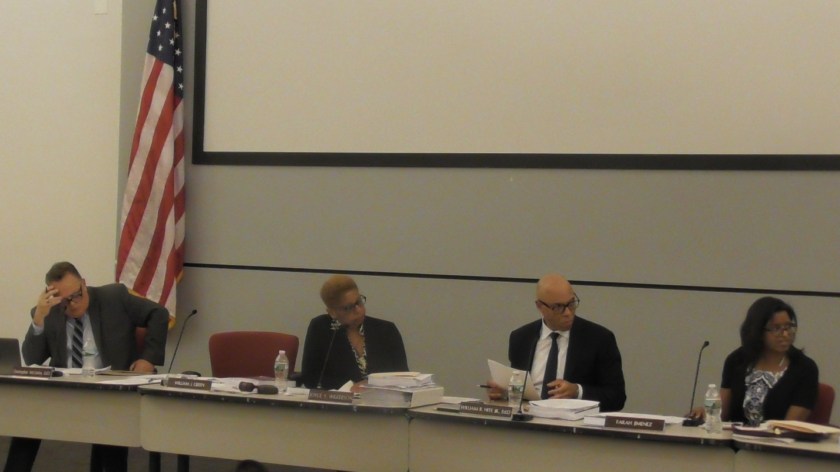
APPS wants to know: Why does Commissioner Green keep leaving SRC meetings during speaker testimony?

S1130011

Click here to read the letter sent by APPS to Commissioner Bill Green about his leaving SRC meetings during speaker testimonies.


This article was published in the Philadelphia School Notebook
by Dale Mezzacappa – May 4, 2017

Activist group asks: Why did Bill Green leave SRC Meetings?

The Alliance for Philadelphia Public Schools is asking why Bill Green left for large portions of the last two School Reform Commission meetings, suggesting that the behavior “calls into question” his ability to serve on that body and saying that he should consider resigning.

At both the April 27 and May 1 meetings, Green, who reportedly has back problems, left during the public speaking portion, then rejoined the meeting by telephone in time to vote on resolutions. Both meetings were marathon sessions lasting several hours.

Lisa Haver, APPS co-founder, said that Green’s absence clearly violates the SRC’s own policies and that APPS is not ruling out legal action to question the validity of the votes taken at the two meetings.

“Does the SRC make rules and say they don’t have to follow them?” Haver asked. “Those are their bylaws, that is their speakers’ policy. Mr. Green wasn’t there for the whole meeting, it’s spelled out what the requirement is.”

The policy in question is 006.1, which says that the someone joining by electronic communication “shall be considered present only if the Commissioner can hear everything said at the meeting and all those attending the meeting can hear everything said by that Commissioner. ”

The School District issued a statement saying that “all business transacted at both meetings was valid and in accordance with the applicable law.” Reached by telephone, Green took no questions and offered no explanation for his actions. The statement is “all that we’re going to say on the matter,” he said.

The statement, attributed to Miles Shore of the General Counsel’s office, said: “At the regular action meeting of the School Reform Commission on April 27, 2017 and at the special meeting on May 1, 2017, a quorum of Commissioners (a majority of appointed Commissioners) was present when the meetings were called to order.  All business transacted at both meetings was valid and in accordance with the applicable law.  The SRC did not not transact business or take any formal action at the regular meeting on April 27, 2017 or at the special meeting on May 1, 2017 in the absence of a quorum.”

But the relevant policy says that when a commissioner joins the meeting remotely, “a majority of Commissioners shall be physically present.” At the April 27 meeting, Commissioner Christopher McGinley was not present, leaving only two commissioners in the room, Farah Jimenez and chair Joyce Wilkerson.

The five-member body has only four members now because the state senate has yet to confirm Gov. Wolf’s nomination of Estelle Richman to fill the seat vacated by Feather Houstoun. Richman has been attending the meetings as an observer.

Haver said that in leaving without explanation, Green disrespected the people and the process. “Mr Green owes an explanation to the people why he didn’t listen to all the information on what he voted on,” she said.

At that meeting, the SRC voted on nearly 50 resolutions, including amendments to some charter agreements and a several contracts, including one allocating $149 million to operate alternative schools for the next five years.

At the May 1 meeting, the SRC voted to approve eight charter renewals, started the nonrenewal process for one charter, and delayed a voting on a second nonrenewal recommendation. It also voted on two charter amendments.

The April 27 meeting had 58 registered speakers, and the May 1 meeting had more than 30. At both meetings, Green left during the earlier part of the speaker segments and called back just before the vote on resolutions was about to start.

“At the April 27 meeting, you missed the testimony of 50 parents, students, district employees and community members, in addition to questions and comments by other commissioners,” the APPS’ letter states. “At the May 1 meeting, you missed two of the Charter Applicant Speaker Representatives and 23 or the 24 public speakers. You were not present to hear any part of the presentation by Charter School Office Executive Director DawnLynne Kacer and CSO Program Manager Regan Reamer on the 23 charter renewals and two charter amendments.

“Your apparently planned absences are disrespectful to the parents, students, employees and community members who took the time to research and write testimony…More importantly, your failure to be present for these meetings reflects a disregard for the responsibility that an SRC commissioner has to the stakeholders of the district.”

The letter, signed by Haver and APPS legislative liaison Lynda Rubin, says that Green’s actions warrant his leaving the commission. “We ask that you consider resigning your post,” the letter reads.

Haver, a retired District teacher, and her organization have tangled with the SRC before, winning legal concessions around Sunshine Act violations and over their right to carry protest signs into the meeting space.

“I think if the SRC makes rules, they have to follow them, and if they don’t follow them, there has to be some form of ramifications,” Haver said. “If Mr. Green has some reason why he can’t serve, he should resign.  But he owes everybody an explanation why he couldn’t be there for the whole meeting.”