APPS Calls on Mayor, Governor to Investigate SRC Actions on Renaissance Renewals

SRC 4-28-16 resize

Honorable James Kenney, Mayor
City of Philadelphia
Philadelphia PA   19107

Honorable Thomas Wolf, Governor
Commonwealth of Pennsylvania
225 Main Capitol Building
Harrisburg, PA   17120

June 8, 2016

Dear Mayor Kenney and Governor Wolf:

On behalf of the members of the Alliance for Philadelphia Public Schools, we request that you conduct an investigation into the actions of the School Reform Commission during its current renewal procedure of the charters for Aspira Stetson School and Aspira Olney School. We have attended all of the SRC meetings in April and May when these resolutions were considered, and we have serious concerns that the public has been denied the right to a fair and impartial process in these matters.

Aspira Inc. was granted a charter to manage John B. Stetson Middle in April 2010 and one to manage Olney High School in April 2011, after the district deemed each “low-performing” and placed them in its Renaissance program. The purpose of that program, according to the district’s website, is to “dramatically improve the learning environment in underperforming school district schools and to create highly effective schools that provide exceptional opportunities for student achievement and preparedness for success in college and the workforce.” The SRC’s Charter Schools Office (CSO) has cited several reasons—academic, financial, and managerial—which confirm that Aspira has failed to provide its students with a high-quality education and has failed to meet basic standards for proper school management. In addition, Aspira representatives admitted to financial irregularities enumerated in the CSO report.

Reasons cited by the CSO for non-renewal of Stetson include:

Click here to read the entire letter.

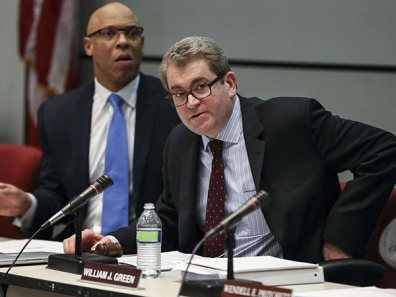
APPS calls on SRC Commissioner Green to drop his lawsuit to be reinstated as SRC Chair

src+and+bill+green
Members of the Alliance for Philadelphia Public Schools call on SRC Commissioner William Green to drop his lawsuit against Governor Wolf to reappoint him as SRC Chair and  to join with Philadelphians in supporting the Governor’s fight to fully fund the city’s public schools. 
 
“Mr. Green’s pointless power grab serves only to divert attention from the SRC’s failure to provide the city’s children with safe, adequately staffed schools, the instability created by their rushed decision to outsource substitutes, the millions paid to outside legal counsel in their attempt to cancel the teachers’ contract, or to address the impending chaos brought on by the forcing out of teachers and principals from seven district schools,” said Lisa Haver, co-founder of the Alliance.
 
“Commissioner Green’s attack on Governor Wolf doesn’t address the real issue:  that the people of this city continue to lose out because of the failure of the Republican-led legislature to fully fund Pennsylvania’s schools,” Haver said. 
 
APPS noted that Mr. Green  has refused to join the lawsuit challenging the under-funding of schools, has been criticized for shutting the public out of the decision making process, and has failed to obey Pennsylvania’s Sunshine Act.

The Philadelphia Inquirer article about Green’s suit. The APPS press release is cited in the article.
Lawsuit: Restoring Bill Green as SRC Chair will help Philly schools | Philadelphia Inquirer – April 19, 2016.
Green sues to regain SRC chairmanship | Philadelphia Notebook – April 19, 2016

 In the update to the preceding Inquirer article about Green’s suit, Green is quoted as saying: “State legislators “might have more confidence in sending the district money” if he were in charge.” In other words, ALEC legislators would give more money for the School District if he were in charge because he would fast track the expansion of charters.
Note: Green’s lawsuit is being sponsored by the Fairness Center, a right-wing, anti-union think tank. It is affiliated with the Commonwealth Foundation which has ties to the American Legislative Exchange Council (ALEC).

The problem with the District’s philanthropic fund for literacy

564686367677841877-the-fund-kickoff.0.386.3264.1632.full

by Lisa Haver

April 12, 2015

Reprinted from the Philadelphia Public School Notebook.

The state takeover of the School District of Philadelphia more than 15 years ago brought a new set of problems, not the least being the failure of the School Reform Commission — and a succession of highly paid superintendents and CEOs — to fulfill its stated purpose of restoring the District’s financial stability.

At the same time, the public’s ability to be heard on these and other issues has been squelched by growing corporate influence, as grants from outside organizations, including the Gates Foundation, the Philadelphia School Partnership, the William Penn Foundation, and others, have come with mandates for school closures, charter expansion, and weakening of some collective bargaining rights such as longstanding seniority protections. The Great Schools Compact Committee, which oversaw distribution of the Gates money, acted as a shadow school board.

The revival of the Fund for the School District of Philadelphia appears to be an extension of that model, in which private money has a growing influence on a public institution. Established in 2003 as a fundraising arm of the District, it later collected private donations to buy out former Superintendent Arlene Ackerman’s contract, although the District ultimately picked up the bill. Its 17-member board is made up of representatives from banking, energy, cable, financial investment, and consulting businesses — and two educators. “Investors” include GlaxoSmithKline, Wells Fargo, and the Barra, Carnegie and Lenfest Foundations.

Executive Director Donna Frisby-Greenwood said in a NewsWorks interview in January that “the Fund is committed to transparency.” But when I called to ask when the next board meeting would be held, Frisby-Greenwood told me “those meetings are private.”

The fund’s website says that the board will be working with Superintendent William Hite to “help set funding priorities … toward the needs of Philadelphia’s public schools to improve educational services and academic achievement.” But it is not the role of a handful of people from one stratum of society to make those decisions. Giving corporations and foundations a larger voice in decisions on education cedes control of the democratic process to those with the highest net worth. The rest of us get three minutes a month at the SRC meeting.

One of the fund’s initiatives is to build “classroom libraries” in the lower grades to promote early literacy. Countless studies show that having a school library with research facilities, staffed by a certified librarian – not just a small collection of books in each classroom – makes significant improvements in student learning.  The fund’s spending priorities, in this case, send the message that our children should settle for a lesser version of a school library instead of the real thing. No one should be setting those kinds of low expectations for our students.

Schools have long been recipients of donations from local businesses, some of whom develop a relationship with the students and faculty.  But having this kind of funding become institutionalized places our children in the role of charity cases, who can only receive a decent education if they have demonstrated their worthiness. The fund’s website may tell us that “the private donations that we contribute to the District do not supplant government monies,” but it does send the message that someone is here to pick up the slack when Harrisburg comes up short year after year.

Wealthy individuals and corporations, and their lobbyists, have significant influence in  Harrisburg. They should use that power to speak in one voice for a permanent fair funding formula so that principals and teachers don’t have to beg for what their schools deserve.

Mayor Kenney, who hosted a $5,000-a-person inaugural party to benefit the fund, should not place his stamp of approval on an organization that shuts out the people he has vowed to represent.  “I trust these folks and know where they stand on the issues and trust them for raising money for them,” he said of the fund’s board. But the public does not know those who staff the fund. The people, as citizens and taxpayers, are the fund for the School District of Philadelphia. That ensures us an equal place at the table when decisions about our children’s futures are made.
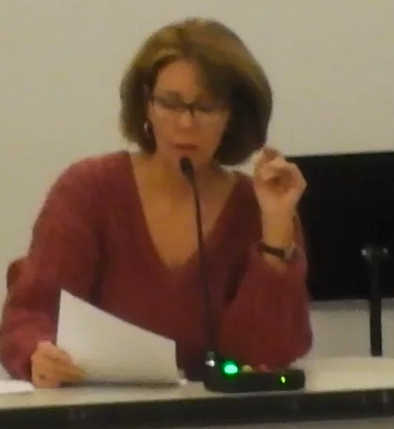
Commentary: District’s ‘turnaround’ plan is bad for students

Lisa Haver SRC 1-21-16

The following commentary by APPS member Lisa Haver was printed on April 1, 2016 in the Philadelphia Daily News.

If you read the paper or listen to the news, you probably have some opinions about the issues facing the Philadelphia School District.

You know that Harrisburg’s repeated slashing of education spending and its failure to come up with a fair and permanent funding formula continue to take a toll.

Adding to that problem are questionable district priorities, which have resulted in:

* More than 160 teacher vacancies, leaving at least 5,300 students without a full-time teacher this year.

* The substitute fill rate plummeting from 65 percent to below 40 percent after the School Reform Commission’s vote to outsource jobs.

* Lack of support staff, including counselors and classroom aides, resulting in an increase in serious incidents in many schools.

* Fewer than eight certified school librarians in the entire district.

Also, the physical condition of the buildings themselves, along with the dearth of full-time nurses, has resulted in higher student absenteeism.

The school district, though, has a different take on the situation: The problem is that teachers and principals are in the wrong buildings, and that moving them is the solution.

Last month, Superintendent William Hite announced yet another “turnaround plan” for four more neighborhood schools, the main feature of that plan being the forced transfer of principals and teachers.

Hite has rejected critics’ characterization of his plan as “destabilization,” but recent history shows that it represents only the latest chapter in a pattern of destabilization for all four schools. Consider:

* S. Weir Mitchell in Kingsessing was a K-5 elementary until 2013. When the district closed two nearby schools, Mitchell incorporated those students and added seventh and eighth grades.

Comments to the article can be read at the Inquirer post:
Commentary: District’s ‘turnaround’ plan is bad for students | Philadelphia Inquirer – April 1, 2016