Ears on the SRC: May 25, 2017

SRC 5-25-17 edited

by Diane Payne
June 3, 2017

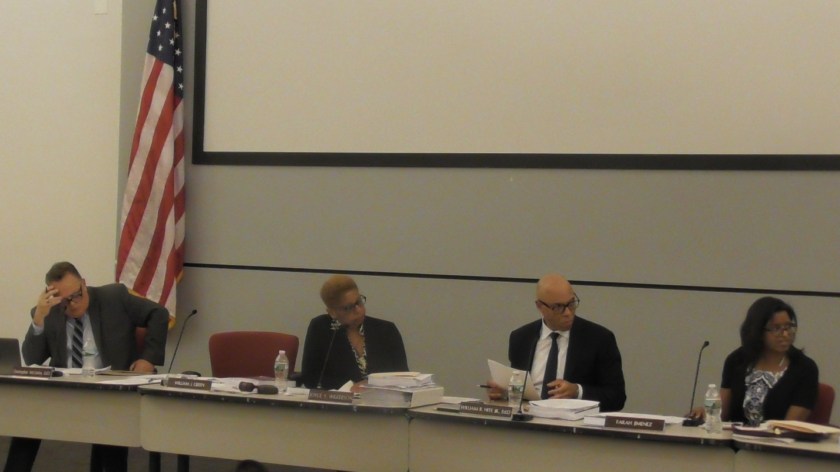
This regular Action Meeting of the SRC had been scheduled for the specific purpose of voting on the FY 2017-18 budget. In the three days before the meeting, however, several items were added, including the unannounced reconsideration of Deep Roots charter, whose application was rejected 3-1 in February. All five commissioners attended.

Eight APPS members gave testimony in defense of public education.

SRC’s Willful, Continuous Violations of the Letter and Spirit of the Sunshine Act

The 2016 Commonwealth Court-ordered settlement of the suit brought by APPS after SRC violations of the Sunshine Act stipulates that resolutions must be posted two weeks prior to each meeting.  Unfortunately, there have been repeated violations of this settlement agreement by the SRC. The resolution summary for May 18 was not posted in time. Some resolutions have only a title, but no description, which was the case for all of this meeting’s resolutions with one exception. In the case of the charter school resolutions, the SRC now designates every charter amendment—new applications, renewals, amendments—as “quasi-judicial’, then uses that unexplained designation as justification for 1) not providing full resolutions and 2) discussing charter business in executive session instead of in open meetings. APPS has repeatedly questioned the legality of hiding information from the public regarding the crucial actions on charter school applications, but the SRC continues to stonewall. This SRC changes policy on a whim (the number of speakers at the May 1st meeting was limited to 24 total, and half were from one school), breaks its own rules (conducting the April 27th and May 1st meetings after Commissioner Green left the meeting in violation of policy 006.1), and ignores the Sunshine Act—all the while paying lip service to transparency and community engagement.

The Deep Roots Charter Sham

This issue alone shows the depth of the corruption of the SRC. Their actions before and during the meeting on Deep Roots leave no doubt that it has, and will, put the interests of charter operators and investors before those of the students, parents and communities.

The SRC waited until three days before the meeting to post a resolution (with no text, just a title) to vote on a revised Deep Roots application—which has yet to be released by the district. There was no explanation of why this charter company was back only three months after it had been rejected. In fact, the Charter Office director acknowledged that there were “no substantive differences” between the first application and the revision.

APPS’ Deb Grill repeated many of the same points she made in February about the obvious inadequacy of Deep Roots’ curriculum, teacher recruitment, ELL resources, etc. She noted, again, that Logan Blyler, the school’s projected instructional leader, has only five years teaching experience, all in charters. He has no principal or administrative certification, although he is allegedly pursuing one at the “School Leader Fellow” program with Jounce Partners, a program comparable to that of Relay Graduate School. Jounce’s program is new, untried and lacks any evidence of success. Deb reminded the commissioners of the intense, scripted teacher coaching plan which can only result in high teacher attrition. Those teachers, in the revised application, would actually be paid less to work a 12-month year with only short breaks. Deep Roots’ mission statement says it will teach “motivated” students without addressing how to motivate the others.

The new proposal increases the allocation for nursing services by $30,000. Nursing services are outsourced with an unnamed health services provider to provide mandated health screening and other services in the Pennsylvania School Code. A nurse will be at the school several days a week. To pay for this, they reduced the salary of teachers from $50, 00 to $47,500. This includes an extended year for students and teachers of 188 days and 20 days of professional development for teachers.

The application actually invokes both Restorative Practices and No Excuses models without acknowledging that they are contradictory; this was cited by the hearing examiner in January as an indication that the application was a cut-and-paste from other charters, particularly KIPP. Deb asked whether those commissioners who had worked with Deep Roots board member Sophie Bryan would recuse themselves. Bryan served in several high-ranking positions in the district, including the Superintendent’s and Charter offices. She also served as Green’s chief of staff when he was in City Council. (No one abstained when the vote was taken.)

Karel Kilimnik told the SRC that Deep Roots’ application had “holes big enough to drive an 18-wheeler through”.

Click here to see the Charter Office’s reevaluation of Deep Roots.

SRC Perpetuates Expensive Farce

Click here to read the rest of the post.
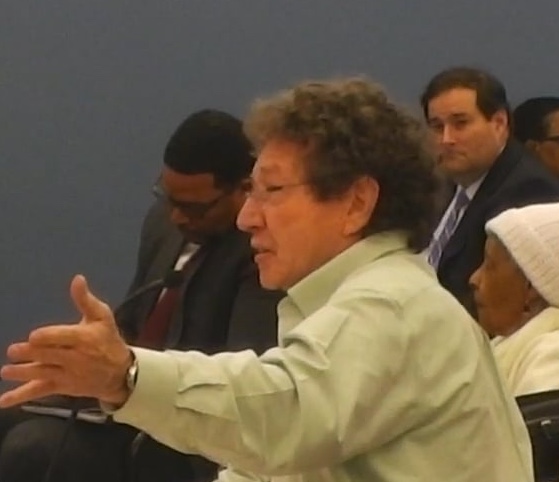
 

Richard Migliore: Turzai’s letter raises issues of public concern

The Philadelphia Notebook published the following Op Ed from APPS member Rich Migiore.

rich-migliore

Speaker of the House Mike Turzai’s recent letter to the School Reform Commission criticizing the District’s charter school renewal process raises serious issues of public importance. All of us who care about public education should be alarmed at what was said by Representative Turzai.

Turzai not only levels an unfounded attack on the SRC members, he attacks Philadelphia in his letter and makes a not very veiled threat to the SRC members: if they do not renew the charters in question, funding for Philadelphia’s schools will be in jeopardy. That is a misuse of his office.

SRC Chairwoman Joyce Wilkerson responded to Turzai in a letter defending the SRC’s charter renewal process. As a retired teacher and principal, and an advocate for public education, I also responded directly to Turzai. My 8-page letter to him addresses the impropriety of his actions and the issues which his actions raise. They are issues of public concern.

Neither the District’s renewal process for the 26 schools in question, nor the SRC’s conditions for renewal are “overreach or inappropriate” as Turzai described them. Pursuant to the Charter School Law, the SRC and the District have an “affirmative legal duty” to assess whether our charter schools are meeting the requirements for student performance, meeting the “conditions” of its charter, and to determine whether the charter school is complying with applicable law.

If not, the SRC has the legal duty and responsibility to “revoke or not to renew” the charter. That can occur “during the term of the charter or at the end of the term.” The “causes for nonrenewal or termination” are stated quite clearly in Section 17-1729-A of the Charter School Law. The District’s recommendations for conditions are not only prudent, they are necessary for the basic functioning of those charter schools.

Such negotiated conditions are legal and appropriate to regulate those charter schools in the best interests of all of Philadelphia’s schoolchildren and our school community. Without those conditions, it would be the affirmative legal responsibility of the SRC to close those schools.

The Pennsylvania Supreme Court has ruled that the relationship between a local school board and a charter school is “regulatory.” That is exactly what the SRC members are doing. They are engaging in their public responsibility to the people of Philadelphia and the children in charter schools to regulate Philadelphia’s charter schools.

Partly in response to the public outcry about the lack of oversight of the charter schools, the SRC increased the staff of its Charter School Office, which is now led by the very able DawnLynne Kacer.

The question of whether a charter school should be renewed requires a very public process with full transparency. The PA Sunshine Act protects the public’s right to “notice and opportunity to comment meaningfully” on all proposed actions of the SRC and other school boards in Pennsylvania. The Sunshine Act codifies constitutional principles of public governance.  Our right to notice and opportunity to comment applies to any action of the SRC, including those pertaining to charter schools. It is an inalienable right of the citizens of Philadelphia and Pennsylvania.

The public has a right to know what is written in those schools’ charters, including all conditions and requirements. We have a right to copies of those documents and any proposed resolutions of the SRC or the charter schools themselves. We have a right to copies before any votes are taken by the SRC. That is required by the Sunshine Act.

Those of us who believe in democracy, and that our public schools should be fully governed by locally elected school boards, also believe that our local school boards should not be circumvented or short circuited in any way. Without adherence to the due process of public decision-making — we cease to have truly public schools. Democracy is the purification process for the ills that plague our schools. Democracy is the sine qua non for greatness in our public schools.

The SRC’s decision to revoke a school’s charter does not have to mean displacement of students or shuttering of the building. A charter revocation only means that the SRC becomes the school’s board of trustees and Superintendent Hite becomes its superintendent. The certified teachers on staff can immediately be hired by the District.

Charter schools’ boards of trustees have the right to pursue an appeals process when the school’s charter is revoked or terminated.  When public schools are closed, or converted to a charter school, there is no appeals process for those students and parents.  Perhaps Turzai could use the powers of his office to rectify that injustice.

There are many fine charter schools which operate properly and in the best interests of its students; those schools have no problem being renewed by the SRC. Our charter school community should embrace the public decision-making process for the renewal of our deserving charter schools.

Turzai knows who has the legal standing and the responsibility to enforce the responsibilities of charter schools and the rights of its students to an adequate education — it is the School Reform Commission. The very same body imposed on Philadelphia by the state legislature in which he serves. Until he and his colleagues vote to return the governance of public schools to those who live in Philadelphia, he should let the SRC carry out its duties.


APPS wants to know: Why does Commissioner Green keep leaving SRC meetings during speaker testimony?

S1130011

Click here to read the letter sent by APPS to Commissioner Bill Green about his leaving SRC meetings during speaker testimonies.


This article was published in the Philadelphia School Notebook
by Dale Mezzacappa – May 4, 2017

Activist group asks: Why did Bill Green leave SRC Meetings?

The Alliance for Philadelphia Public Schools is asking why Bill Green left for large portions of the last two School Reform Commission meetings, suggesting that the behavior “calls into question” his ability to serve on that body and saying that he should consider resigning.

At both the April 27 and May 1 meetings, Green, who reportedly has back problems, left during the public speaking portion, then rejoined the meeting by telephone in time to vote on resolutions. Both meetings were marathon sessions lasting several hours.

Lisa Haver, APPS co-founder, said that Green’s absence clearly violates the SRC’s own policies and that APPS is not ruling out legal action to question the validity of the votes taken at the two meetings.

“Does the SRC make rules and say they don’t have to follow them?” Haver asked. “Those are their bylaws, that is their speakers’ policy. Mr. Green wasn’t there for the whole meeting, it’s spelled out what the requirement is.”

The policy in question is 006.1, which says that the someone joining by electronic communication “shall be considered present only if the Commissioner can hear everything said at the meeting and all those attending the meeting can hear everything said by that Commissioner. ”

The School District issued a statement saying that “all business transacted at both meetings was valid and in accordance with the applicable law.” Reached by telephone, Green took no questions and offered no explanation for his actions. The statement is “all that we’re going to say on the matter,” he said.

The statement, attributed to Miles Shore of the General Counsel’s office, said: “At the regular action meeting of the School Reform Commission on April 27, 2017 and at the special meeting on May 1, 2017, a quorum of Commissioners (a majority of appointed Commissioners) was present when the meetings were called to order.  All business transacted at both meetings was valid and in accordance with the applicable law.  The SRC did not not transact business or take any formal action at the regular meeting on April 27, 2017 or at the special meeting on May 1, 2017 in the absence of a quorum.”

But the relevant policy says that when a commissioner joins the meeting remotely, “a majority of Commissioners shall be physically present.” At the April 27 meeting, Commissioner Christopher McGinley was not present, leaving only two commissioners in the room, Farah Jimenez and chair Joyce Wilkerson.

The five-member body has only four members now because the state senate has yet to confirm Gov. Wolf’s nomination of Estelle Richman to fill the seat vacated by Feather Houstoun. Richman has been attending the meetings as an observer.

Haver said that in leaving without explanation, Green disrespected the people and the process. “Mr Green owes an explanation to the people why he didn’t listen to all the information on what he voted on,” she said.

At that meeting, the SRC voted on nearly 50 resolutions, including amendments to some charter agreements and a several contracts, including one allocating $149 million to operate alternative schools for the next five years.

At the May 1 meeting, the SRC voted to approve eight charter renewals, started the nonrenewal process for one charter, and delayed a voting on a second nonrenewal recommendation. It also voted on two charter amendments.

The April 27 meeting had 58 registered speakers, and the May 1 meeting had more than 30. At both meetings, Green left during the earlier part of the speaker segments and called back just before the vote on resolutions was about to start.

“At the April 27 meeting, you missed the testimony of 50 parents, students, district employees and community members, in addition to questions and comments by other commissioners,” the APPS’ letter states. “At the May 1 meeting, you missed two of the Charter Applicant Speaker Representatives and 23 or the 24 public speakers. You were not present to hear any part of the presentation by Charter School Office Executive Director DawnLynne Kacer and CSO Program Manager Regan Reamer on the 23 charter renewals and two charter amendments.

“Your apparently planned absences are disrespectful to the parents, students, employees and community members who took the time to research and write testimony…More importantly, your failure to be present for these meetings reflects a disregard for the responsibility that an SRC commissioner has to the stakeholders of the district.”

The letter, signed by Haver and APPS legislative liaison Lynda Rubin, says that Green’s actions warrant his leaving the commission. “We ask that you consider resigning your post,” the letter reads.

Haver, a retired District teacher, and her organization have tangled with the SRC before, winning legal concessions around Sunshine Act violations and over their right to carry protest signs into the meeting space.

“I think if the SRC makes rules, they have to follow them, and if they don’t follow them, there has to be some form of ramifications,” Haver said. “If Mr. Green has some reason why he can’t serve, he should resign.  But he owes everybody an explanation why he couldn’t be there for the whole meeting.”

District and DHS Violate Due Process Rights of Teacher

marianne-kennedy-src-11-15-16
Marianne Kennedy testifying before the SRC on November 15, 2016

by Lisa Haver

This commentary was published by the Philadelphia Daily News on February 8, 2017
Commentary: Shame on those who tainted teacher who was only trying to do good

Although understandable fears have arisen recently that the constitutional rights we have taken for granted are under attack, Americans, for the most part, still have confidence that those rights remain intact. All citizens have the right to be considered innocent until proven guilty, to have an attorney present during any trial or hearing, to a fair and speedy trial before an impartial judge and to present evidence and witnesses. Both the Fifth and 14th Amendments state that no citizen can be “deprived of life, liberty or property without due process of law” and that all levels of government must adhere to these laws.

Many who read the article last month about the plight of Philadelphia teacher Marianne Kennedy were shocked to learn that those rights apparently do not apply to all Philadelphians.

After coming to the aid of a troubled student with a history of behavior problems last June, Kennedy was summoned by a social worker at the city’s Department of Human Services to come in and “have a conversation” about an incident at the school when the child lay on the floor, screaming and blocking access to a classroom. The DHS worker assured Kennedy she did not need to have an attorney present, and a colleague who accompanied her was barred from the interview. Kennedy explained that the child’s parents, who had just lost custody of him, had a history of drug abuse and that the school’s staff and administration had worked with his guardian to provide emotional and academic supports for him.

Kennedy was shocked to find a few weeks later that her employer had been notified by DHS that she had been identified as a child abuser and that the district was already taking steps to have her terminated – even though she was not, and still has not, been provided with any notice of allegations that specifically states what she could have done that could be construed as abuse.

Several witnesses, including the principal, submitted statements sent to DHS and the district that Kennedy followed proper procedure and never did anything to harm the child. Only the organized and vocal support by her colleagues and community members prevented Kennedy, a teacher with over 20 years of exemplary service to the students of the district, from being fired. There is no law that says that a preliminary determination by one DHS worker must result in the firing of any school district employee.

DHS scheduled a hearing six months after that initial interview, presided over by an administrative law judge hired by that agency. Kennedy has spent those six months in “teacher jail,” even though she had no formal hearing before the School Reform Commission – a clear violation of her tenure rights. Thus, Kennedy was guilty until proven innocent. Her reputation was damaged and her livelihood threatened without due process. She has had to raise thousands of dollars for attorney’s fees.

Kennedy is one of a number of Philadelphians who work with children in schools and day-care centers who now find themselves branded as criminals before they ever see the inside of a courtroom. Not only have they been denied their constitutional rights, many have lost their livelihoods and their reputations – not because they have been convicted or even arrested, but because one bureaucrat at the city’s Department of Human Services makes a determination based, very often, on hearsay.

Mayor Jim Kenney and other elected officials have shown courage and leadership in fighting to defend the constitutional rights of immigrants and other targeted groups. Those same officials must take immediate steps to prevent denial of due process and equal protection under the law by any city agency under their own authority.

Click here for more coverage of Marianne Kennedy’s case.

Also see:
As child abuse allegations in Philly schools rise, ‘teacher jail’ thrives and reputations are at stake https://tinyurl.com/y9a4ow9r – Inquirer – July 21, 2018