Ears on the SRC: March 15, 2018

SRC 3 3-15-18

by Diane Payne
March 21, 2018

Present

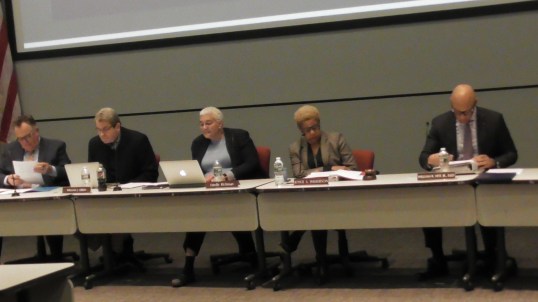
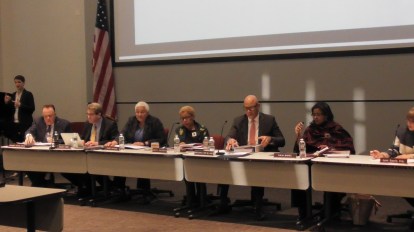
This was a regularly scheduled action meeting, and all four of the remaining commissioners were present. Commissioner Farah Jimenez resigned unexpectedly after last month’s meeting. In her resignation letter to Governor Wolf, which gave no reason for her resignation, Jimenez said that “..it has been a gift to be in service to the students of Philadelphia.”

Ms. Jimenez secured the position of President and CEO of the Philadelphia Education Fund (PEF) in 2016. Prior to Jimenez’s appointment, PEF meetings were open to the public. However, slightly more than a year after assuming this role, Ms. Jimenez barred three regular attenders of PEF Compact meetings, including a public school parent, even though they had tickets (which were not required prior to Jimenez’s appointment). Admittance to these meeting are now guaranteed only to regular financial contributors of PEF, even though their purpose is to discuss public education; others can take their chances on a waiting list. APPS has questioned, as have members of City Council, the potential conflict of interest in serving as an SRC Commissioner while leading PEF.

Jimenez has been a consistent and vocal supporter of charter schools. No matter the drain of resources it caused to existing public schools, no matter the harm to remaining public school students, and no matter the lack of demonstrable success of charter schools. Charter expansion at any cost is a big part of the legacy of Commissioner Jimenez.

Ten members of APPS were present for this meeting; four members and others testified on behalf of public education.

A Matter of Integrity

Click here to read the rest of the post.

Eyes on the SRC:  March 15, 2018

src

by Karel Kilimnik
March 12, 2018

Reading about the many recent school shootings has been heartbreaking. School culture has changed so that students today have grown up with metal detectors, school police officers, and lockdowns. Resolution A-4 (Operating Budget: $500,000 Contracts with AstroPhysics, Autoclear, and Ceia – Weapons Screening Equipment and Supplies) tells a sad tale of what has become normal in so many of our schools. Veteran teacher Kristin Luebbert described a lockdown drill at her school in the Philadelphia Inquirer:

Hearing the signal while in the hall with her students, she quickly shepherded them back into the room, plastered the windows with paper and sent the children to the back. Turning around she saw her students arming themselves with scissors, a heavy-duty stapler, and a bottle of Windex.  They told her they were prepared to defend themselves and her.

Edu-vendors continue to prosper at the expense of our students. Carnegie Learning (B-3) siphons off another $3 million as the District extends their contract to “provide professional development services to approximately 1500 K-8 and Algebra I teachers in support of the District’s annual summer mathematics initiative (2018 Summer Math Institute).”

Carnegie Learning traces its roots back to the 1980’s, when researchers at Carnegie Mellon University developed an “intelligent” math tutoring system. (Carnegie Learning spun out as an independent company in 1998, and its ownership has changed hands several times between private equity groups and other investors.)

Other investors, thereby blurring the lines of accountability and transparency, routinely gobble these private companies up. They are accountable to their investors—not the public.

In January, APPS members submitted questions to the SRC about the resolution approving the sale of the former Ada Lewis Middle School in East Germantown. This meeting’s Resolution A-10 reflects a modification to the sale. How this will affect the community is unknown. The January resolution description provided little information. In our analysis of that Resolution, we share the details we were given at that SRC meeting.  We need to keep in mind that Dr. Hite and Mayor Kenney are united in their intention to close more neighborhood schools.   District schools receive no dispensation and have no pathway to appeal any decision by the Superintendent or the SRC to close them down. Five years ago, students, parents, and teachers in twenty-four public schools found they had no standing in the fight to save their own schools. Their stories were heartbreaking but caused no change in the decision. The state’s charter law, on the other hand, guarantees an extensive legal process for any charter facing closure, effectively keeping the school open for many years.

Drexel University (A-18) was chosen to manage the federal ProSPER grant whose origins lie to the North in Harlem.  ProSPER represents the Obama Administration’s attempt to replicate the Harlem Children’s Zone, a private non-profit with several charter schools, preschool programs, health clinics, social service agencies, and parenting programs.  The Harlem Children’s Zone provides cradle-to-high school services provided by a private entity. Some of what they have done is worthy of duplication but not under private control where the accountability and transparency evaporate. The question is how much autonomy the District schools have in saying what their school needs.

What If…?

…instead of outsourcing almost $ 4 million services this month, that money was used to put a dent in the estimated $5 billion it will cost to repair our public school buildings—from leaky roofs to deficient electrical systems?

Register to speak at the March 15, 2018 meeting. Call 215-400-4180 before 3:30 PM Wednesday, March 14.

Next SRC meeting: Thursday March 22 at 4:30 PM. To register to speak, call 215-400-4180 before 3:30 PM Wednesday, March 21.
Click here to read Resolutions of Note
for the March 15th SRC meeting.


Ears on the SRC: February 22, 2018

SRC 3

by Diane Payne
March 1, 2018

All five commissioners were present for this special meeting of the SRC, held for the purpose of voting on the seven remaining applications for new charter schools: SRC-1 Antonia Pantoja Preparatory Charter School, SRC-2 APM Community Charter School, SRC-3 Eugenio Maria de Hostos Preparatory Charter School, SRC-4 Franklin Towne Charter Middle School, SRC-5 MaST Community Charter School III, SRC-6 Mastery Charter Elementary School, and SRC-7 Philadelphia Hebrew Public Charter School. Five members of APPS testified against the approval of any new charter school. Four other community members and teachers spoke against approval of any of the applications.   (You can see all of these testimonies at APPSPhilly.net )

SRC Votes to Change Policy (After Enactment)

Without any explanation, the SRC limited the number of public speakers for this meeting to fourteen. Seven additional slots were reserved for the charter applicants, who spoke first. In Policy 903, Public Participation at Committee Meetings, no language appears limiting the number of public speakers. This is not the first time the SRC has changed the policy for just one meeting. Last year, they violated their own policy by limiting speakers without voting on the change. This year, they changed the policy before voting on it.

In addition, the SRC changed the order of the agenda and moved the staff presentation on these applications after the public speakers. In all other SRC meetings, the staff presentations come before the public speakers giving speakers some important information prior to their turn at the mic. Again, no explanation.

APPS Again Calls on SRC to Stop Hiding Behind “Quasi-Judicial”

Click here to read the rest of the post.


Ears on the SRC: February 15, 2018

SRC 1

by Diane Payne
February 26, 2018

 All Present

All five commissioners were present for this action meeting. Eight members of APPS spoke on behalf of public education at this meeting; to view their testimony, go to APPSPhilly.net.

Four additional community members spoke in opposition to resolutions A-7 and B-12. Resolution A-7 proposed a $9,549,665 contract with NCS Pearson for “integrated web access. Resolution B-12 spent a whopping $10 million for various vendors providing online courses and adaptive software. (This is in addition to the $10 million the SRC set aside for blended learning last year).

There were two wonderful performances by students from Franklin Learning Center High School (FLC). Two students (piano and voice) beautifully performed the moving song, Strange Fruit, and another student gave a “Little Black Girl” spoken word performance.

SRC Staff Answers Questions

In his remarks, Dr. Hite addressed the millions going to web access and blended learning in Resolutions A-7 and B-12. He assured the audience of privacy protections and gave what some interpreted as lip service to teachers being primary to children’s education.

Teacher Vanessa Baker, in speaking against Resolutions A-7 and B-12, reported on recent events around the city in which business leaders and social impact investors have met behind closed doors–leaving out students, parents or educators– to discuss the direction of education. On January 29th, the Philadelphia Chamber of Commerce held a ticketed, closed-door event for members of the business community on Roadmap for Growth: Exploring Business Engagement in Philadelphia’s Schools. On February 7th, Comcast sent a busload of “Impact Investors” to Feltonville School of Arts and Sciences. Dr. Hite addressed Baker after her remarks to assure her that the attendees at Feltonville were only there to observe and see what is happening at the school. So, when the fox circles the henhouse during the day to see what is happening, does the farmer feel secure going to bed that night that his chicks will be safe?

Another recent exercise in exclusion of community stakeholders is that of the Philadelphia Education Fund (PEF), whose CEO is SRC Commissioner Farah Jimenez. (Yes, APPS has asked why this isn’t considered a conflict of interest, to no avail.)   Since Commissioner Jimenez has taken the helm at PEF, meetings about public education that were always open to the public have become closed-door events with preference to PEF donors. Jimenez has banned some individuals, including APPS co-founder Lisa Haver, from PEF meetings, and has refused to give any reason despite several communications with her and the PEF board. Discussions among business and nonprofits about the future of our schools now shut out the very people whose lives are most affected by them.

APPS members (and apparently some other members of the community) had submitted written questions to the SRC prior to this meeting about the ongoing approval of expenditures with no supporting evidence or explanation of their benefit. Interestingly, the staff presentations and Superintendent Hite’s remarks addressed some of these questions. Coincidence or public pressure forcing the minimum of explanation? In addition, the SRC staff provided written answers to questions which was made available to the public just prior to the meeting.

Click here to read the SRC responses to APPS and community members