Board of Education Action Meeting: October 24, 2024
by Lisa Haver
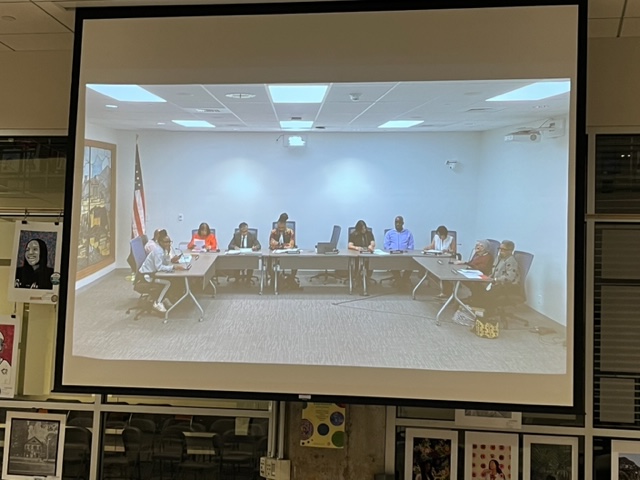
After all of the public speakers had testified, and before the voting on action items, about twenty-five members of the audience went to the front of the room, held up signs and demanded the reinstatement of Keziah Ridgeway to her teaching position at Northeast High School. Less than a minute after the protestors stood, board members and Superintendent Tony Watlington left the room without comment or explanation. During this time, Lisa Haver went down to the board’s office on the first floor, knowing that they would do what they did five years ago when students protested their vote on metal detectors: scurry down to their committee room, accompanied by security, and lock the door.APPS members demanded entry to the meeting then, and we demanded it this time. Haver knocked on the door as the board members entered the committee room; she continued to knock for the entirety of the secret meeting. Several district security and Philadelphia police officers ordered her to move, even threatening arrest, but she refused to move. Eventually they backed off. Board members could be heard on hot mics over the livestream commenting about Haver: “Why is she knocking?” and “Is she taking pictures?” In their barricaded room, with no public allowed, the board voted to approve over $94 million in contracts to various vendors. They also voted unanimously to grant the KOZ (Keystone Opportunity Zone) tax abatement extensions to developers of properties at the Navy Yard and the massive Hilco/Bellwether site. APPS had intended to state a formal objection to the KOZ votes under the state’s Sunshine Act as the board did not disclose in its item how much the KOZs would be costing the district. None of the votes taken in that private meeting is legitimate. Ilene Poses contributed to this report.
Protesters Demand Reinstatement of Northeast High Teacher
Eight months ago, members of the Northeast High School community–parents, students, and educators–came to the school board and asked them to resolve the issue of the targeting of NEHS teacher Keziah Ridgeway after her students displayed a project that focused on the current plight of Palestinians. They returned every month, but none of the board members ever responded. Last month, the district suspended Ridgeway under pressure from an outside organization who objected to some of her social media posts. Board Member Joan Stern is a trustee of that organization; she has not responded to several requests from speakers to explain her involvement, if any, in the district’s decision to remove Ridgeway. Were the board members hoping that Ridgeway’s supporters, whose numbers grew every time they returned, would just give up? Fourteen of the thirty adult speakers registered to testify on this topic, as did one of the student speakers. A large contingent of supporters stood behind each when they testified. They were not just standing up for this one teacher. They were standing up against censorship and the harm done to students when their teacher is gone one day and they have no idea when she will return. The board bills these meetings as “action meetings”. When will they act on this matter?
District Hosts Private Gathering of Charter CEOs
Board President Reginald Streater announced that last week the district hosted a “convening” of “public charter school” operators last week. That came as a surprise to APPS members, who attend all hearings on charter business. Turns out it was a private meeting open only to the charter administrators but not to the public that pays for them. It is another example of how the board caves to charter operators–who in turn accuse them and the Charter Schools Office staff of being racist. Rather than hold public charter renewal hearings, as APPS has demanded for years, the board hosts a private gathering for charter CEOs who already have an open door to conduct private negotiations for renewals and enrollment increases. Had the public not been shut out of the meeting, APPS members would have attended in order to raise the question of how charter investors and CEOs have managed to build an entrenched patronage system while the board continues to give them cover.
Developers Win, Students Lose
This meeting was actually the second one that day in which a governing body was voting to reward wealthy, politically connected developers at the expense of their constituents: just hours before the board voted to grant tax abatements to the owner/investors of property in the Navy Yard and the Bellwether/Hilco site, Philadelphia City Council introduced a series of bills that will benefit the developers of the proposed 76ers arena adjacent to Chinatown. Eleven students (and several teachers) testified at this meeting about how devastating the cuts to the extra-curricular (EC) activities at their schools, in particular debate and robotics, have been to them. Some told of how these activities brought them out of their shell and made them more excited about coming to school every day. Aster Lin, a junior at Palumbo High who had also attended the City Council hearing and spoke at the rally outside City Hall, told the board that robotics became a place where she found sanctuary: “Through extracurriculars I have been able to grow out of my comfort zone and develop skills outside of a class setting…I cannot stress enough the importance after-school activities have on the entirety of a school body and community.” After Watlington’s remarks earlier in the meeting, BM Sarah-Ashley Andrews asked what his administration is doing to increase student attendance. Students made it clear what the district can do to bring students to school. The board took no action to restore funding to extra-curricular activities.
Board Moves Closer to Closing Neighborhood Schools
President Streater announced dates of community meetings, billed as “community conversations” in which the district will present its”Facilities Planning Process”, a euphemism for closing more neighborhood schools. Pre-registration is required, although the sign-up page doesn’t give a time when the window closes. Continuing its policy of speaker suppression, the board allows individuals to speak at only one of the eight scheduled meetings. Should a family have two children who attend schools in two different neighborhoods, they could only be heard in one. Eleven years ago, the state-imposed School Reform Commission, in one vote, closed 23 neighborhood schools. The district claimed, falsely, that it would save money by closing under-enrolled schools that were not achieving. If the board applies that same criteria now, they would have to start by closing about half of the city’s charter schools. Of course, the law grants any charter school facing non-renewal an extensive and expensive appeals process which takes years, during which the school continues to operate. Public schools have no legal appeal process. The board has to hold meetings so they can say they listened (although it’s not clear whether they will be attending any of them), but they will eventually do what they had intended to do all along: keep substandard charters open at the expense of neighborhood public schools.
Board Grants KOZ Extensions Under Political Pressure
The board made room on its agenda for several representatives of the City Commerce Department to make their case, on behalf of the developers, for extensions to Keystone Opportunity Zone (KOZ) tax abatements. The city officials, appointed by Mayor Cherelle Parker, narrated their slideshow, justifying the financial loss to the district by implying that the developers’ payment of PILOTS (payments in lieu of taxes) made up for the tax breaks.. A recent Chalkbeat story, however, makes it clear that “… even with the PILOT payments, the zones ultimately lead to less funding for the district than if the developers paid regular taxes.” Despite repeated requests from Chalkbeat, the board stonewalled the paper, refusing to answer any questions on the matter: “‘The tax breaks have the support of Mayor Cherelle Parker and the state,’ Philadelphia Director of Commerce Alba Martinez told the board Thursday. Board members — all of whom were appointed or reappointed by Parker — have consistently declined Chalkbeat’s repeated requests for comment about why they continue to approve the tax breaks. They have directed all questions to the city’s Commerce Department.”
APPS Members Protest KOZs, Call for Restoring Librarians
Barbara Dowdall welcomed the new director of Library Science and noted again that restoration of this essential resource, along with lower class sizes and a variety of extra-curriculars, must be a priority for the district. PARSL (Philadelphia Alliance to Restore School Librarians) member Lauren Popp and district parent of two children submitted a petition with 678 signatures calling for the district to restore school libraries staffed by certified school librarians to every school, and declared that she wants her children to always be in a school with a fully functioning library. Ilene Poses responded to the chief academic officer’s remarks that blamed special education teachers for the recent low standardized test scores of students and suggested that those students needed to be exposed more to the regular curriculum. Poses said that success would be better measured by using students’ IEPs. Lisa Haver urged the board to vote No on the KOZs, asking why students have to come and beg for funding for extra-curriculars while all developers have to do is stick their hands out?
November board meetings: Action Meeting, Thursday, November 21 at 4 pm; Policy Committee, November 7 at 4 pm; Goals and Guardrails, November 14 at 4 pm. (See above for Facilities meetings.)
 Alliance for Philadelphia Public Schools