
Board of Education Action Meeting: January 30, 2025
by Lisa Haver
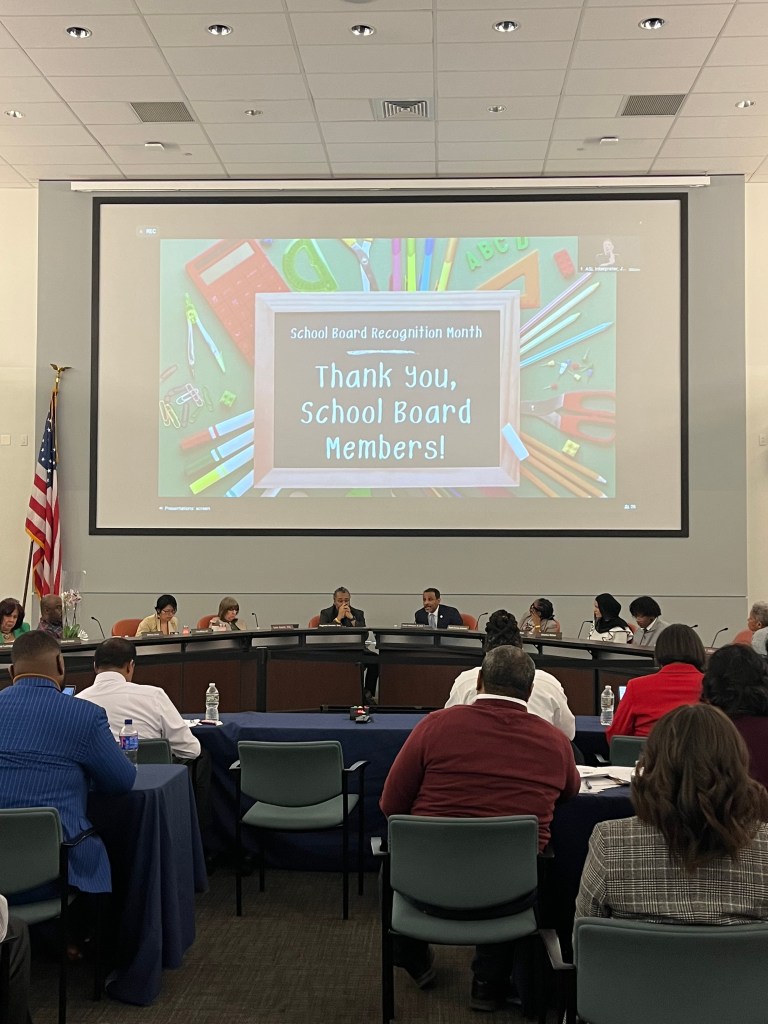
Members of the Board of Education, at their January action meeting, spent more time congratulating themselves and the administration than they did deliberating on action items or responding to public speakers. Board members offered no questions or comments on any of the 27 action items before passing them unanimously. Several board members praised Superintendent Tony Watlington for his data-centered report on the state of the district, but none inquired as to the inconsistencies in that data. Not one board member answered questions from any of the 38 students, parents, educators, or community members about what the board intends to do about bringing back school librarians, protecting students from ICE raids, repairing dangerous facilities at a district high school, or voting on two new charter applications. Every year, they bask in self-congratulation just for showing up. Have they lowered class size? Brought back school librarians? Taken steps to rein in rampant charter corruption?
Ilene Poses contributed to this report.
Board Cannot Bar Public from Public Meetings
When Board President Reginald Streater convened the meeting, almost half the auditorium was empty. APPS members stood up and asked him why security was detaining people downstairs and telling them that no one would be admitted until all the registered speakers had arrived. Lynda Rubin was one of three APPS members being detained. She showed the guard her name on the list; he then told her that she couldn’t go up because she was on the waiting list. After we complained, security began to let people up. The board limits the number of public speakers, then bars people from attending because they didn’t make it onto the list. Lisa Haver, in her testimony, told the board that security downstairs told her that it was “policy” that she needed to show ID. Haver told them to show her the policy; since there is none, they relented and let her go up. District staff at the newly installed check-in table outside the auditorium are telling people the falsehood that it is policy now that they must sign in and wear a badge to enter this public meeting. But what about people who don’t review board policy as APPS has learned to do? What about people who don’t have ID? Haver warned of the dangers of creating a “papers, please” barrier to board meetings. The board should not mirror the authoritarian regime now ruling in Washington.
Parents, Community Members Testify Against More Charters
One manifestation of the board’s ongoing speaker suppression is its withholding information on matters that members of the public want to speak about. The most recent example is the board’s hearings on two new charter applications, which if approved would cost the taxpayers millions annually for the foreseeable future. State law requires two hearings for each applicant. No public testimony is heard at the second, although the charter investors have hours to make their case. Without explanation, the board decided to hold all meetings remotely, thus denying members of the public the opportunity to show support or opposition to either or both of the applicants. That is a violation of the Pennsylvania Sunshine Act. Temple Law professor and charter expert Susan DeJarnatt included several charts in her testimony; one showed that there are over 2000 empty seats in the city’s charter high schools. The board will hear a presentation from its Charter Schools Office at the February action meeting, immediately after which it will take a final vote on the applications.
Facilities Committees Must Not Exclude Community Members
Superintendent Watlington summarized the “state of the district” report that he had presented in a press conference earlier that day. Regarding the facilities issue, he remarked that some district schools are under-enrolled, one reason why they may be targeted for closure. Why then is the board not moving to close the charters with significant under-enrollment? Watlington told the board that there are now several advisory groups meeting to discuss facilities. He did not say how they were chosen or by whom; he did not say when or if they would be issuing reports to the public with any recommendations. The district has also appointed a special committee of VIPs called the “Team Project”. That committee includes CEOs of two charter companies that have benefited from carrying out hostile takeovers of neighborhood schools as part of the Renaissance program, described by a former board member as “the most expensive failure in district history.” Penny Nixon, as Universal Charters CEO, abandoned two of the company’s Renaissance charters, Bluford and Daroff, refusing to meet with parents or any members of the school communities. (Universal has abandoned schools in at least one other city.) APPS has written to the board asking that the schedules of all meetings of all advisory councils and committees be posted on the district website, that they be fully open to the public and have opportunity for public comment. The state’s Sunshine Act clearly states that any committee advising a governing body must abide by the rules set forth in the act.
Six Years of Board Governance, Still No School Librarians
Philadelphia teacher Maddie Luebbert, who resigned last year from the district and now works as a substitute, joined the many voices calling for the restoration of school librarians. They spoke with pride about their former students at Kensington Health Sciences Academy High School and their success in raising funds and building their “Dream Escape”, a room filled with books that students can visit. Luebbert, lamenting the fact that none of the students at KHSA had ever attended a school with a library, asked whether we should really celebrate “when kids have to hustle” for a facsimile of something they have always deserved. “Let’s be honest”, they told the board, “the DreamEscape library is amazing, but it’s nothing compared to a school library in a dedicated space staffed by a full-time, certified school librarian.”
Olney High Community Advocates for Better Student Spaces
Eleven speakers representing Olney High School–principal, teachers and students–came to the board to ask for urgently needed repairs to the school’s football field and athletic complex. They described in detail the near unusable facilities and lack of bathrooms for students and coaches. None of the board members raised the question of whether Aspira Charters, which occupied the building for ten years, is responsible for the damage. Aspira was cited by the state’s attorney general for “questionable” financial practices for diverting funds allotted for their two Renaissance charters to other Aspira businesses.
Board Speed-Votes on Spending, Policies
In less than one minute, the board voted unanimously to pass 27 action items. Without a single question or comment, they approved spending $26,381,926 for items including early childhood data management and drone surveillance of teachers and staff at John Bartram High School. They also voted to accept $2,714,146 in grant money for various projects.
Item 26 provides for a $15 million agreement with the city to extend the Community Schools initiative at nine district schools, most of which were named community schools almost ten years ago. None of the board members asked how that initiative has helped to improve the educational experience of the children at any of those schools.
The meeting adjourned at 6:32 pm.
Next board action meeting: Thursday, February 27 at 4 pm at 440 North Broad Street and via zoom.
Next Goals and Guardrails meeting: Thursday, February 13 at 4 pm at 440 North Broad Street and via zoom.
 Alliance for Philadelphia Public Schools