by Lisa Haver
September 16, 2025
At its September 2024 Action Meeting, the Board of Education, by unanimous vote, approved contracts with two consulting companies totaling $4,880,918. The board approved a one-year $430,000 contract with Brownstone PR and Insight Education Group, LLC for “Community Engagement and Facilitation Support”. Purpose: “For support in community engagement and the facilitation of advisory groups and a working group related to the Facilities Planning Process”. They also hired DLR Group Inc. for “Facilities Planning Services” for $4,450,918; one-year contract for “development of a comprehensive Facilities including Facility Condition Assessments, Educational Suitability Assessments, updated enrollment projections, and stakeholder engagement.
One year later, at its August 2025 Action Meeting, the board unanimously ratified a $404,626 contract extension with Aramark, Inc. for “Facilities Assessment for Phase III”. According to meeting agenda attachments: “The facilities planning data warehouse has been completed and is currently hosted by Aramark.”
The board has not mentioned the consultants at any meeting or in any news story. There have been no updates on what any of the companies is doing. But we can see how poorly the Brownstone PR company has performed: the meetings in September 2024 and in July 2025 have been very sparsely attended.
The board had scheduled no public meetings after those in Fall 2024 and before the board was to announce its list of schools to be closed. APPS members raised the issue in testimony, in articles on our website, and in commentaries. In June Superintendent Tony Watlington Sr. announced a new round of community meetings to be held in July.
Around the same time the board hired the two consulting companies, they convened nine “advisory groups” and one “Project Team” whose members were selected by the Watlington administration and whose meetings are closed to the public. In May, APPS sent a letter to the board asking that all meetings on facilities be open to the public; we followed that with a Right to Know request that all minutes of all committees be released. We reminded the board that the Pennsylvania Sunshine Act clearly stipulates that all meetings of a government body or agency must be open to the public. Section 703 of the Act includes “all committees…that are authorized to render any advice or take official action on behalf of the governing body” in its definition of “agency”. The board denied our requests. The committee meetings remain closed to the public.
The district’s facilities webpage states that the Project Team’s thirty members, including two Renaissance charter operators and five senior district administrators, “will meet monthly throughout this process to synthesize inputs from our public listening sessions and surveys, as well as review a wide range of data, to generate drafts for feedback from the Advisory Groups and the public overall.” That sounds like what the board hired the consultants to do. Since the first meeting of the Project Team in September, the public has not been told how many meetings have been held, who has attended, or what was on the agenda. Will this be the committee that comes up with a list of schools targeted for permanent closure?
The Board of Education has set up a system where the public can’t know what the consultants are doing nor can we know what the committees are doing. When the recommendations come out in the fall, we will likely have no way of knowing who has come up with the list of schools to be closed.
Fortunately, members of the Education and Community Partners Committee have publicly expressed their frustrations with how the district is conducting the facilities process. Meetings were cancelled at the last minute and members were frustrated “by bureaucratic presentations and unspecific brainstorming sessions.” University of Pennsylvania Professor Akira Drake Rodriguez told Philadelphia Chalkbeat that the committee members want a plan “that prioritizes community needs and not just the district’s.” She stated that she wants the district to avoid closing schools “entirely”.
In that same June 2025 article, Sharon Ward, Mayor Parker’s Deputy Chief Education, told Chalkbeat that the mayor was “finalizing the membership list and intends to announce the group soon.” Three months later, there has been no announcement. No member of City Council has spoken out against the closing of neighborhood public schools.
Last September, Board President Reginald Streater told the Philadelphia Inquirer that “the district will consider its 17 Renaissance charter schools as part of the planning process.” Actually, none of the lists of schools distributed by the district at the meetings we attended included any Renaissance charters.District data shows that over half of the city’s charter schools are under-enrolled, many significantly. Did the charter CEOs on the Project Team push for keeping those charters off of the list?
APPS members have attended almost all of the community meetings in both September 2024 and July 2025. We met principals, parents, teachers and community members, but no one introduced themselves as a Project Team member. Any “inputs” from the public listening sessions would be second-hand. In addition, a recent Chalkbeat article showed how flawed the data distributed at the community sessions has been: “At community engagement meetings held by the district this month, some educators pointed out that the district’s stated capacity for their schools did not seem accurate, based on their experiences in their buildings. Others noted that the data creates an incomplete picture about the city’s enrollment, as it only captures a moment in time and does not include charter or parochial school enrollment.”
Community members including APPS members asked what the numbers and color codes assigned to categories including “Program Alignment” and “Capacity Utilization” actually reflected, but as noted in Chalkbeat, the facilitators “did not explain how these scores and codes could make different outcomes for schools more or less likely.”
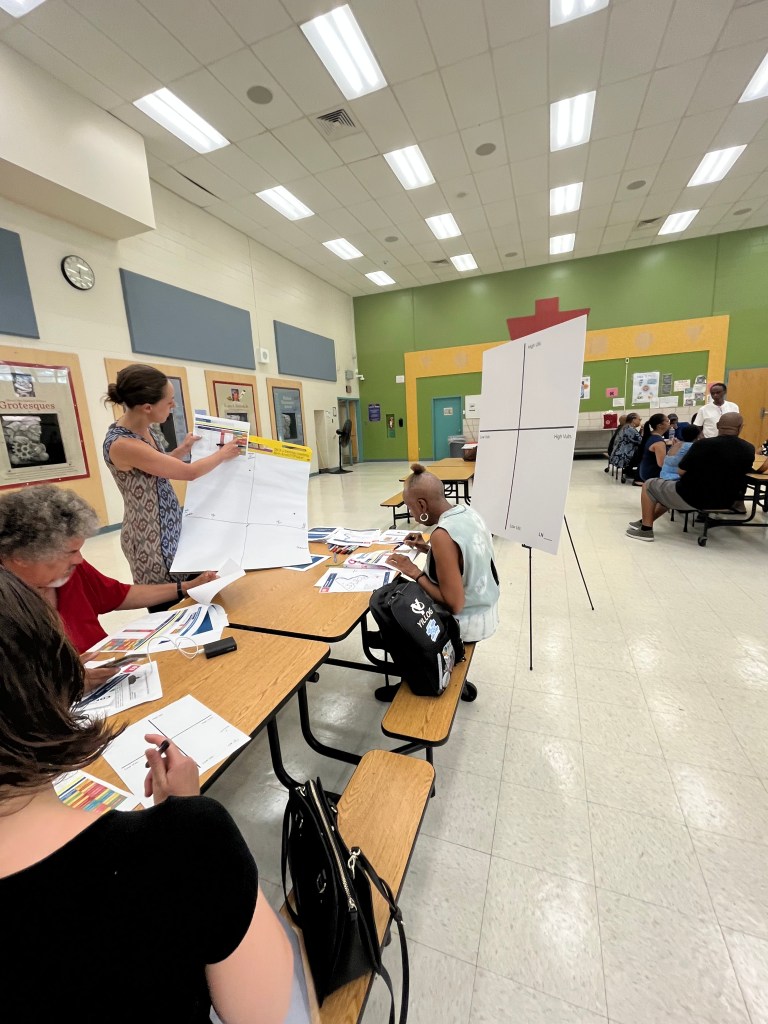
APPS member Lynda Rubin attended the first July 7 session held at Southwark Elementary. Parents and community members who came were directed to tables holding groups of 5 to 10 people in sessions. Rubin reports that there was never a time when the entire group was able to ask questions or communicate with each other and to share information about each others’ schools. Of course, that tactic also means less opportunity for community members to network and to organize against school closings. There was no summary at the end of the meeting of all the groups’ questions and answers; there was no discussion time for the entire group. What did not seem to be a priority was for the Board to hear from us at different schools at different levels about common goals or problems. Rubin concluded that the meeting was set up to sell the district’s version and their confusing data, not to have open discussion among school staff, parents, and community. APPS members had the same experience at all of the sessions we attended. Not a single parent, educator, student or community member said they wanted to see their school closed.
APPS members Barbara Dowdall and LIsa Haver attended the July 9 session at Bluford Elementary in Overbrook. The session presented the same data in the same format as at Southwark. There was a packet of data that was confusing, and according to one of the two principals at our table, not accurate. Haver asked what some of the categories meant, like “Project Alignment” and how that could be measured, but did not get answers that cleared up the confusion among those in the group.
Dowdall also attended a session that week at school district headquarters at 440 N. Broad Street. Same format, same data.
APPS member Ilene Poses attended the July 10 session at Solis Cohen Elementary in Mayfair. Fewer than ten members of the public attended, and most of them were district staff. One person who identified as a Philadelphia Federation of Teachers member from another school in the Northeast said that the district should not be closing any schools. Almost every school in the Northeast is very overcrowded.
Rubin also attended the July 14 session at McDaniel Elementary in South Philadelphia which was sparsely attended. She pointed out in her small group that the Watlington administration is missing the point by pre-determing school building needs before hearing what parents and community members’ true concerns are. Again, there was no time given for the entire group to communicate their questions and concerns with one another.
Dowdall attended the July 17 session at Andrew Hamilton Elementary in West Philadelphia and the July 18 session at Vare-Washington Elementary in South Philadelphia. Fewer than 20 people came out. Dowdall asked whether the restoration of school librarians is included in the “Desired Outcomes” of the facilities plan. The district staffer responded, “It isn’t.” Dowdall described this meeting as “frustrating”, with more questions than answers.
In the very rare cases when the board begins non-renewal proceedings on a charter that fails to meet basic academic standards for years and is significantly under-enrolled, the charter school can take the case to court for years, with taxpayers bearing legal costs for both sides. When the board moves to shut down neighborhood public schools, we get district-controlled, data-heavy presentations.
When the Board of Education releases its list of schools targeted for closure, they will claim that the district held meetings where they listened to the people. But APPS members who attended those meetings know that was never true.
Lynda Rubin, Ilene Poses, and Barbara Dowdall contributed to this report.
 Alliance for Philadelphia Public Schools