Board of Education Action Meeting: December 4, 2025
by Lisa Haver
(Photo: Lisa Haver)
The Board of Education says little of consequence. They create the illusion of deliberation, but most of what they say is directed not to members of the public but to the administration–not to question Superintendent Tony Watlington Sr. but to thank him and his staff for doing their jobs. At this action meeting, Board President Reginald Streater called on every board member for questions or comments after Watlington’s announcement of the new contract with members of the principals’ union (CASA). Except for Board Member Chou Wing-Lam, who asked one question, the rest simply echoed each others’ thanks to Watlington and his negotiating team. That took eleven minutes. But real deliberation? Almost none. Prior to every action meeting, the board members agree to move most items into a “consent agenda” (likely a Sunshine Act violation), then take one vote–whether it’s for ten items or ninety–without any deliberation. At most action meetings, the entire process takes less than one minute. Streater calls this “efficiency. Parents, students, educators and community members who come to be heard and to get answers have never demanded “efficiency”. They ask the board and the administration to answer them and to take the time to address issues and solve problems that affect their children. The board is the governing body of the School District of Philadelphia. Their constituents include every person in the city–who deserve answers from board members.
Ilene Poses contributed to this report.
Board, Administration Continue Stonewalling on Facilities Plan
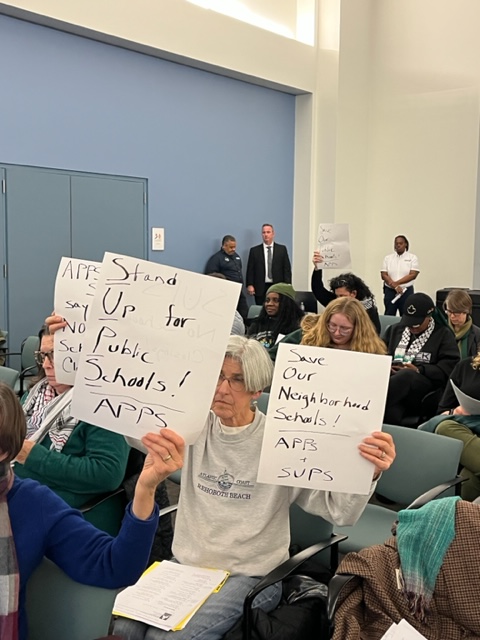
The board said nothing about the biggest issue facing district families: the imminent closing of their neighborhood schools. None of them asked Watlington why he did not release this month as his posted timeline had promised for over a year. APPS members attended almost every community meeting over the past fifteen months. Not one participant said they want their school, or any school, to close. None of the board members asked when the plan would be released. Watlington first promised December, then last month said January. Now it’s sometime this winter. We don’t know how many schools are targeted for closure or in which neighborhoods. The board has yet to ask the crucial question: Why does the district plan to close neighborhood schools? Several members of the Stand Up for Public Schools (SUPS) coalition, including APPS members, came both this month and last to demand that the board vote for a facilities plan that does not include any school closings. SUPS members include teachers and school psychologists, along with parents and community members. Watlington mentioned underenrollment at this meeting, but as APPS members have pointed out, more than half of charter schools are under-enrolled and no one is threatening to close them. Last month Watlington put out yet another survey online. Now he is talking about more meetings? The board can do more than clap for the administration. They can demand answers about the future of the city’s public schools.
Speakers Urge Board to Protect District Educators
Last month, a Congressional committee led by Republicans opened an investigation into allegations of anti-semitism against students in a number of school districts including Philadelphia. Several speakers at this meeting cited the district’s own disciplinary actions against teachers who have been falsely accused of anit-semitism. District parent and teacher Freda Anderson, who identified as part Ashkenazi Jew, testified that “…the government keeps conflating anti-semitism with anti-zionism” and characterized the investigation as a “witch hunt” that will continue to target black, brown and Muslim students and staff.” Teacher Tom Quinn testified about his own unfair persecution by Pennsylvania Republicans when he initiated a campaign to register students to vote. He reminded the board that teachers who didn’t sign loyalty anti-Communist loyalty oaths were fired during the 1950s McCarthy era. Quinn told the board: “To be clear, these attacks on our district and educators are attacks on our students, robbing them of our best teachers and the liberatory power of a critical education.” District parent, teacher and coach Alex Volin Avelin called the Congressional investigation “political theater” that is “not about protecting students but about intimidating and silencing teachers.” Former district teacher and APPS member Kristin Luebbert testified that she has been witness to “many incidents that exposed the endemic racism, Islamaphobia, Anti-Palestinian, and Anti-Immigrant attitudes that exist in our district.” She questioned why the government has opened no investigation into these patterns of discrimination.
Board Conducts Most Official Business Outside of Public Meetings
Board members voted to re-elect the current president and vice-president; BM Crystal Cubbage abstained without explanation on the vote for president. The board operates as if the president were in charge. He is not. He is a facilitator. Neither the city’s Home Rule Charter nor the board’s by-laws give special powers to the president or vice-president. The board’s silence on crucial issues, their lack of even one minute of deliberation on official items, their capitulation to the charter patronage representatives–all demonstrate their choice to stay quiet rather than defend public education and speak up for the best interest of Philadelphia’s children. At this meeting, they did deliberate on one item: the Board’s proposed 2026 meeting calendar. BM Lam proposed incorporating the Goals and Guardrails committee meeting into the action meeting. It was indicative of how little most of the board members knew about the board before they were appointed to it: the G and G presentations were part of the action meetings for over a year. APPS and others protested the fact that public speakers, many parents with children, had to wait until after 8 or 9 PM to testify–one manifestation of speaker suppression. To their credit, the other members of the board rejected the move. BM Joyce Wilkerson pointed out that combining the two meetings would decrease public participation. The board voted unanimously to pass the 10 items on the consent agenda, approving $7,050,796 in district spending.
The meeting adjourned at 6:54 PM.
Next board committee meeting: Goals and Guardrails, Thursday, December 11, 2025 at 4 PM.
Next action meeting: Thursday, January 29, 2026 at 4 PM.
 Alliance for Philadelphia Public Schools