Board of Education Action Meeting: May 30, 2024
by Lisa Haver
Philadelphia’s unelected Board of Education demonstrated how little it is accountable to the public at this May action meeting. Before and during the meeting, both district security and Philadelphia police blocked parents, students, educators and community members from entering the building and the auditorium. As social media was documenting in real time the violation of the rights of the people outside the doors to exercise their First and Fourth Amendment rights, as people were calling out to the board to do something, not one member of the board spoke up for their constituents. At least two reporters who showed press credentials were blocked from entering the building by 440 security and Philadelphia police; another reporter had to intercede twice before they were allowed inside.
The board’s speaker suppression policies not only block people from being heard, they block them from being seen. As usual, the board set up only 140 chairs in an auditorium that holds 240 people. Security has adopted a “papers, please” enforcement policy of asking people if they are on the speaker list, then rejecting them if they are not. So those who didn’t sign up in time for the board’s limited speaker slots, or those who came not to speak but to witness their government in action, were relegated to a holding area on the first floor. Those who attempted to sign up on Tuesday, heeding the district’s announcement that all schools and offices were closed for the Monday holiday, found out too late that the sign-up window actually opened Monday as usual.
Why were Philadelphia Police on bikes blocking elevators inside the building? Why were parents of children who were on the speaker list blocked from entering? Rally organizers reported that district spokesperson Monique Braxton joined security in blocking people from entering, telling them that the rally was threatening and that participants were behaving in an unprofessional manner.
Ironically, many of those who came to protest the district’s ongoing censoring of teachers and students were the ones kept out. Northeast High parent Jethro Heiko interrupted the meeting to file a formal objection to the board’s violation of the PA Sunshine Act. He told the board that this was not a public meeting if the board was preventing the public from attending. Board President Reginald Streater announced a 15-minute “break” one hour and ten minutes into the meeting; the board did not return for 30 minutes. Streater gave no explanation for the recess nor did he report on what the board did during that time.
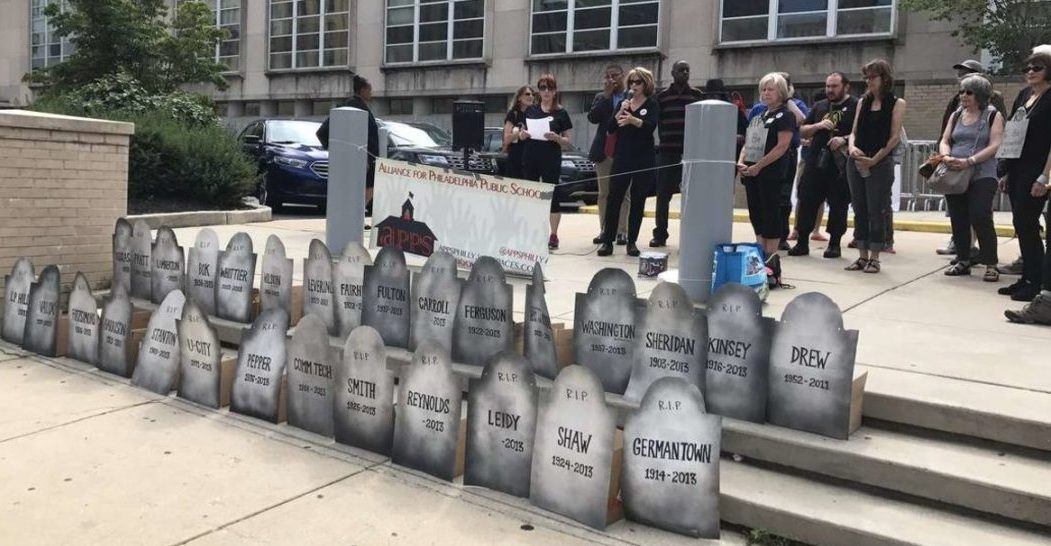
APPS and others were posting pictures online of the many empty seats in the auditorium. Many of those who came to the meeting never made it into the building. They were told that there wasn’t adequate security. For what? This was a peaceful protest both inside and out. There was no threat of violence in the auditorium. Does the board consider parents and students standing in solidarity a security risk?
Ilene Poses and Deborah Grill contributed to this report.
Students, Parents, Educators Rally for Palestine, Against Censorship
Philly Educators for Palestine organized a rally in front of 440 that started just before the board meeting convened. They expressed their demands, both at the rally and to the board directly, that the district condemn the “ongoing genocide in Palestine” and ensure the safety of those attempting to teach and learn about Palestine. Several rabbis, including Rabbi Alissa Wise, representing Rabbis for Ceasefire, testified in support of the students and teachers advocating for an open discussion of Israel’s actions in Gaza. Northeast High students and parents including Heiko asked, as they have since February, why teachers who published the names of NEHS students online have not been disciplined and remain in the classroom while those whose students completed a project on Palestine or raised the issue in a professional development session are facing disciplinary action. Heiko told the board and Superintendent Tony Watlington that a group calling itself “The School District of Philadelphia Jewish Family Association” has been making false accusations of anti-semitism; he asked that the district make it known that the group is not an official part of the district (none of the members of the Association were on the registered speakers list). Heiko argued that the district’s failure to act to protect teachers and students amounted to a “don’t say Palestine” policy, similar to “don’t say gay” laws in other states. He asked: Does the district want to be like Ron DiSantis’s Florida?
After the public testimony, Superintendent Tony Watlington addressed the speakers, in particular those who asked for the district to provide a safe space for discussing the crisis in Gaza. He said that the district does not take a stand on international conflicts and that the district did not condone any acts of anti-semitism or Islamophobia. He did agree to provide a safe space for discussion, but would not give any specifics about when that would take place. Watlington, who pointed out that he is a “certified Social Studies teacher”, announced that the district was contracting with a global non-profit to provide curricular consulting in this area.
More Substandard Charters Recommended for Renewal
Charter Schools Office Director Peng Chao, in a presentation not posted on the meeting agenda, listed the sixteen schools in the 2023-24 renewal cohort along with the CSO’s recommendation. The slide presentation, not posted on the district website or distributed in the meeting materials, showed a number of charters that failed to meet standards in at least one of the major categories–academics, organization, and financial–with recommendations for 5-year renewals. A recent APPS report showed that only one of the eighteen charter schools in the 2022-23 renewal in 2022-23 met standards in all three categories, yet most were recommended for renewal. When the board proclaims that it is “child-centered”, does that include the children in charter schools?
The board should hold public renewal hearings so that the public, including the parents and students from every charter school, can examine the data and ask questions about why many charter schools fail to meet the most minimal standards and why charter CEOs and administrators are paid such exorbitant salaries.
Later, the board voted to approve three charter amendments that the public had no knowledge of before this meeting, were not distributed at the meeting, and are still not posted in the board’s online meeting materials. One amendment gives permission to Belmont Charter to move its high school from West Philadelphia to a lucrative Center City location. Before voting to approve the amendment, Board Member Joyce Wilkerson expressed her concerns about Belmont Charter School’s plan to leave West Philadelphia and move to Center City. In fact, Belmont is a catchment-area school; its original agreement in 2005 stipulated that it would remain so. Belmont Elementary was a neighborhood school for generations before district CEO Paul Vallas gave control of it to real estate developer Michael Karp in 2002. In 2015, the School Reform Commission approved an amendment to add grades 9-12 to the school. APPS again stated its objection to the board taking, in essence, a secret vote on official amendments that will affect several communities. Lisa Haver asked the board to be mindful of the actions of Belmont’s board in the past. In 2019, Belmont CEO Karp lobbied to have the Republican-controlled state legislature change the law for the sole purpose of allowing Belmont, for all intents and purposes, to secede from the district. After a school fails to meet standards year after year, and after its administration undermines the authority of the board, what does the board do? It caves in to their request to abandon the school’s community and move to a Center City location. The board’s claim that it strives to be above politics takes another hit here.
Community Members Demands Better Ventilation for Students
Members of Philadelphia Democratic Socialists of America (Philly DSA) and their supporters returned to the board to demand that students in all schools be able to breathe clean and healthy air. APPS has supported DSA in its efforts; our members have participated in their Corsi-Rosenthal box-building sessions. Philadelphia City Councilmember Nicholas O’Rourke, along with PA State Senator Nikil Saval and PA State Representatives Rick Krajewski and Elizabeth Fiedler, all urged the board to make sure that adequate air filtration is installed in all classrooms and common areas. All of those elected officials also expressed solidarity with the demands of the Philly Educators for Palestine.
Board Approves Over $77 Million in Spending Without Deliberation
The board passed all 52 action meeting agenda items, including 5 Intermediate Unit Items; 50 passed unanimously. Board Member ChauWing Lam was absent. Board Member Crystal Cubbage abstained from Item 47, the Youth Build Charter relocation amendment, for “business reasons”. That is not an adequate explanation; board members must state the specific reason for their abstention or recusal including their business or personal relation to the vendor or contractor. Board Member Joan Stern apparently abstained from Item 23; her comment could not be heard by the audience.
In just two minutes, the board voted to approve 44 items totaling $77,656,135 (no amounts were posted for the costs of adding grades to charters or for the relocations). There was no deliberation on any of the 44 items, no questions or comments even on the most costly items. The action meeting adjourned at 9:02 p.m. when the Intermediate Unit meeting convened. In the next two minutes, the board voted unanimously to approve all 5 items. The meeting adjourned at 9:06 PM.
Next board meeting: public hearing on Thursday, June 6 at 4 p.m. at Benjamin Rush School.
 Alliance for Philadelphia Public Schools