Board of Education Action Meeting: January 29, 2026
by Lisa Haver
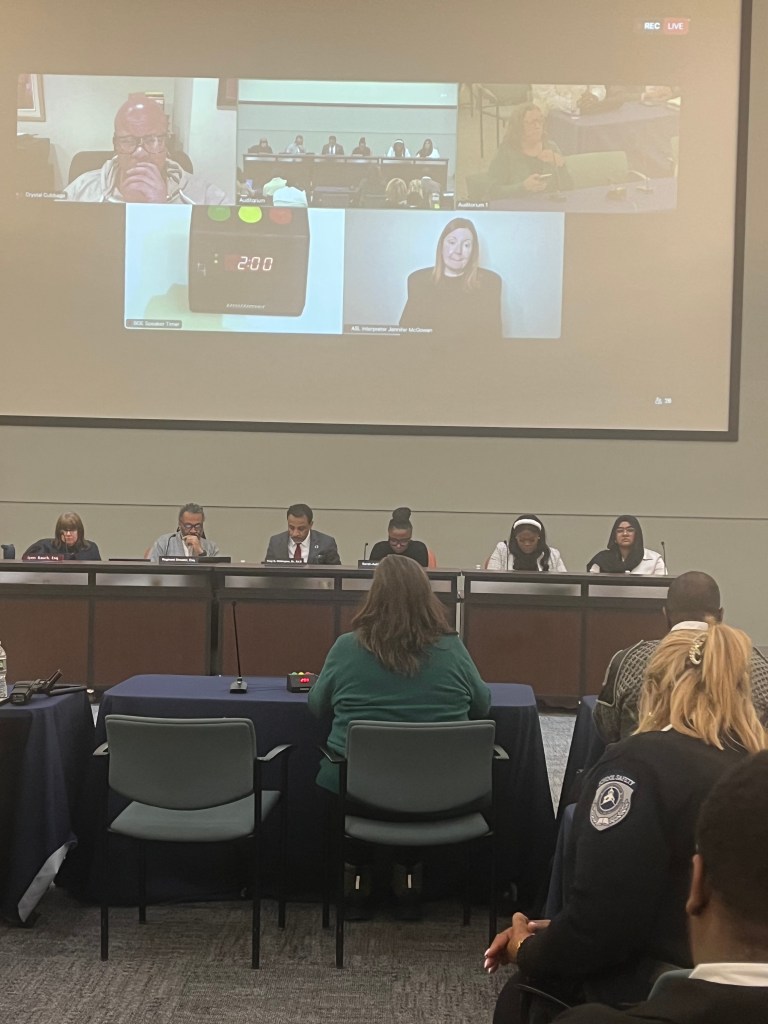
The students showed up. So did the parents, teachers, principals, and community members who packed the auditorium at 440. Who didn’t show up? Most of the members of the Board of Education. Only President Reginald Streater and Vice-president Sarah-Ashley Andrews attended in person. Board Members Wanda Novales, Whitney Jones and Joan Stern were absent. Joyce Wilkerson, Crystal Cubbage and Chou-Wing Lam could be seen intermittently on the screen but were not fully present even virtually; Lam was visible for less than 15 minutes throughout.. Cheryl Harper never appeared; her voice could be heard occasionally. Board of Education Policy 006.1, Meetings, clearly states that members may attend remotely if they “participate in the entire meeting”. Board members “must be visible on the screen”; if they step away “they must notify the Board’s Chief of Staff or their designee.” The board violated all of these provisions. The board did not have a quorum as only the two members in the auditorium were fully present. The board must re-vote on all of the action items at a subsequent meeting. The board’s disrespect for the public, especially after the release of a potentially devastating facilities plan, is unacceptable.
APPS members found out that the board actually had a plan to abandon the meeting before it even began, apparently because they were afraid of the people conducting a peaceful protest outside 440. Board staff asked people as they came in whether they wanted to testify remotely. We asked why someone in the room would need to testify virtually. They finally admitted that the board had a “contingency plan”. The board has abandoned action meetings twice before, the most recent October 2024. APPS has told the board that when they barricade themselves in a room and broadcast a live feed, that is a TV show, not a public meeting. It is a clear violation of the state’s Sunshine Act.
Board Asks No Questions about School Closings
Superintendent Tony Watlington Sr. released the twice-postponed Facilities Master Plan on Thursday, January 22, one week before this action meeting. The Philadelphia Inquirer, Chalkbeat Philadelphia, KYW NewsRadio and other news outlets featured stories about the plan. Parents, teachers and students were interviewed. Elected officials were quoted. But Board of Education members apparently decided before the meeting to maintain a collective silence. . Not one board member asked a question or made a comment about a plan that will change the face of the district for years to come. Not one responded to any student, parent, educator or community member who spoke against the plan and for their schools. But Streater did respond to Watlington, thanking him for his “robust” community engagement while repeating the district’s claim that it has been responsive to community members. Streater rationalized his silence on the issue by saying that it wouldn’t be right for him to comment until Watlington “presented” the plan to the board at next month’s action meeting–will that be a different plan? Yet some board members were vocal in urging the public to attend the community meetings just scheduled and said that they would be there. Lisa Haver testified that APPS members attended community meetings in neighborhoods across the city in 2024 and 2025; they did not see a single board member at any of them. “Cut us a break”, Haver asked the board.
Facilities Plan Doesn’t Cover All District Changes
The most striking thing about the “plan” released by the district is that it in no way reflects the wishes of the people of the district. Another is that the plan does not acknowledge the devastation and trauma that it will cause. Watlington’s plan is, by his own admission, not complete, although he has not said how incomplete. Philadelphia DSA member Katy Egan pointed out in her testimony that the plan released so far only covers about 25% of the projected reconfigurations of district schools. Watlington did not correct her figure. APPS has been told of individual schools who were notified of mergers or modernizations that were not on the official list. For example, parents and teachers at Moffet Elementary in West Allegheny received emails from district operations staff that the school will be converted from an elementary to a middle school. That may not be listed as “closing”, but the school that served that community for generations will cease to exist as it is.
Stand Up for Public Schools Coalition Rallies
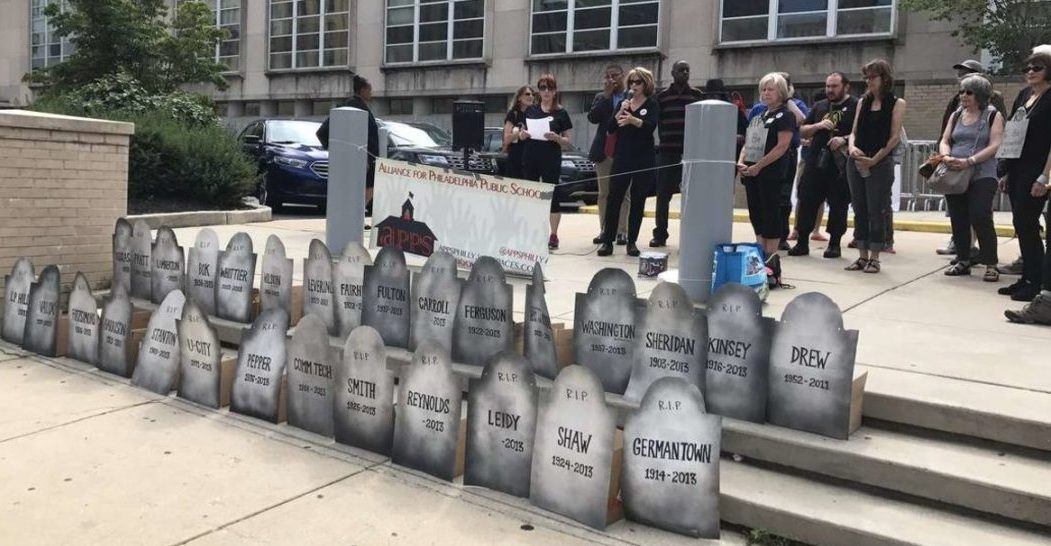
APPS members, as part of the Stand Up for Public Schools (SUPS) coalition, attended and spoke at the SUPS rally held on the steps of 440 just before the meeting. Parents, students, educators and community members braved the freezing cold to demand that the district keep all schools open. Students and parents from Conwell Middle Magnet School, Lankenau Environmental Sciences High School and others promised to continue to fight to save their schools.
APPS Members Testify Against Devastating Plan
Deborah Grill told the board that as she “doom-scrolled” through the plan, she realized that it was much worse than the 2013 closing of 24 neighborhood public schools. She asked why the facilities plan did not include any of the district’s 84 charter schools, especially since more than half are under-enrolled. Former district counselor Lynda Rubin told the board that children need stability in all aspects of their lives, that they need to know that their school will still be there for them. Barbara Dowdall, a lifelong Germantown resident, told of her sorrow at seeing the empty buildings where schools used to be: Fulton Elementary, Germantown High, Ada Lewis MIddle. Dowdall testified that Black communities don’t just lose schools, they lose part of their history. Kristin Luebbert reminded the board that they must govern as an independent body, not as an appendage of the mayor’s office. The board makes room on its agenda for representatives from the mayor’s office who pitch the various business abatements, she pointed out, then block the public with various tactics like removing half the seats in the auditorium, having security block admission to the auditorium because “there’s no room”, and placing time limits on public testimony. “We need an elected school board”, Luebbert said.
Community Vow to Defend Public Schools
Members of school communities under attack, including Ludlow, Waring, and Stetson, showed up in force despite the freezing weather and treacherous conditions. The principal and several parents from Russell Conwell MIddle School, in the heart of Kensington, testified about its value to a community that has struggled with so many issues including poverty, violence and drug trafficking. One former Conwell student attributed his success, including more than one graduate degree, to the teachers who believed in him and worked with him despite his academic and behavioral issues. The Conwell community believed, wrongly it turns out, that their school was safe after the city and the district spent hundreds of thousands in recent years for a new media lab, STEAM programming, a new science lab and more after-school programs including a new soccer field. Lankenau High students told of the unique curriculum and setting of their CTE (Career and Technical Education) school; they attempted to explain to the board that an environmental curriculum in a natural setting can’t just be relocated at another school. One parent told of how her son went through a rigorous admission process and his joy at being accepted to the school. She told the board the district they felt like victims of a “bait-and-switch”. West Philadelphia parent Lizzie Rothwell has children at GAMP and Lea Elementary; her husband teaches at Penn Treaty in Fishtown, which is now targeted for closure. She told the board that she had attended several community meetings and filled out district surveys, but “,,,throughout the process, the questions being asked and the format of answers permitted were increasingly aimed away from the concrete issues that people were talking about – asbestos, bathrooms, overcrowding, indoor air quality – into vague goals that were easy to agree with and unclear how to meet.” Dr. Ryan Pfleger, who worked as a researcher in another large school district, presented his analysis on the racial disparities of the facilities plan. His chart showed that Black students are roughly 1.6 times more likely to be enrolled in schools slated for closure. “Fifteen of the twenty schools proposed for closure are majority black”, Pflegler testified.
Board Votes without A Quorum
Without any deliberation or discussion, six members of the board voted to approve all 29 items on the agenda at a cost of$56,353,784. Wilkerson, Cubbage, Lam and Harper were permitted to vote, violating the board’s own by-laws.
The meeting adjourned at 7:11 PM.
Next Goals and Guardrails Meeting: Thursday, February 12 at 4 PM.
Next Action Meeting: Thursday, February 26 at 4 PM.
Published February 1, 2026
 Alliance for Philadelphia Public Schools