
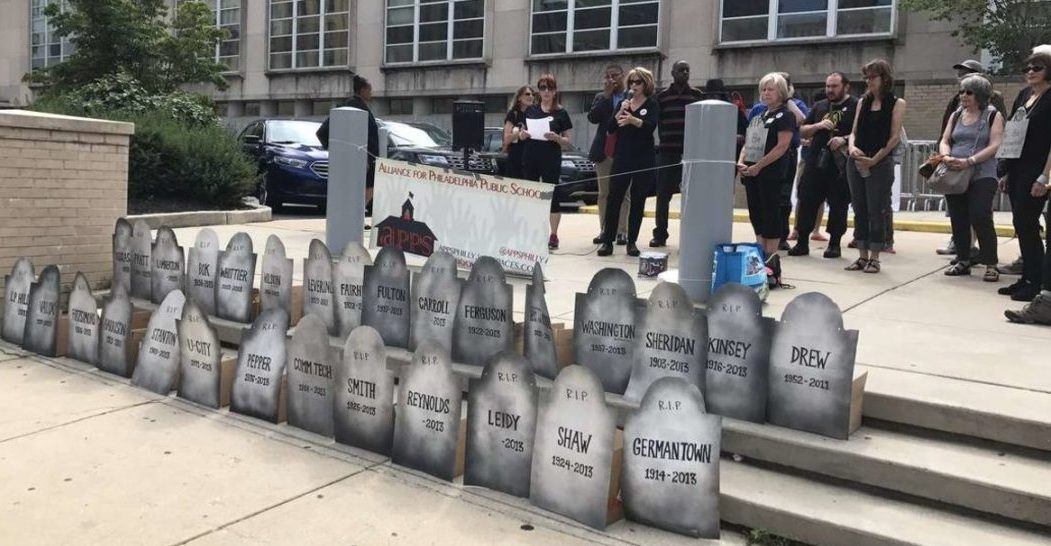
by Lisa Haver
In its recent report on alleged bias against some charter school operators, the law firm of Ballard Spahr recommended that the Philadelphia Board of Education make the renewal process more transparent, with more opportunities for public input. APPS has been calling for public renewal hearings for over ten years. It seemed strange that the charter operators themselves were not making the same demand, as it would give them a chance to present evidence that they were outperforming district schools. Charter operators could list the charter schools that were fully enrolled or over overenrolled, thus verifying their assertion that there is a waiting list of 40,000 students waiting for admission to the city’s charter schools. When you consider, though, the fact that district schools outperform charters in every category, that charter schools in every area of the city are actually significantly under-enrolled, and that charter administrators are collecting exorbitant salary and compensation packages, the failure of charter operators to call for public hearings starts to make sense.
During the expansion of charter schools, enabled by the state takeover of the district and the installation of the School Reform Commission in 2001, charters sold themselves by promising to outperform public schools and provide children with better education. Every year, however, the data shows that has not happened.
Charter operators have organized themselves into a vocal and well-funded coalition. With the financial backing of corporate donors, through organizations including the Philadelphia School Partnership (renamed Elevate 215), Philadelphia Charters for Excellence, and Jeffrey Yass’s Commonwealth Foundation, charter investors have created an effective public relations and lobbying force. Many unquestioningly accept the assertions that charter schools are better than public schools, despite overwhelming evidence to the contrary. This analysis of renewals shows that very few charter schools are doing better than district schools—especially in academics.
School choice advocates used to say that parents were “voting with their feet” in choosing charter schools. Of course, after the SRC closed over 30 neighborhood schools, parents had many fewer choices. Now that APPS has shown that over half of the city’s charter schools are under-enrolled, we don’t hear that slogan anymore.
APPS’ review of last year’s cohort of charter renewals shows that not one of the 18 schools met all three of the basic standards: Academic, Organization, Financial.
Standards usually provide a simple binary choice: whether or not a standard is met. But the district’s evaluation system provides a third choice: “Approaches Standard”. After charter operators were invited to secret meetings in 2017 to reformulate the Charter Performance Framework, charter schools could avoid a “Does Not Meet” by getting “Approaches”, which only took only 45% of total points in Academics and 50% in Organization..
A “Does Not Meet” in any domain could lead the Board of Education to begin a non-renewal process. More often, though, the lack of recommendation gives charter operators an extended period in which they can negotiate with the Charter Schools Office (CSO)–without any public disclosure–for conditions that would allow them to continue operating without making any meaningful changes. But years ago, the former CSO director told the SRC, in response to a question from one commissioner, that there are no consequences for failing to meet conditions. Charters who refuse to accept conditions recommended by the CSO can operate indefinitely under the previous agreement; there is no penalty for failing to improve academic performance or organizational deficiencies. In addition, the district’s charter school directory does not always indicate whether the charter has been renewed. Charter schools are renewed when the school’s administration agrees—there is no deadline. Schools can reject conditions and continue to operate. In the rare case when the board carries out the non-renewal, the district hearings, followed by the appeal to CAB and to the courts, takes years, during which the school continues to operate.
The SRC closed over 30 neighborhood schools, most of them at one meeting in April 2013. Their main justifications: those schools were under enrolled and had low standardized test scores. If those standards were applied today, the Board would initiate non-renewal proceedings in at least half of the district’s charter schools.
In the 2022-23 renewal cohort, 14 charter schools recommended for renewal despite failing to meet standards in all categories; 13 were recommended for renewal despite failing to rate “Meets” in Academics.
Note: All information in this report is taken from most recent CSO charter evaluations. Charter agreements are negotiated with charter operators; there are no public renewal hearings. CEO and other administrative salary/compensation information is taken from 2021-22 IRS 990 documents. Charter CEOs are not required to have administrative certification. Most schools have principals, assistant principals and other administrators in addition to CEOs.
Lynda Rubin contributed to this report.
Eugenio Maria De Hostos (Aspira network)
Grades K-8, 19120
Annual CEO salary/compensation: $239,609; COO $405,510; Controller $290,469.
Recommend: 5-year renewal with conditions
Academic: Meets
Organization: Approaches
Financial: Meets
Antonia Pantoja (Aspira network)
Grades K-8, 19140
Annual salary/compensation for Aspira network administrators: CEO $239,609; COO $405,510; Controller $290,469.
Recommend: 5-year renewal
Academic: Meets
Organization: Approaches
Financial: Meets
Deep Roots
Grades K-8, 19134
Annual CEO Salary/compensation: $124,309.
Renewed March 2024
Academic: Does Not Meet
Organization: Approaches
Financial: Meets
School proficiency rates below district in all tested subjects. Attendance 95% of days/more: 3% compared to district 37%. Board renewed Deep Roots in March 2024 with conditions.
PSSA Proficiency points: 30%
Jacqueline Y. Kelley
Grades K-8, 19131
Annual CEO salary/compensation: $252,529.
Recommend: 5-year renewal with conditions
Academic: Approaches
Organization: Approaches
Financial: Meets
Renewal evaluation: English Language Learners (ELL) did not receive services in a timely manner; several barriers to enrollment cited; over 50% of student files reviewed missing immunization records; no opportunity for public comment at board meetings; school’s Code of Conduct did not outline students’ right to due process in disciplinary matters.
PSSA Proficiency points: 35%
Friere
Grades 5-8, 19107; 9-12, 19103
Annual CEO/school leader salary/compensation $207,073; “Ex-officio head of school” $228,670.
Recommend: 5-year renewal
Academic: Meets
Organization: Approaches
Financial: Meets
KIPP Du Bois
Grades 9-12, 19131
Annual CEO salary/compensation for KIPP network administrators: CEO $284,044; COO $244,179; CSO $221,576.
Recommend: 5-year renewal with conditions
Academic: Approaches
Organization: Approaches
Financial: Meets
Keystone proficiency rates significantly below district in all subjects, including 1% in Algebra. Students attending 95% of days or more: 9% compared to 34% district. School served no ELL students in past 5 years. Several personnel files lacked legally required child protection clearances;
KIPP North Philadelphia
Grades K-4, 19134
Annual CEO salary/compensation for KIPP network administrators: CEO $284,044; COO $244,179; CSO $221,576.
No recommendation
Academic: Does Not Meet
Organization: Approaches
Financial: Approaches
PSSA Proficiency points: 40%. Proficiency rates below district in all tested subjects; attendance for 95%/more days below district in all years of evaluated term.
Maritime Academy
Grades K-8,19137; 9-12, 19125
Annual CEO salary/compensation: $234,786.
Recommend: 5-year renewal with conditions
Academic: Approaches
Organization: Approaches
Financial: Approaches
PSSA Proficiency: 45%; K-8 school proficiency rates below district in Reading and Math. Report has no Keystone ratings because not enough students took the test. Renewal evaluation contains several citations for lack of screening and services for students with special needs; several barriers to enrollment and violations of students’ right to know due process rights. Several statements of financial interest required by board members and administrators were missing or incomplete. Cited for missing financial information including debt statements. Evaluation cites school’s failure to provide evidence that the school fulfilled conditions from previous renewal agreement.
Hardy Williams
Grades K-12, 19143
Mastery network annual CEO salary/compensation: $340,662.
Recommendation: 5-year renewal
Academic: Approaches
Organization: Approaches
Financial: Meets
Proficiency points: 55%; PSSA proficiency rates lower than district in all tested subjects.
Pastorius Mastery
Grades K-8, 19138
Mastery network annual CEO salary/compensation: $340,662.
Recommendation: 5-year renewal Academic: Approaches
Organization: Approaches
Financial: Meets
Proficiency rates lower than district in all tested subjects.
Mastery Prep Elementary
Grades K-6, 19140
Mastery network annual CEO salary/compensation: $340,662.
No recommendation
Academic: Does Not Meet
Organization: Meets
Financial: Meets
Math Civics Science
Grades 1-12, 19123
Annual CEO Salary/compensation: $334,492.
No recommendation
Academic: Does Not Meet
Organization: Does Not Meet
Financial: Does Not Meet
PSSA proficiency rates lower than district in all tested subjects, including 2% in Math; overall proficiency rates 10%: overall Keystone proficiency rate 0%. Several citations for barriers to enrollment and lack of services to students with special needs and ELL students. Renewed in 2013 and 2018 despite receiving a “Does Not Meet” in all categories in both evaluations. Several news stories about the school’s discrimination practices. School CEO has decided to close the school at the end of this school year.
Pan American
Grades K-8, 19133
Annual CEO Salary/compensation: $259,314.
Recommend: 5-year renewal
Academic: Approaches
Organization: Meets
Financial: Meets
Proficiency rates below district in all tested subjects.
Philadelphia Academy Grades K-12, 19116
Annual CEO Salary/compensation: $177,191.
Recommend: 5-year renewal with conditions
Academic: K-8 Meets, 9-12 Approaches
Organization: Approaches
Financial: Meets
Last official 5-year renewal issued in 2008.
Enrollment 64% White, 12% African-American.
Universal Alcorn (Renaissance charter)
Grades K-8, 19146
Annual Universal network CEO Salary/compensation: $230,900.
Recommend: 5-year renewal Academics: Meets
Organization: Meets
Financial: Approaches
Universal Institute Grades K-8, 19146
Annual Universal network CEO salary/compensation: $230,900
Recommend: 5-year renewal
Academics: Approaches
Organization: Approaches
Financial: Approaches
PSSA Proficiency points: 45%
Young Scholars Grades 6-8, 19123
Annual CEO Salary/compensation: $293,196.
Recommend: 5-year renewal with conditions
Academic: Approaches
Organize: Meets
Financial: Meets
PSSA Proficiency points: 30%. School’s PSSA scores below district’s in all tested subjects.
Published: May 2024
 Alliance for Philadelphia Public Schools