
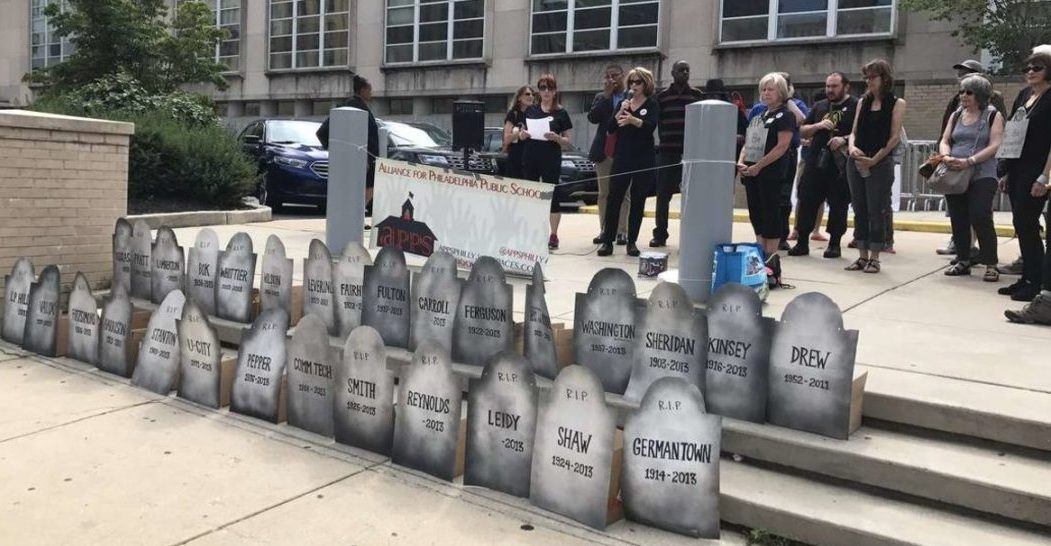
Board of Education Meeting, September 21, 2023
by Lisa Haver
Members of the board paid tribute to two educators who passed away this week: Temple President JoAnn Epps and former district superintendent Constance Clayton. Board President Reginald Streater proposed that the board vote to name district headquarters “The Constance E. Clayton Education Center”. This type of action deserves more time and consideration. There have been many notable Superintendents and Board Presidents, including Dr. Ruth Wright Hayre, the first African-American president of the board. As APPS member Barbara Dowdall pointed out in her testimony, Dr. Clayton was a strong supporter of school libraries and worked during her term to put a Certified Teacher Librarian in every school. Now, fewer than five schools have full-time librarians. The board can honor Dr. Clayton by restoring school librarians with full-time teacher librarians to every school.
Board Members Cave on Arsenal KOZ
Last month, the board voted decisively to deny the developers of the Arsenal property in Tacony another 10-year Keystone Opportunity Zone (KOZ) tax abatement; they did vote to approve five other KOZs for other properties. These abatements mean less funding for the city’s public schools. After a lengthy presentation given by three representative’s of Mayor James Kenney’s Commerce Department, and in deliberations just before the vote, several members explained why they would be voting No. Several concurred that the developers had more than enough time to build on the property. BM Lam argued that granting another 10-year abatement could create a “perverse incentive” for developers to do nothing with the properties. The vote to deny was decisive, 3-6, with just Wilkerson, Fix Lopez and Egea-Hinton voting Yes.
This month, five of them flipped, with BM Julia Danzy casting the only No vote in the 7-1 decision. Just two weeks after the August meeting, the board posted the same item on the September agenda, giving the property’s owners and managers, Arsenal Capital Partners and Hankin Management respectively, a quick do-over. Lam, before reversing her vote, said something about “environmental concerns” but did not explain what they were. This time, there was no presentation on the agenda. But in remarks justifying her turnaround, BM Salley referred to a trip some board members took to the Arsenal site. In a conversation with APPS members after the meeting adjourned, Salley confirmed that the City Commerce Department representatives who had appeared in August made arrangements for board members to tour the site and speak directly to the developers. This is a very disturbing development. The fact that board members had a private lobbying session with the developers, at the request of the mayor’s office, and solely for the financial benefit of the developers, should have been disclosed by President Streater prior to this vote. In addition to the obvious conflict, there is a question of whether the board members violated the state’s Sunshine Act by deliberating on a pending item without public knowledge. How many board members attended? Was a quorum present when they toured the site and discussed the abatement? The board has made clear its priorities here— protecting the financial interests of developers (who never appeared at any public board meeting) rather than those of the children and families in the district. When was the last group visit by board members at an asbestos-ridden school?
Unite Here Local 634 Demands A Fair Contract
APPS members joined Unite Here Local 634 on the steps of 440 at their rally for a fair contract and a living wage. Last week, the Watlington administration told Local 634 that their proposal for a $1.50/hour raise was “not feasible”. The district keeps many of the workers below the 5-hour a day minimum needed to qualify for health benefits. Keep in mind that many of these workers have children in district schools who are kept impoverished by these conditions. Local 634 members are among the lowest paid workers in the district. The 1900-member union voted last week to authorize a strike if terms are not agreed upon by September 30, when the present contract expires.
Board Negotiates Questionable Settlement with Aspira
Two days before this action meeting, the board added Item 34 to its agenda. Apparently, the board and Aspira, Inc. had reached an agreement on an issue the public had no knowledge of. It appears that Aspira had been exceeding its enrollment caps, which are clearly stated in charter renewal agreements, in two of its schools, Antonio Pantoja and Eugenio de Hostos. Under the state’s charter law, the district was obligated to pay for all students enrolled by Aspira until the matter was settled. Aspira has a long history of questionable financial practices, most notably its diversion of funds designated for its Renaissance charters (subsequently taken back by the board) to its real estate interests, a move that an Aspira attorney referred to as “cross-collateralization”. The Item passed 8-1, with Salley dissenting without explanation. As reported in Chalkbeat: “[Charter Schools Office Director Peng] Chao did not make a presentation at the meeting explaining the resolution that included the settlement. No board members asked questions or commented on the resolution before voting on it. And no one from Aspira came to speak during the meeting’s public comment period. Board members didn’t respond when [APPS co-founder] Lisa Haver asked for a fuller explanation of the resolution.” Why is the board stonewalling the public on this matter?
Board Renews More Substandard Charters
The Board of Education refuses to hold public charter renewal hearings, conducting all charter business in private negotiations with individual school managers. Each year, the Charter Schools Office (CSO) gives one presentation on the performances of all of the charter schools in the year’s renewal cohort. Charter schools can continue to operate without a current agreement; many do so rather than agree to conditions for improvement. When the CSO and charter school come to terms, a renewal item is placed on the agenda for board approval. The board does not post the terms of the agreement, in effect taking a secret vote, which APPS objects to as a violation of the PA Sunshine Act. This month, the board voted to renew two KIPP schools, KIPP North Philadelphia and KIPP DeBois. Neither school met the minimum academic standard. Neither met the standard for organization. Both schools had chronic absenteeism over the past five years. KIPP North Philadelphia showed lower Proficiency rates than district schools in all tested subjects. Yet the board voted 8-1 to renew both schools for five years, with BM Salley dissenting without explanation. The board does not post projected costs for charter renewals; however, based on district budget information, the combined projected cost for both 5-year renewals is approximately $79 million.
In addition to the charter renewal costs, and not including extensions on existing contracts, the board approved spending of $187, 333, 313.
The meeting adjourned at 7:59 PM.
 Alliance for Philadelphia Public Schools