
Board of Education Meeting: June 29, 2023
by Lisa Haver and Lynda Rubin
During this month’s meeting, APPS member Barbara Dowdall was detained by district security who told her she couldn’t go into the auditorium because she wasn’t on the speakers list. (In May it was Lisa Haver, in April Ilene Poses.) The board set up 96 chairs for this meeting in an auditorium with a 240-person capacity. When APPS wrote to the board about their setting up only 82 chairs in April, President Reginald Streater replied that they were “working with building management to address it”, as if building management staff could overrule the president of the board. When we wrote to him again in June because the board had barred people from attending because of the current speaker suppression policies, we received no reply. No matter how the board sets up its arbitrary number of chairs, forcing people to stand, they cannot bar people from attending a public meeting. That is illegal.
The board began this 7-hour meeting without putting out any official materials: no agenda, no action item descriptions, no speakers lists. After 20 minutes, Lisa Haver approached the board table and asked when they were going to provide attendees with the materials they needed to follow the board’s actions. Streater appeared annoyed that someone would ask for the materials that the board failed to distribute. After 15 more minutes, some of the materials appeared, but not the full descriptions of the 105 items on the agenda. Haver went back to ask why 40 minutes into the meeting they still hadn’t put out all of the materials and to ask why people were being detained outside the auditorium. Streater again blamed Haver for interrupting instead of apologizing for the board’s failure. Does he expect people to sit there without any way to know what the board was talking about when they are voting to spend over $220 million in taxpayer funds? Doesn’t barring people from attending public meetings violate the board’s own Goals and Guardrails and their stated commitment to partnering with parents, families and communities to be “welcoming and supportive”? District teacher observations include an appraisal of how prepared they are and whether they have the necessary materials for optimal student participation. Should this not apply to the district’s governing body?
Frankford Students Can Return in September
Superintendent Tony Watlington announced some good news: Frankford high students will not be shut out of their building next year. Because of extensive asbestos found in the building, students and staff had been told that they would have to spend the entire 2023-24 school year learning remotely. Now students in grades 10-12 will be able to attend school at Frankford; freshmen will be relocated to Roberto Clemente Middle School.
Dr. Watlington also narrated his 15-minute slideshow about his administration’s review of the special-admit enrollment process. He then brought up two representatives of Accenture Consultants who narrated their own 30- minute presentation. By the end of the board’s Q & A session, one hour of the 7-hour meeting had been spent on this one issue. If the board and administration had listened to parents and principals before changing the admissions process for special-admit schools, they would not have had to hire an outside consulting firm at a cost of $280,000 to make the same recommendations after the fact.
Board Hears Speakers after 9 PM
The board posts speaker rules, then ignores them. One member of the audience got up during Watlington’s presentation and told him that she had something to say. Neither Watlington nor Streater stopped her at any point during her 3-minute speech; in fact, Watlington answered her after she was finished. Another man then got up and made a speech; Watlington responded to him. Neither was on the speaker list.
Students who did follow the rules were blocked when they tried to sign up to speak. Two student speakers told the board that the window closed after only seven students were confirmed. Streater told them that if it happened again to call the board office. How would anyone know how many speakers were confirmed until the speaker list came out the day of the meeting? In addition, the general speaker list shut down at 4:15 pm, just 15 minutes after it opened. Half of those allowed to speak by the board were people advocating for the renewal of charter schools. The board did not allow anyone with an opposing point of view to speak. Didn’t the board justify its speaker suppression policies by saying they wanted to hear from different people each month? How does stacking the list with people on the same side of one topic present differing views? In addition, the board allowed three charter CEOs and one charter principal–all of whom have direct access to the board and CSO staff–to sign up and testify as “community members”.
It is a violation of both the letter and spirit of the PA Sunshine Act that the board limit the number of student and adult speakers regardless of public interest or the number of items on the agenda. BM Cecelia Thompson asked President Streater why there were so many items on the agenda this month, but she failed to ask why the public was not allowed to comment on most of them. The board states that testimony can be submitted in writing, but public statements made by board representatives during the trial on speaker suppression prove that board members are not required to read it and that most do not. BM Salley reads a heavily summarized version of written testimony. Written testimony is in no way a substitute for in-person testimony.
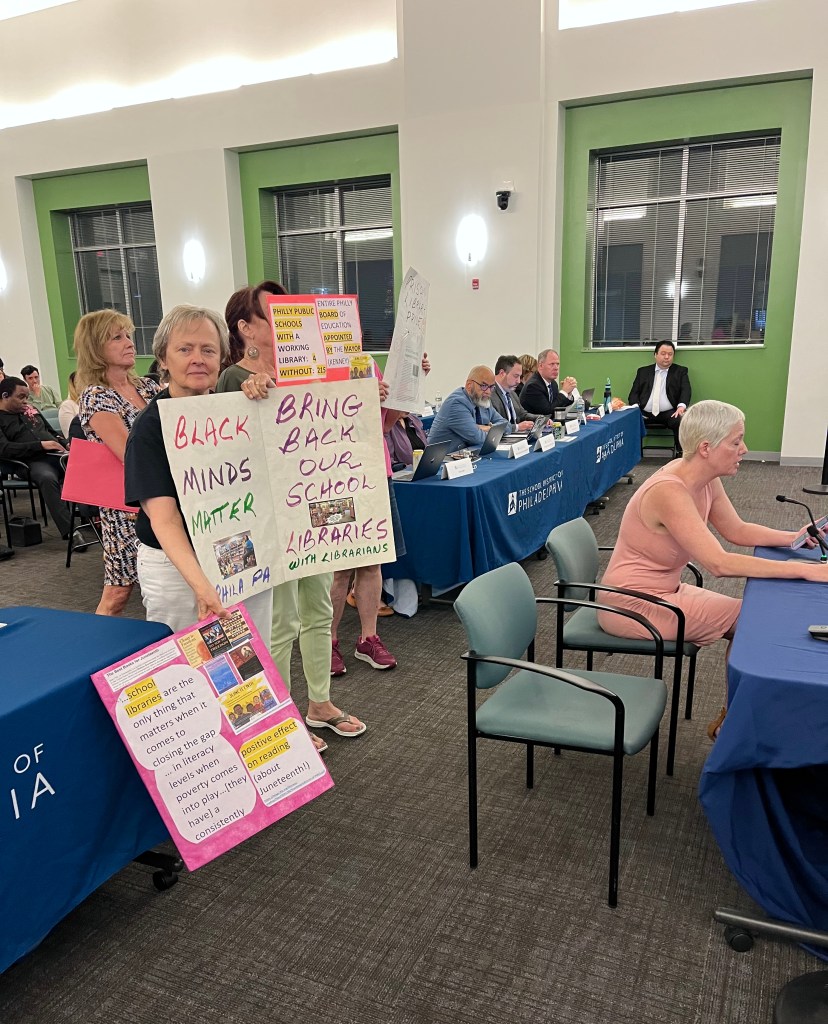
Representatives of the Philadelphia Alliance to Restore School Librarians (PARSL), supported by APPS members, urged the board to make bringing back certified teacher librarians a priority. Cathi Fuhrman and Lydia Currie testified that Philadelphia’s children need and deserve school libraries and that research shows that having access to school libraries improves students’ reading success.
Lynda Rubin, the only APPS member allowed on the speaker list this month, urged the board to vote No on Item 2, a grant from Elevate 215 (formerly Philadelphia School Partnership) to target funding to three schools chosen by the Elevate 215/PSP board to “Beat the Odds”. Rubin testified that this grant followed PSP’s “Dump the Losers” legacy by granting resources to schools with somewhat higher test scores and leaving more struggling schools behind.
Several representatives of Philly DSA (Democratic Socialist of America) testified to the need for better ventilation in district schools. They urged the board to put Corsi-Rosental boxes in every classroom. APPS members supported the DSA speakers and have participated in the building of these boxes over the past year.
The seven students allowed to speak testified on issues ranging from clean air in schools to supporting the name change of Chester Arthur Elementary School to Marian Anderson Neighborhood Academy. One spoke about the lack of support for Student Equity, Restorative Training and the need for teachers to learn how to use and teach this. Another spoke on the need for increased support for extracurricular activities because the district is not actively helping the student experience. They decried the district’s cutting Music, Art and other and other subjects despite the clear advantages they provide youth.
PA Rep. Joseph Hohenstein spoke of his disappointment that the district did not apply for a PA Department of Education grant to implement the Disability Inclusive Curriculum passed in Harrisburg last year. That curriculum would allow all students to gain a better understanding of how disabilities affect them and would encourage a wider understanding and acceptance of all students. Hohenstein urged the district to participate in the pilot program; Streater did not commit to that but told Hohenstein that he would discuss it with Watlington.
Outgoing Student Board Representative Sophia Roach thanked board members, administration and other students throughout the city for their support. She urged the board to increase student engagement on issues of importance to them that might otherwise be unknown to board and Administration members. President Streater reminded the audience that Ms. Roach will be attending Harvard University next year on a full scholarship.
Charter Renewals Proceed without Public Hearings
Hearing Examiner Rudy Garcia presented a summary of his report following the 9-day hearing on the proposed non-renewal of Southwest Leadership Academy; that report had been distributed to board members about three weeks ago. Garcia concluded, after reviewing extensive data on academic and financial performance and after hearing witnesses from the charter school, that SWLA students were not receiving an adequate education. The board voted later to proceed with the non-renewal.
Charter Schools Office (CSO) Peng Chao narrated a presentation (not available before, during or after the meeting) on this year’s cohort of charter schools due for 5-year renewals. Of the 19 schools in the cohort, board members focused on Math, Civics and Science, perhaps because of recent controversy stemming from CEO Veronica Joyner’s barring a student who had survived being shot ten times from attending school, the prom or graduation.
Although no vote was taken by the board, Streater announced the schools that would receive 5-year or 1-year renewals. Unlike in other districts in the state, the board does not hold public renewal hearings. The CSO holds private negotiations with “public” charter schools on all matters.
Board Members Must Be Fully Present
At this meeting, the board voted to relax Covid restrictions. All district schools and offices have been open for over two years. So why is BM Thompson still attending remotely? At several times during the meeting she is not visible, leading people to wonder whether she is still present.
During the charter renewal presentation and before the public speakers, BM Lam left the auditorium. Neither General Counsel Lynn Rauch nor President Streater announced her departure. Some time later, Lam showed up on screen briefly before disappearing. Rauch then announced that although the public could not see Lam, she was present. This is unacceptable. The public has a right to know which board members are present for the entire meeting. Any board members the public cannot see are not present. No board member who is absent during public testimony should vote on the action items.
Board Voting: Not What Democracy Looks Like
President Streater pledged when he took office this year to follow Robert’s Rules of Order in presiding over meetings, but he seems to have abandoned that position. The way in which voting is conducted, if not a violation of Roberts Rules or the Sunshine Act, seems deliberately designed to keep the public from following or understanding what the board is doing. The process allows the board to vote on costly items, such as the $26 million contract with Pearson Inc. and the $69 million transaction with Philadelphia Authority for Industrial Development (PAID) with no explanation or deliberation. The board also approved a new taxing structure without explanation, one that will mean higher rates for working people and lower rates for those with unearned income (Item 24). Streater reads off the numbers of items to be bundled for voting so rapidly that it is impossible to follow or to write them down. There is no explanation of why the board votes this way. During the roll call, board members call out the items on which they are voting No or abstaining. This is not a proper way for a governmental body to vote on official items during a public meeting.
All 105 items passed, most unanimously. After 7 hours and 11 minutes, the meeting adjourned at 11:11 PM.
 Alliance for Philadelphia Public Schools