Richard Migliore: Turzai’s letter raises issues of public concern

The Philadelphia Notebook published the following Op Ed from APPS member Rich Migiore.

rich-migliore

Speaker of the House Mike Turzai’s recent letter to the School Reform Commission criticizing the District’s charter school renewal process raises serious issues of public importance. All of us who care about public education should be alarmed at what was said by Representative Turzai.

Turzai not only levels an unfounded attack on the SRC members, he attacks Philadelphia in his letter and makes a not very veiled threat to the SRC members: if they do not renew the charters in question, funding for Philadelphia’s schools will be in jeopardy. That is a misuse of his office.

SRC Chairwoman Joyce Wilkerson responded to Turzai in a letter defending the SRC’s charter renewal process. As a retired teacher and principal, and an advocate for public education, I also responded directly to Turzai. My 8-page letter to him addresses the impropriety of his actions and the issues which his actions raise. They are issues of public concern.

Neither the District’s renewal process for the 26 schools in question, nor the SRC’s conditions for renewal are “overreach or inappropriate” as Turzai described them. Pursuant to the Charter School Law, the SRC and the District have an “affirmative legal duty” to assess whether our charter schools are meeting the requirements for student performance, meeting the “conditions” of its charter, and to determine whether the charter school is complying with applicable law.

If not, the SRC has the legal duty and responsibility to “revoke or not to renew” the charter. That can occur “during the term of the charter or at the end of the term.” The “causes for nonrenewal or termination” are stated quite clearly in Section 17-1729-A of the Charter School Law. The District’s recommendations for conditions are not only prudent, they are necessary for the basic functioning of those charter schools.

Such negotiated conditions are legal and appropriate to regulate those charter schools in the best interests of all of Philadelphia’s schoolchildren and our school community. Without those conditions, it would be the affirmative legal responsibility of the SRC to close those schools.

The Pennsylvania Supreme Court has ruled that the relationship between a local school board and a charter school is “regulatory.” That is exactly what the SRC members are doing. They are engaging in their public responsibility to the people of Philadelphia and the children in charter schools to regulate Philadelphia’s charter schools.

Partly in response to the public outcry about the lack of oversight of the charter schools, the SRC increased the staff of its Charter School Office, which is now led by the very able DawnLynne Kacer.

The question of whether a charter school should be renewed requires a very public process with full transparency. The PA Sunshine Act protects the public’s right to “notice and opportunity to comment meaningfully” on all proposed actions of the SRC and other school boards in Pennsylvania. The Sunshine Act codifies constitutional principles of public governance.  Our right to notice and opportunity to comment applies to any action of the SRC, including those pertaining to charter schools. It is an inalienable right of the citizens of Philadelphia and Pennsylvania.

The public has a right to know what is written in those schools’ charters, including all conditions and requirements. We have a right to copies of those documents and any proposed resolutions of the SRC or the charter schools themselves. We have a right to copies before any votes are taken by the SRC. That is required by the Sunshine Act.

Those of us who believe in democracy, and that our public schools should be fully governed by locally elected school boards, also believe that our local school boards should not be circumvented or short circuited in any way. Without adherence to the due process of public decision-making — we cease to have truly public schools. Democracy is the purification process for the ills that plague our schools. Democracy is the sine qua non for greatness in our public schools.

The SRC’s decision to revoke a school’s charter does not have to mean displacement of students or shuttering of the building. A charter revocation only means that the SRC becomes the school’s board of trustees and Superintendent Hite becomes its superintendent. The certified teachers on staff can immediately be hired by the District.

Charter schools’ boards of trustees have the right to pursue an appeals process when the school’s charter is revoked or terminated.  When public schools are closed, or converted to a charter school, there is no appeals process for those students and parents.  Perhaps Turzai could use the powers of his office to rectify that injustice.

There are many fine charter schools which operate properly and in the best interests of its students; those schools have no problem being renewed by the SRC. Our charter school community should embrace the public decision-making process for the renewal of our deserving charter schools.

Turzai knows who has the legal standing and the responsibility to enforce the responsibilities of charter schools and the rights of its students to an adequate education — it is the School Reform Commission. The very same body imposed on Philadelphia by the state legislature in which he serves. Until he and his colleagues vote to return the governance of public schools to those who live in Philadelphia, he should let the SRC carry out its duties.


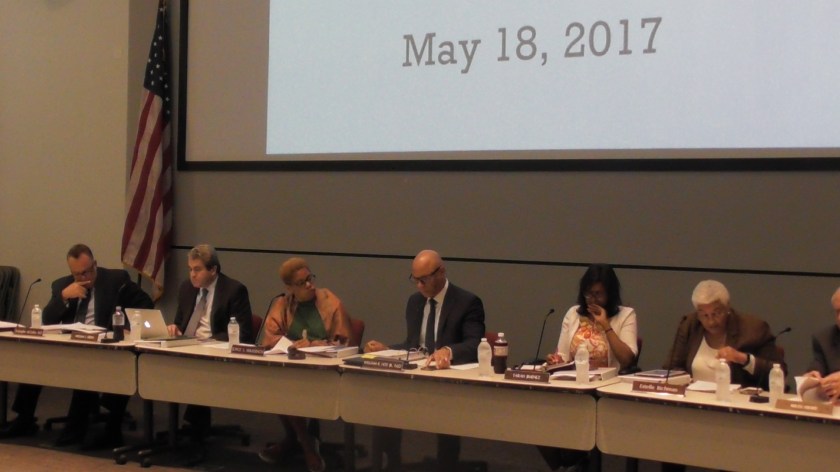
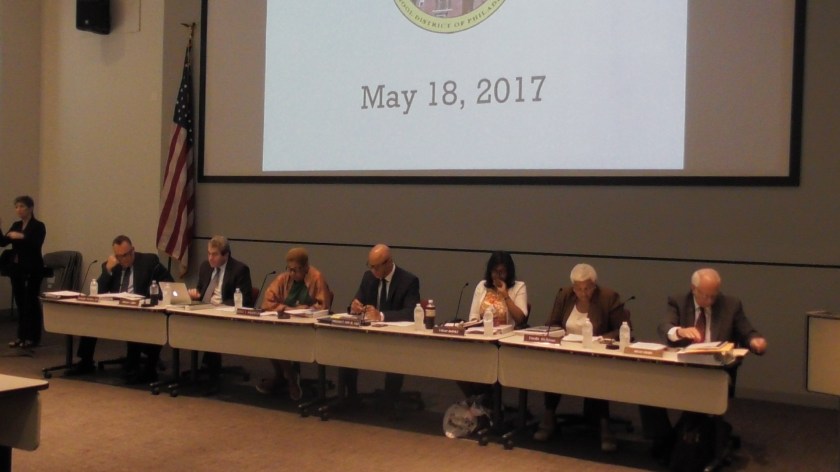
Eyes on the SRC: May 18, 2017

SRC logo

by Karel Kilimnik
May 15, 2017

Outsourcing of professional development for teachers and administrators continues with this month’s resolutions. Relay Graduate School of Education, which received a contract just two months ago, will be paid to send three assistant superintendents and nine principals to a twelve-day summer program in Texas. Dave Levin, co-founder of KIPP, is also one of the Relay founders. KIPP has a large presence in Texas.

After four years, the district still has not reached a settlement with PFT members. That may be the reason that the district has had to undertake a large recruitment effort for the second year in a row. Resolution  A-2 calls for the Office of Talent to “develop, implement, and refine a pilot Teacher Residency Program for the District”. It’s ironic that this recruitment effort is being underwritten by the Philadelphia School Partnership. PSP has made the forcing out of teachers a condition for funding school transformations, including Blaine and WD Kelley elementary schools.


What If…?
Instead of paying $415,800 to a vendor to provide a summer school literacy program at seven schools, every school could determine what summer enrichment program to provide for its students. If we took all of the money from contracts going to corporate education vendors at this one SRC meeting, there would be over $1 million for almost 20 summer school programs.

Note: The next two SRC Action Meetings will be held on Thursday May 18 and Thursday May 25, both at 4:30 PM. To register to speak, call 215.400.4180 before 3PM the previous day.

Click here to read selected Resolutions for the May 18th meeting and the APPS analysis.

APPS News: May 2017

APPS-Banner-851px-2

by Karel Kilimnik
May 10, 2017

Spring is showering SRC meetings upon us: there are two meetings each month from March until June. We continue to inform supporters of public education in several ways: an overview of Resolutions to be voted on in our Eyes on the SRC, a report of these meetings in Ears on the SRC, video of testimonies from members and supporters, and a new section of Calendar Events. We appreciate any and all feedback on our writings. Please feel free to share additional information and resources or to ask questions. The next two SRC meetings for May are listed in the Calendar section.  We are happy to advise those who want to testify but have never done so. We urge all who want to fight for public schools to attend and bring a sign if possible.

New SRC Policy Committee Meets—When Those Affected by Policies Cannot Attend
In March the SRC passed a resolution creating “ a policy committee that will review policies that affect students and staff”.  They scheduled these meetings for 9 AM, when a when students, staff,  and working parents are unable to attend.  Thus, those who are responsible for implementing the policies, and those affected by them, are excluded. The first meeting of the SRC Policy Committee, Chaired by Commissioner McGinley and attended by SRC Chair Joyce Wilkerson and Superintendent-designee Naomi Wyatt, met on April 6 in a small conference room at 440. About 80% of those present were district staff.  Four APPS members attended, along with Councilwoman Helen Gym and her chief of staff. Prior to this initial meeting over 75 pages of district policies were posted Friday afternoon March 31 for public perusal. Read the APPS Ears on this Meeting for a more detailed account.  If the intent was to enable the public, in particular those directly affected by these policies, to have some input, then these meetings need to be scheduled at a more convenient time.

Action Meeting Morphs into Budget Meeting

Click here to read the rest of the article.

Ears on the SRC Special Meeting – May 1, 2017

SRC pic May 1 2017 #2

by Diane Payne
May 9, 2017

This special meeting of the School Reform Commission was announced in a press release sent out Monday April 24. The school district’s official notice was not published in the newspaper until Wednesday April 26. Those who wished to speak had to sign up by Friday. The sole purpose of the meeting was to vote on charter renewals and amendments for 26 schools. The day after giving notice of this meeting, an article appeared in the Notebook giving the public some information on the schools up for renewal. Because of that article, the public did have some information on the performance of these schools.

For the past year, the district has violated the PA Sunshine Act by failing to post or distribute the full resolutions on charter applications, renewals and amendments. The SRC has given no explanation for this change in practice except to designate these actions “quasi-judicial”. APPS has asked for an official explanation of this legal term and why it now applies to all charter matters. The district has not provided this, despite their many promises to be transparent. District Chief Financial Officer Uri Monson has stated at every budget hearing that charters are the single biggest driver of increased district costs. The SRC has a legal obligation to inform the public of all matters, especially those that are diverting so much from funding public schools.

APPS continues to monitor the district’s adherence to the PA Sunshine Act, which was enacted in order to ensure that the public can know what its government is doing and have an opportunity to speak about it. The SRC violates not only the Sunshine Act, but the court-ordered settlement between the SRC and APPS. We are challenging their practice of only announcing the topic before the vote, then publishing a full resolution in a revised Resolution Summary after the meeting. No governmental body is permitted to report false information about its public proceedings.

SRC Position Remains Unfilled
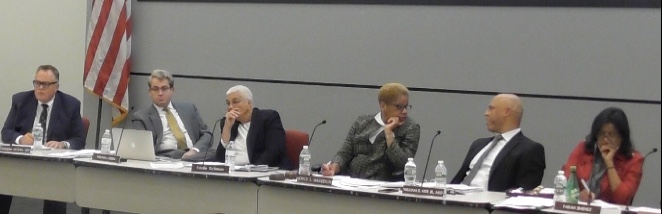
Present for this meeting were Chair Joyce Wilkerson and Commissioners Farah Jimenez, Bill Green and Chris McGinley. The State Senate still has not confirmed Governor Wolf appointee Estelle Richman. State legislators, most recently House Speaker Michael Turzai, are quick to meddle in the school district’s business, making false statements about legal conditions which charters must follow, yet they fail to do their own job of holding a senate confirmation hearing—as well as a failing to fully and fairly fund our district and others across the state.

Green Disappears–Again

Click here to read the entire article.